

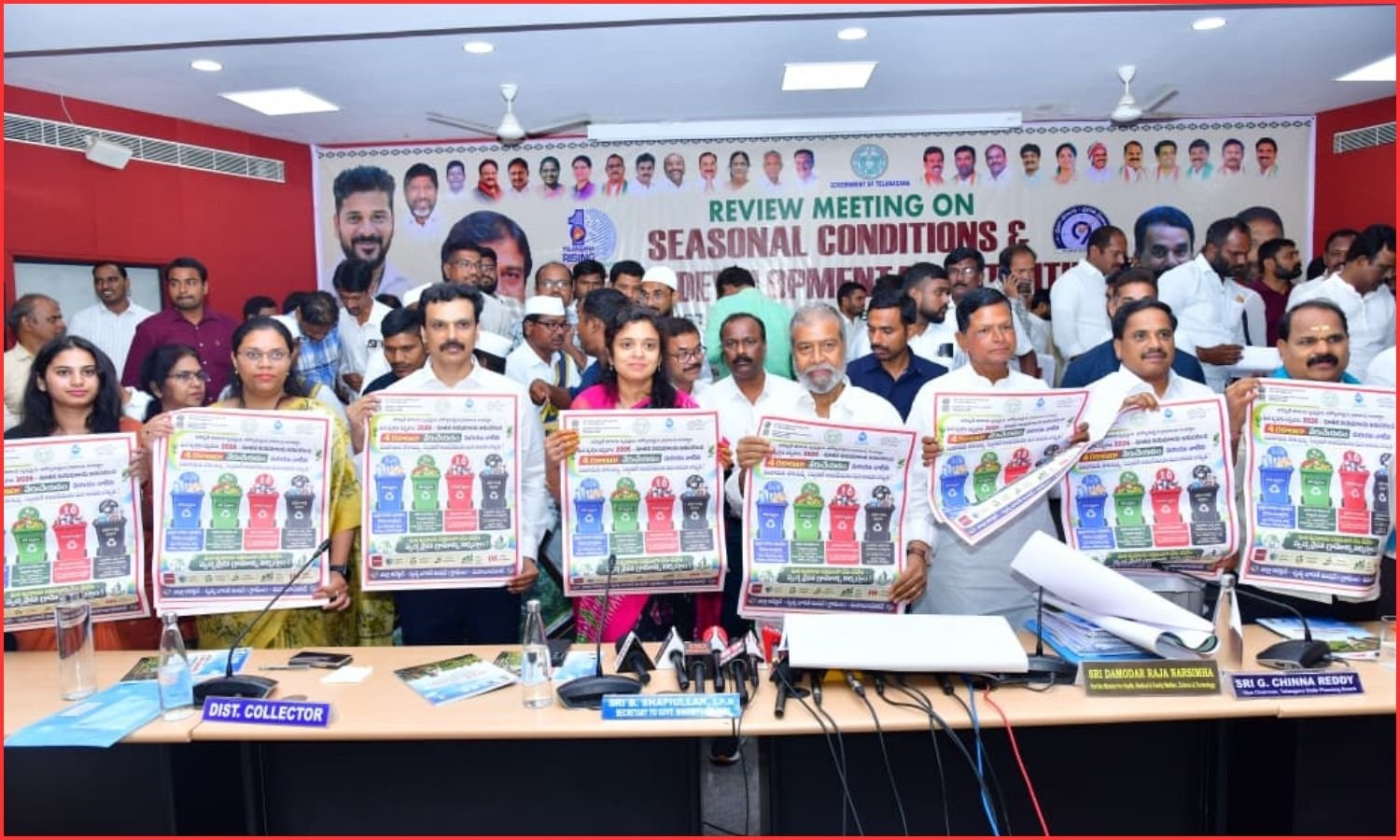
Hyderabad: Health Minister and Joint Mahabubnagar district in-charge Minister Damodar Raja Narasimha directed all government departments to intensify El Niño preparedness to minimise the impact of possible drought conditions across the region. He instructed officials to prepare department-wise contingency plans by July 31. The plans should safeguard drinking water, irrigation, agriculture, electricity, livestock and public health.
Accordingly, the minister chaired a review meeting at the Mahabubnagar Collectorate following State Cabinet decisions and directions issued by Chief Minister Revanth Reddy. He reviewed the preparedness of Mahabubnagar, Nagarkurnool, Wanaparthy, Jogulamba Gadwal and Narayanpet districts.
Planning Commission Vice-Chairman and El Niño Expert Committee Chairman Chinna Reddy, Special Officer Shafi Ulla, MLAs Yennam Srinivas Reddy, Madhusudhan Reddy, Anirudh Reddy, Rajesh Reddy, Megha Reddy, Bandla Krishna Mohan Reddy, Kasireddy Narayana Reddy, Dr. Vamsi Krishna, Veerlapalli Shankar, Vijayudu, public representatives, district collectors and senior officials attended the meeting.
Meanwhile, officials informed the minister that the joint Mahabubnagar district had recorded nearly 40 per cent below-normal rainfall compared with the seasonal average.
The minister said every department should work with advance planning to reduce the impact of adverse weather conditions. In addition, he directed officials to create awareness about El Niño at the village level. Scientific information, he said, should be shared without creating unnecessary public anxiety.
El Niño preparedness focuses on water and agriculture
Officials informed the meeting that major irrigation projects in the joint Mahabubnagar district depend on Krishna River water. They said downstream inflows normally begin only after the Almatti reservoir in Karnataka reaches capacity.
Accordingly, Damodar Raja Narasimha directed officials to use available water resources efficiently. He said drinking water must receive the highest priority under all circumstances.
The minister instructed collectors to prevent drinking water shortages. He directed them to repair non-functional hand pumps and borewells immediately. If required, alternative drinking water arrangements should also be made.
Furthermore, he asked departments to accelerate groundwater recharge measures. These include borewell recharge structures, soak pits, check dams, percolation tanks and other water conservation works. As a result, groundwater availability can improve over time.
Moreover, the minister directed the Agriculture and Horticulture departments to work in coordination. They should advise farmers on suitable cropping patterns. Instead, they should encourage flowers, horticulture crops and other alternatives that require less water and have shorter cultivation periods. At the same time, farmers should receive seeds and technical guidance without delay.
Damodar Raja Narasimha instructed officials to expand employment opportunities under the Mahatma Gandhi National Rural Employment Guarantee Scheme. If necessary, additional workdays should be provided beyond the normal schedule.
Public health and contingency plans reviewed
Likewise, the minister directed officials to ensure uninterrupted electricity supply for agriculture and drinking water needs. He said all preventive arrangements should be completed before the situation worsens.
The minister instructed the Health Department to prevent outbreaks of water-borne diseases caused by drinking water shortages. Additionally, government hospitals should maintain adequate stocks of medicines, ORS packets and emergency medical supplies.
Besides, the minister ordered intensified sanitation measures. Chlorination, fogging and anti-larval operations should be carried out to prevent dengue, malaria, chikungunya, diarrhoea and gastroenteritis.
Damodar Raja Narasimha directed officials to appoint special officers for every mandal, similar to those already assigned to each joint district. Thereafter, the officers should continuously monitor local conditions and respond without delay.
Further, he instructed every department to submit its El Niño preparedness action plan and budget proposals to the government by July 31. The State Government, he said, was ready to provide additional funds for implementation.
However, the minister cautioned that El Niño could also trigger episodes of extremely heavy rainfall and flash floods despite drought conditions. He directed Panchayat Raj, Municipal Administration and Irrigation Department officials to remain prepared, particularly in urban areas vulnerable to sudden flooding.
Appealing for public cooperation, Damodar Raja Narasimha said the prevailing conditions were the result of a natural challenge rather than a human-made crisis. He said the State Government would continue taking all necessary measures to reduce the impact of El Niño. Together, public representatives, officials and citizens could effectively address the challenge, he added.