

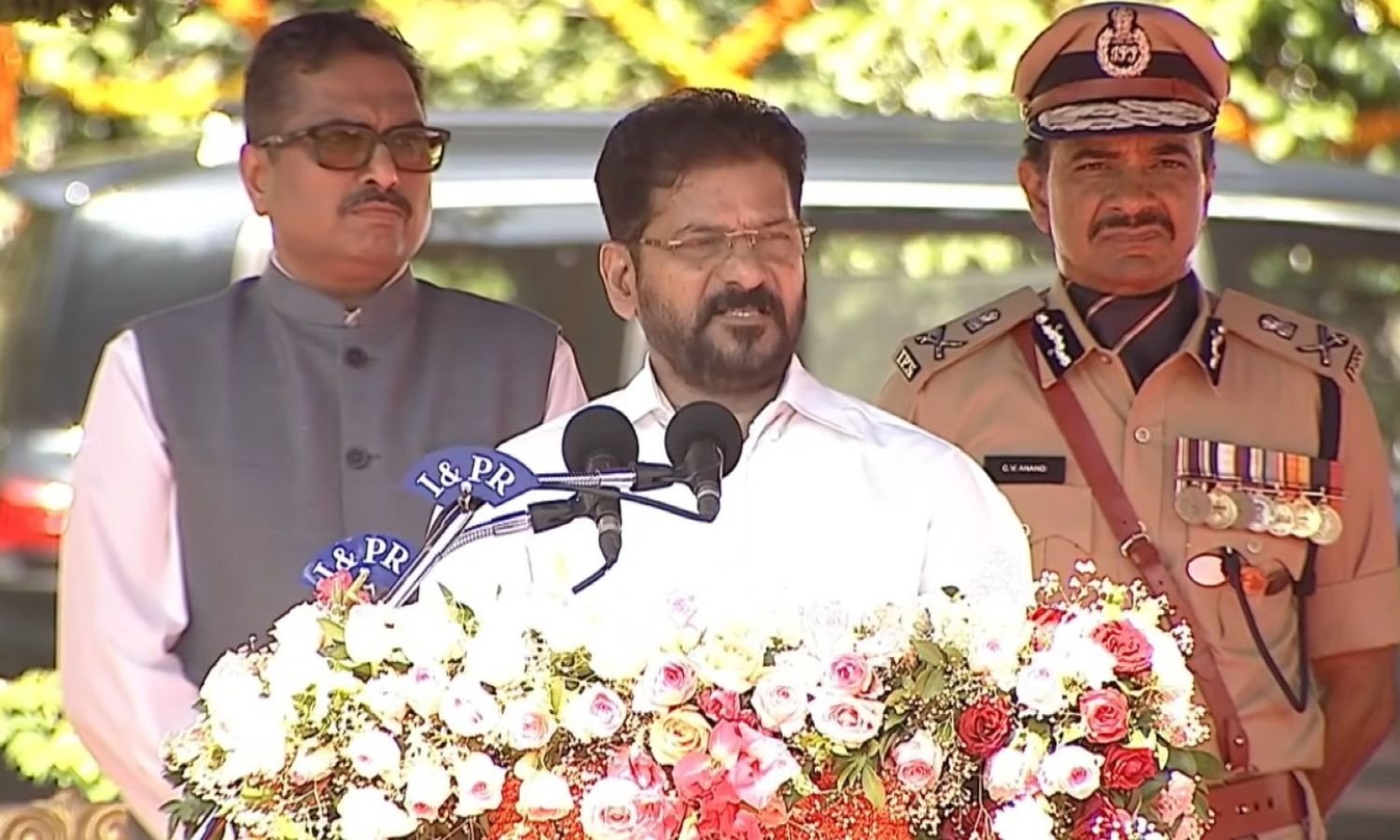
Hyderabad: Chief Minister A. Revanth Reddy on Thursday outlined his government’s welfare and development record at the Praja Palana Dinotsavam celebrations. He also set out an ambitious economic and infrastructure agenda for Telangana through 2047. Addressing the celebrations at Public Gardens, he said Praja Palana placed people, their rights and aspirations at the centre of governance.
Reddy greeted Telangana’s four crore people and paid tribute to those who fought for freedom, self-respect and rights. He recalled Telangana’s history of resistance, from Sammakka-Saralamma to the Telangana armed peasant struggle and the separate state movement. He said September 17, 1948 held a special place in that history.
India became independent on August 15, 1947, while the erstwhile Hyderabad State remained under Nizam rule. Revanth Reddy noted that parts of present-day Maharashtra and Karnataka were also then part of Hyderabad State. He said Hyderabad had progressed in industry, agriculture, education and healthcare under the Nizam and gained global recognition.
However, he said rural Telangana faced severe feudal exploitation, forced labour and oppression. Razakar violence also created turmoil during the final phase of Nizam rule. Meanwhile, public demand for Hyderabad’s integration with India grew stronger.
Movements were organised under the Nizam Andhra Mahasabha and Hyderabad State Congress. At the same time, Communists led an armed struggle against Razakar violence, feudal exploitation and forced labour. Revanth Reddy recalled leaders including Ravi Narayana Reddy, Bhimreddy Narasimha Reddy, Anabheri Prabhakar Rao, Chakali Ilamma, Arutla Kamaladevi and Mallu Swarajyam.
Against this backdrop, Operation Polo was launched under then Prime Minister Jawaharlal Nehru and Deputy Prime Minister Sardar Vallabhbhai Patel. The seventh Nizam surrendered to the Indian government after the military action. Hyderabad State formally became part of India on September 17, 1948.
Revanth Reddy described the event as more than the end of the Nizam’s authority. He said it opened the way from monarchical rule to democratic governance. Therefore, Telangana observed September 17 as Praja Palana Dinotsavam, he said.
The Chief Minister said Praja Palana meant respecting people’s voices, resolving their problems and protecting their rights. It also meant ensuring public resources reached everyone and allowing every person to live with dignity. He said Telangana’s long history of struggles carried a clear message that people must remain central to governance.
Revanth Reddy said Telangana was now competing not merely with neighbouring states but with the world. He put the state’s per capita income at Rs 4,18,931, nearly 91% above the national figure. However, he said development must be visible in people’s lives rather than only in statistics.
On agriculture, Revanth Reddy said the government had waived crop loans of up to Rs 2 lakh. It released Rs 20,616 crore for the waiver, benefiting 25.35 lakh farmer families, he said. The government also deposited more than Rs 36,000 crore into farmers’ accounts under Rythu Bharosa.
The state paid a Rs 500-per-quintal bonus for fine varieties of paddy, he said. Revanth Reddy claimed government support helped Telangana secure the country’s top position in paddy cultivation area and output. He said nearly Rs 1.72 lakh crore was spent on agriculture and farmer welfare over 32 months.
The Chief Minister said the government introduced comprehensive land administration reforms through the Bhu Bharati Act. It also launched Bhudhar and AI-based Bhumitra services. According to him, pattadar passbooks were issued to 5.94 lakh farmers.
Revanth Reddy said Telangana was pursuing a legal battle for its rightful share of Krishna river waters. Work on Palamuru-Rangareddy, Sitarama lift schemes, SLBC and other pending projects was being taken up on a war footing.
Turning to women’s welfare, Revanth Reddy said the government wanted one crore women to become financially empowered. Under the Mahalakshmi scheme, women received free RTC bus travel. He said the journeys had saved women about Rs 12,385 crore.
Under Gruha Jyothi, more than 53 lakh families were receiving up to 200 units of free electricity. Another 43 lakh families were getting cooking gas cylinders for Rs 500, he said. The government provided Rs 4,709 crore to 1.68 lakh women under Kalyana Lakshmi and Shaadi Mubarak.
Revanth Reddy said 4.54 lakh self-help groups received Rs 60,487 crore in bank linkage and Rs 1,900 crore in interest subsidy. Women’s marts, petrol pumps and RTC rental buses were also being used to increase their income. He said the government wanted women to become participants in the economy rather than remain only beneficiaries.
The Chief Minister said 3.42 crore people were receiving fine rice through the public distribution system. More than 15 lakh new smart ration cards had also been distributed. Over 43 lakh people were receiving social security pensions, he said.
Since the government assumed office, about Rs 31,000 crore had been provided through pensions, according to Revanth Reddy. He added that arrangements were being made to extend pensions to another 2.25 lakh people.
On housing, Revanth Reddy said the first phase of Indiramma housing sanctioned 4.50 lakh houses with an outlay of Rs 22,500 crore. Each house received an allocation of Rs 5 lakh. Another 2.50 lakh houses were sanctioned in the second phase.
The government also began the Indiramma Towers initiative to build one lakh Indiramma houses within Hyderabad city limits. Revanth Reddy said the programme reflected the government’s goal of enabling every family to live with dignity.
Social justice was another foundation of Praja Palana, he said. The government conducted a social, economic, educational, employment and political caste survey. Based on its data, the Assembly approved bills providing 42% reservations for BCs in education, employment and local bodies.
Those bills were sent for Presidential approval, Reddy said. He also said Telangana implemented SC categorisation in accordance with the Supreme Court judgment. The state was observing February 4 every year as Telangana Social Justice Day.
Revanth Reddy said social justice could not remain a slogan. It required bringing disadvantaged communities forward and creating more opportunities for those who had received fewer chances.
Education and healthcare were like two eyes of the government, he said. Young India Integrated Residential Schools were being constructed in every Assembly constituency. Each school was planned on 20 to 25 acres with comprehensive facilities.
The government also started pre-primary classes in government schools and decided to establish a Telangana Public School in every constituency. It was spending Rs 927 crore to provide breakfast and milk to government school students. The midday meal programme was extended up to Class 12.
Scholarships and fee reimbursement were being directly credited to the bank accounts of 11 lakh students, Revanth Reddy said. He attributed Telangana’s rise from 28th to 18th place in the Performance Grading Index to education reforms.
The government was also trying to bring offshore campuses of leading global universities to Hyderabad. Revanth Reddy said Northeastern University in the United States had shown interest. The University of London, a federation of 17 independent institutions in Britain, had also expressed willingness to establish an offshore campus.
In healthcare, the government increased the Rajiv Aarogyasri limit from Rs 5 lakh to Rs 10 lakh. Reddy said the Chief Minister’s Relief Fund provided Rs 2,526 crore to 5.19 lakh people.
Construction of a new Osmania Hospital began at Goshamahal with an outlay of Rs 2,700 crore, he said. The Marri Channa Reddy TIMS Super Speciality Hospital at Sanathnagar was opened. TIMS super-speciality hospitals at Alwal and LB Nagar would become available soon, he added.
Revanth Reddy said Telangana’s youth had been at the forefront of the statehood movement, particularly over jobs and employment opportunities. His government had completed more than 72,000 government recruitments transparently, he said. Examinations from Group-I to Group-IV were also conducted transparently.
He said artificial intelligence was changing the nature of jobs and increasing demand for new skills. Therefore, the government established Young India Skills University. It also upgraded ITIs into Advanced Technology Centres to meet current industry needs.
Students trained at the ATCs were securing campus placements, he said. New courses were also being introduced in polytechnic colleges. Revanth Reddy said Telangana’s youth should develop the skills required to compete globally.
Praja Palana Dinotsavam: CM unveils 2047 plans
The government was rapidly expanding infrastructure required for Telangana’s development, Revanth Reddy said. It submitted proposals for the 122.9-km second phase of Hyderabad Metro at an estimated Rs 38,595 crore. Approvals were also secured for airports at Adilabad and Mamunur, while required land acquisition was taken up.
Revanth Reddy said the Musi rejuvenation project was launched to provide cleaner air and water to Hyderabad residents. The government planned to rejuvenate a 55-km stretch of the river. He also said food adulteration that endangered public health would not be tolerated.
The government established TG Safe to tackle food safety concerns, he said. It also strengthened the EAGLE system as part of efforts to make Telangana drug-free.
Revanth Reddy said the government’s objective went beyond meeting immediate needs and extended to building Telangana’s future. Plans were prepared under Telangana Rising Vision 2047. The government aimed to turn Telangana into a $3 trillion economy by 2047, he said.
It also planned to raise Telangana’s contribution to India’s GDP to 10%. Revanth Reddy said Bharat Future City was being developed across nearly 30,000 acres as the country’s first net-zero smart city.
The Future City master plan would be unveiled during the Invest Telangana Global Summit-2026 in December, he said. Revanth Reddy said TCS had come forward to build what he described as the country’s largest AI data centre in Future City with Rs 70,000 crore.
Amazon had already begun construction of a data centre with an investment of Rs 1 lakh crore, he said. Future City would include dedicated zones such as Young India Skills University, a life sciences hub, EV Park, AI City, Health City and Education City.
Revanth Reddy said the Regional Ring Road, greenfield highways, dry ports and proposed industrial corridors would transform Telangana’s infrastructure. He identified Hyderabad-Nagpur, Hyderabad-Bengaluru and Hyderabad-Vijayawada among the industrial corridors.
The government was also improving road connectivity from villages to mandals, districts and the state capital. Revanth Reddy said road works worth Rs 13,000 crore were being undertaken under the Roads and Buildings Department. Panchayat Raj road works worth Rs 6,294 crore were also in progress.
The Chief Minister said Telangana was currently facing drought-like conditions due to the El Niño effect. Electricity demand had also increased. He said the government was making advance plans to prevent disruptions in drinking water and power supply.
The state was also trying to provide more workdays under VB-G RAM G, he said.
Concluding his address, Revanth Reddy said development and welfare were only part of the government’s approach. Self-respect, freedom, equality and social justice were also foundations of Praja Palana.
He said September 17 was not merely an occasion to remember the past but also a reminder of present responsibilities. Telangana had emerged as a separate state after mass movements, numerous struggles and sacrifices, he said. The benefits of that history and those movements must now be visible in people’s lives.
Revanth Reddy said farmers should have security, women should achieve economic progress and disadvantaged communities should receive justice. Poor children should have access to quality education and healthcare, while young people should receive opportunities to compete globally. Development, he added, should reach every region of Telangana.
The Chief Minister said Telangana would neither forget its history nor stop with its past. He called for the spirit of earlier struggles to guide the building of a modern Telangana. With the participation of four crore people, he said, the state should develop into one that could earn global recognition.