

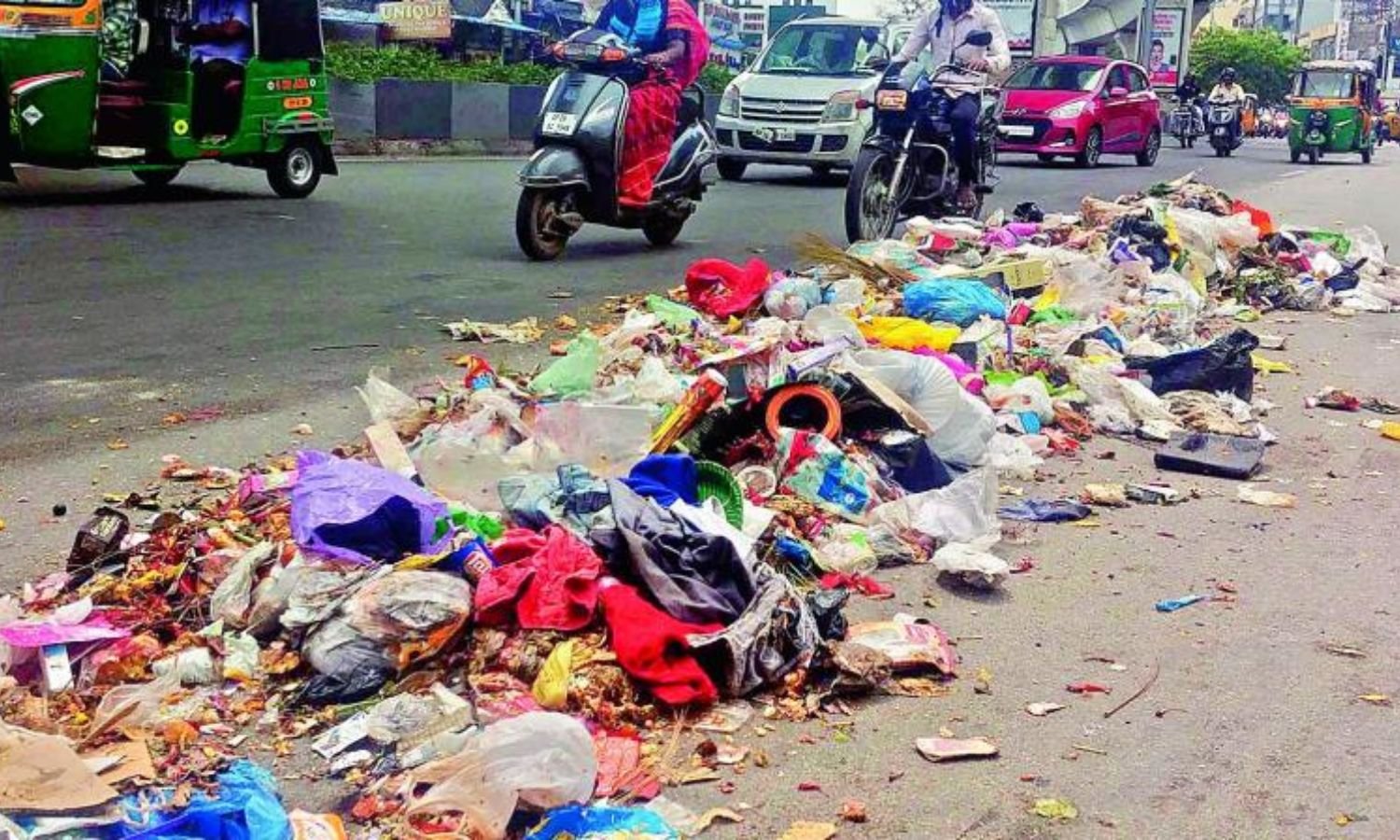
Hyderabad: Environmental experts have called for a complete restructuring of the waste management system in the CURE area, saying wet and sanitary waste should be collected every day while dry waste is handled through separate vehicles and centres. Solid waste management is becoming a major challenge as Hyderabad expands. Waste separated at source must also stay separate until the final stage, rather than simply being collected and moved.
The experts’ view comes against the backdrop of proposed changes in solid waste management, the Supreme Court’s directions to manage waste through scientific methods and the Solid Waste Management Rules-2026. They say the focus should be on building the infrastructure needed at each stage in the CURE area rather than making small changes to the existing system. Doubts have also been raised over whether officials who could not implement the Solid Waste Management Rules-2016 without infrastructure can implement the 2026 rules.
Experts suggest a comprehensive system that prevents mixing at every stage, covering collection, transport, transfer stations, processing centres and final disposal. Segregation at source is the key to scientific waste management. However, even if households separate wet, dry and other waste, the effort serves no purpose if the waste mixes during collection or transport.
Wet and sanitary waste must not be allowed to mix, and the experts suggest two separate compartments in collection vehicles for this purpose. A separate collection system should be set up for dry waste and waste that needs special care. Instead of using a large number of vehicles to collect every type of waste daily, separate vehicles should be provided for dry and special waste. Modernising the transfer stations in the CURE area is another key aspect, and each station should have separate arrangements for wet and sanitary waste.
Dry Resource Collection Centres (DRCCs) and Material Recovery Facilities (MRFs) will be central to dry waste management. Dry waste collected by the special vehicles would be taken to these centres, where it would be received, sorted, stripped of recyclable material, baled and processed by other methods. It would then be sent to recycling firms, which would reduce the quantity reaching dumping yards and final disposal centres.
The state government is working on a special system to monitor waste from collection to processing under the circular economy in the CURE area. Experts want primary collection, transport, transfer stations and processing centres treated as parts of one integrated system rather than as separate departments. They also say a digital mapping system should bring the colonies, apartment complexes and residential areas of every ward into the network, so that people know when and where waste is collected.
EV tippers and the two-bin system
For door-to-door collection and transport, 10,000 EV auto tippers will be operated under Ramky for the GHMC, CMC and MMC within the CURE area. Experts say collection can be handled comprehensively with two bins rather than four. There is a view that separating waste into four bins is not feasible.
The experts estimate that 15 to 20 vehicles per ward for wet and sanitary waste, plus five vehicles for dry and e-waste, would be sufficient. They say wet and sanitary waste should be collected every day, while dry and e-waste can be collected area-wise once a week.