
Inclusive regional growth faces market-led test in India
By Dr Tamma Koti Reddy

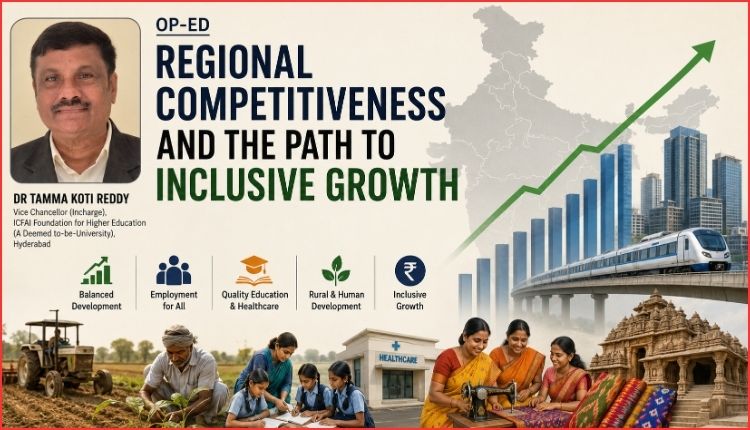
In the era of economic reforms, while regional competitiveness in India has significantly contributed to the growth rate of the national GDP, it raises a critical question: To what extent has this competitive spirit driven market-led systems toward achieving inclusive growth? Liberalized policies provide the framework that leaves significant differences between states and regions in India. The success of a state or region in attracting investment should be expected to create jobs and improve productivity in the region as part of its role in becoming competitive. In certain states, foreign and domestic investments were drawn, and rapid development in the industrial and service sectors was achieved, thus establishing them as major economic powerhouses. More industrialized regions have become engines of economic development, thanks to their innovative and infrastructure efforts. Innovation and infrastructure development have turned highly industrialized states into engines of economic growth.
In recent years, the philosophy of development has shifted noticeably from Balanced Regional Development to Competitive Regional Development. Following the establishment of Special Economic Zones (SEZs), Production Linked Incentive (PLI) schemes, Skill development initiatives, Physical infrastructure & connectivity, State-specific industrial policies, industrial corridors, and Good Governance, the competitiveness of certain states and regions has surged, successfully integrating them into global supply chains. However, this growth has remained localized. Rapid urbanization has resulted in a significant increase in the economic growth rates of states such as Tamil Nadu, Maharashtra, Gujarat, Karnataka and Telangana. The infrastructure has become the key element for investment decisions in the reform period. Gujarat, for example, has been successful in creating port-led development and Maharashtra has been successful in leveraging strong logistics sectors, transport and industrial infrastructure. Tamil Nadu & Karnataka prospered with establishing advanced technology parks. Delhi (NCR) emerged as a top retail and regional trading center, gaining huge Foreign Direct Investment (FDI). As a result of low industrialization, low human development, underinvestment, geographical barriers and lack of power infrastructure, states and regions like Bihar, Jharkhand, Odisha, UP and MP have been growing slowly. Regional competitiveness has taken a strong toll and the efficiency/social value balance has been seriously disrupted.
Disparities in Socio-Economic Indicators Across States in India:
High economic growth and rising per capita incomes are not enough to disguise significant differences among population groups even in states where these levels of development have been attained. The fruits of growth have not been trickling down to all sections of society, with the result that inclusive growth faces grave challenges as reflected in a mountain of empirical evidence. The non-implementation of inclusive growth will increase poverty in the marginalized groups of society and create political unrest and economic stagnation in the long run. There are clear contrasts in the quality of life measures of society and the economy between regions:
There are increasing income inequalities, nutrition gaps and inequities in access to quality education and health care between the states and regions. The flow of migrants from backward states to states that are undergoing rapid urbanization and industrialization has increased. Some states are drawing both capital and skilled workforce, others fall well behind. The Periodic Labor Force Survey (PLFS) 2023–24 reveals that the income inequality in the country has worsened. The Gini coefficient reveals that, while the income inequality situation in Himachal Pradesh and Meghalaya was minimal, there was the highest income inequality in Maharashtra, Odisha and Jharkhand. Nationally, 58% of the national income goes to the top 10% of the income earners with 15% in the hands of the bottom 50% of the income earners. It is a stark reflection of the extent of wealth inequalities in India.
Income and living standards are extremely unevenly distributed across the states. Low literacy rates, limited industrialization, and poor access to infrastructure are all problems in Bihar, Jharkhand, Chhattisgarh, Uttar Pradesh, Odisha, Nagaland, and West Bengal that contribute to the persistent high poverty rates in these regions. On the other hand, Kerala, Goa, Tamil Nadu, Himachal Pradesh, and Gujarat had a lower level of poverty. Widespread access to education and increased infrastructure, along with high urbanization rates (particularly in southern and western states such as Kerala, Maharashtra, Telangana, and Tamil Nadu), have helped to bring poverty levels down. At the same time, lack of industrialization and governance issues are responsible for keeping poverty rates high in northern and eastern states such as Bihar and Uttar Pradesh.
Based on the current weekly status of unemployment, the first half of 2025–26 saw unemployment spiking in Andhra Pradesh, Punjab, Karnataka, and Tamil Nadu, while remaining lower in Gujarat, Jharkhand, Kerala, and Uttar Pradesh. Economically robust states like Telangana, Tamil Nadu, Karnataka, and Maharashtra succeeded in slashing poverty levels, yet struggled to pull down unemployment rates. Similarly, despite making massive strides in income levels and social indicators, Kerala and Karnataka registered high unemployment rates.
A striking difference is observed in the Infant Mortality Rate (IMR per 1000 live births), which is a good proxy measure of access to health care. Chhattisgarh had the highest infant mortality, followed closely by Uttar Pradesh (35) and Madhya Pradesh (35). The good news is that Kerala (8), Himachal Pradesh (11), Tamil Nadu (11), and Delhi (11) had the lowest rates. Additionally, PLFS 2023-24 data shows that the national female Labor Force Participation Rate (LFPR) is 40.3%, whereas it is 76.3% for males. The participation of women in the labour force is very low in Delhi, Haryana, Punjab and Uttar Pradesh when compared to men.
The Gross Enrolment Ratio (GER) of tertiary education level is 28.4% (28.3% for males and 28.5% for females). Although gender gaps in primary, secondary and higher education have narrowed, high dropouts rates are still a serious issue in the system.
The Path to Achieving Inclusive Growth
Market-oriented systems generate spectacular growth figures; however, human development is neglected in terms of the allocation of resources and the society’s urgent needs. Socio-economic differences between groups remain as development is increasingly concentrated within a few states and pockets of urban areas.
The key to inclusive growth is to move away from the policy focus on increasing incomes to the policy agenda of job creation, an emphasis on equal opportunities for all, and empowering marginalized groups. Key drivers include:
- Encouraging human and rural development.
- Creating resilient infrastructure.
- Implementing large-scale skill development programs.
Inclusive growth is indispensable for maintaining political and social stability, achieving social justice, ensuring equity, and dismantling deeply entrenched inequalities. While a rising economic growth rate is mandatory for states, poverty will only decline if they explicitly adopt employment-intensive growth strategies. This will smooth the path to inclusivity. The expansion of economic sectors within market systems boosts both income levels and tax revenues. Government revenue must be robustly channeled into social security and human development. Direct Benefit Transfers (DBT) and financial inclusion not only economically uplift marginalized communities but also trigger positive shifts in social indicators.
There are several identified roadblocks to inclusive growth. These encompass low yields from agriculture, poor irrigation infrastructure, smallholdings and fragmentation of land holdings, underemployment, non-implementation of welfare schemes, and a conspicuous lack of access to tertiary healthcare for backward classes. Further, farmers and the poorest are disproportionately affected by the rural-urban divide, financial exclusion, and climate variations.
Conclusion & Way Forward
Governments need to focus on labor-intensive manufacturing processes and actively support Micro, Small, and Medium Enterprises (MSMEs) based on the available resources to create an inclusive future. In addition to the current policy measures, State Government should announce fresh incentives which will act as an ignition to promote entrepreneurship among the women, minorities, Scheduled Castes (SC) and Scheduled Tribes (ST). To develop competitiveness and healthy cooperation between states and regions, policies need to be more focused on balanced regional development. The formal bank credit, crop insurance and digital financial services must be accessible, seamless and easy to reach for true empowerment, as the number of tenant farmers has swelled.
India will successfully achieve Sustainable Development Goals (SDGs) and inclusive growth only by reinforcing its “cooperative federal structure”. High educational standards have given a few states a massive edge in the technology and knowledge sectors. Ultimately, regional competitiveness will pave the way for true inclusive growth only when the state steps up to play an active, powerful role in agrarian reforms, human capital investment, and social inclusion.
[Dr Tamma Koti Reddy is the Vice Chancellor (Incharge), ICFAI Foundation for Higher Education (A Deemed to-be-University), Hyderabad.