
Waqf transparency campaign seeks asset disclosure, wider Muslim representation

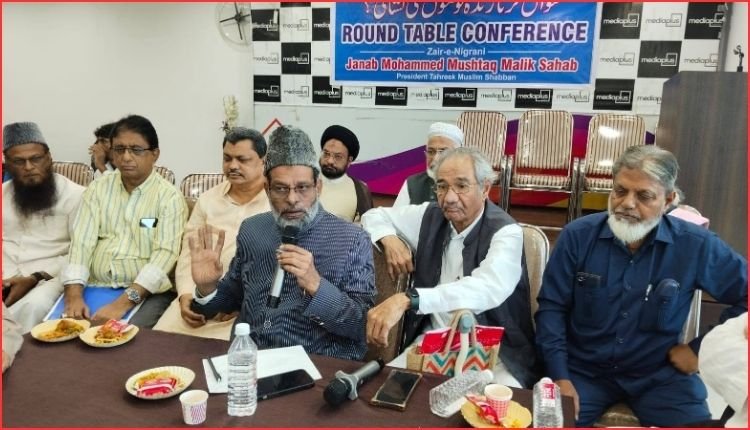
Hyderabad: Tahreek Muslim Shabban on Sunday announced a two-month Waqf transparency campaign seeking disclosure of Waqf assets, income and litigation in Telangana. The campaign also demanded two Muslim ministers and three Muslim MLCs, while a lawyers’ panel was formed to examine pending Waqf cases.
The decisions emerged from a round table conference held at Media Plus. Religious, community and social organisations participated alongside intellectuals, lawyers and social activists. Participants discussed the condition of Waqf properties and Muslim representation in the State government and legislature.
Tahreek Muslim Shabban president Mohammed Mushtaq Mallik said representatives of almost all major religious and community organisations attended. He said only one or two organisations did not participate. The conference subsequently decided to pursue the two issues through a coordinated campaign lasting about two months.
Waqf transparency campaign seeks details of assets
Addressing a press conference after the meeting, Mallik demanded comprehensive information about Waqf properties in Telangana. He said the public lacked complete information about the extent and value of properties under the Telangana State Waqf Board.
Therefore, he asked the Board to disclose the total property currently under its control. He also sought the estimated value of those assets. In addition, Mallik demanded information about Waqf properties involved in litigation before different courts.
He claimed the Muslim community had never received a complete account of Waqf assets. He described their value as running into “lakhs of crores of rupees”. Mallik argued that the Board should place this information in the public domain. He said Waqf properties did not constitute personal assets belonging to individuals or office-bearers.
The Waqf transparency campaign would consequently seek verifiable information on assets rather than only raise allegations, he said. Referring to the Waqf Act, 1995, Mallik discussed the institutional structure established for Waqf Boards.
He said the law provided representation to elected representatives, including MPs and MLAs. He also referred to representation for mutawallis, religious scholars and other sections, including Shia representatives.
Despite that structure, Mallik alleged that Waqf properties had suffered serious losses during the previous three decades. However, he said accountability should not initially focus only on successive political governments.
“We will ask the Telugu Desam, Congress and BRS later. Our first questions will be directed at the Waqf Board,” Mallik said. He argued that the Waqf Board functioned as an autonomous institution. Therefore, he said it carried an independent responsibility to administer and protect Waqf assets.
The campaign planned to question the Board directly about the management of those properties. Mallik also questioned how the Telangana Waqf Board had used income generated from Waqf properties.
He said Waqf assets had historically supported charitable and welfare purposes. These included assistance for orphans, widows, poor families and destitute people. Furthermore, he cited needy students and people requiring medical assistance among the intended beneficiaries. Mallik said such properties also supported education, economic advancement, religious activities and community services.
However, he alleged that the Telangana Waqf Board had not created a visible, systematic mechanism linking its income directly to these beneficiaries. He therefore sought details about the Board’s annual revenue and expenditure.
Mallik also referred to revenue generated through Waqf institutions, including auctions connected with dargahs. He asked why detailed accounts of such income and expenditure were not readily available publicly.
Additionally, he questioned whether administrative costs, hospitality and vehicles consumed Waqf revenues. He argued that income should support education, healthcare and vulnerable sections. “This is the first time we are directly raising these questions with the Waqf Board,” he said.
Waqf transparency campaign cites Karnataka example
Mallik cited Karnataka while arguing for greater use of Waqf income for education. He claimed the Karnataka Waqf Board had allocated ₹10 crore per district towards Minority Degree Colleges for Muslim girls.
According to him, authorities had already provided funds in 15 districts. Mallik further claimed that the Karnataka initiative used the Waqf Board’s own income. He said the funding did not come through a grant sought from the State government.
He argued that Telangana should similarly disclose its Waqf Board’s annual income. Moreover, he sought an explanation of how authorities had utilised that revenue. The Waqf transparency campaign would focus on obtaining such financial information during its proposed two-month programme.
The conference also discussed what participants described as inadequate Muslim representation in Telangana’s political and decision-making institutions. Mallik said Muslims had limited representation in the State government. He argued that the community required accessible representatives who could take its concerns to the highest levels.
Consequently, the conference demanded two Muslim ministers in the State Cabinet and three Muslim members in the Legislative Council. Mallik also referred to opportunities for representation in the Council.
He said Amir Ali Khan already served as a Muslim MLC. However, he argued that another Muslim representative could have secured election under the MLA quota without affecting existing representation.
Mallik alleged that an opportunity to provide additional Muslim representation had been lost. However, he declined to elaborate on what he described as the circumstances behind that development.
He said the round table had made its demand clear. Participants sought three Muslim MLCs and two Muslim ministers. According to Mallik, such representation would give the community a stronger presence in both the executive and legislature.
Waqf transparency campaign forms lawyers’ panel
The conference also decided to examine the legal position of Waqf properties systematically. Mallik announced a lawyers’ panel under the supervision of senior High Court advocate Mir Masood Ali Khan.
He said Mir Masood Ali Khan had previously served as counsel in Waqf matters. The panel was tasked with identifying Waqf-related cases pending before courts. It also planned to examine the current status of those cases.
Moreover, the lawyers would assess whether authorities had taken adequate legal measures to protect the properties involved. Mallik said the exercise sought a clearer account of the number of pending Waqf cases. The panel would also examine what legal intervention important cases required.
The legal review formed another component of the Waqf transparency campaign announced after the round table. Several representatives of religious, social, political and community organisations addressed the conference.
Participants included former MP Aziz Pasha and Maulana Asim Umri of Jamiat-ul-Ahle Hadees. Maulana Taqi Raza Abedi and Dr Taufeeq of Wahdat-e-Islami also addressed the meeting.
Former Urdu Academy Vice-Chairman M.A. Hakeem and Mufti Abrar of Jamiatul Ulema participated. Ashraf Sharfi and Socio Reforms Society president Dr Aleem Khan Falaki also joined the deliberations.
Congress leaders Osman Mohammed Khan and Mujeebullah Shareef attended the conference. Former Telangana Minorities Finance Corporation chairman Dr Imtiyaz Ishaq also participated.
Former Urdu Academy chairman Raheemullah Khan Niyazi and Sunni Ulema Board representative Hamed Hussain Sattari addressed the gathering.
Other participants included Abdul Khadeer, Mujahid Hashmi and Ilyas Shamshi. S.A. Mannan of the CPI and Dr Babar Shaik of Anjuman-e-Ittehad Millat also participated.
Azeez Sahab of Tajiraan Chirm and Sikandarullah of MBT attended. Arshad Hashmi and Advocate Masood were also among the participants. The meeting brought these representatives together to discuss Waqf administration and political representation.
Waqf transparency campaign planned for two months
Mallik said the Joint Action Committee functioning under the leadership of Tahreek Muslim Shabban would conduct a sustained movement. Constituent organisations of the Joint Action Committee would participate in the programme, he said.
The campaign would primarily focus on transparency in Waqf administration. At the same time, participating organisations would press for greater Muslim representation in the government.
Mallik said the movement would continue for about two months. During that period, participating organisations planned to raise the issues through a coordinated programme.
They would also seek responses from the authorities on the questions raised at the conference. Mallik maintained that the initiative aimed to obtain verifiable information rather than merely make allegations.
Specifically, the organisations sought information about Waqf assets, their income and pending court cases. They also wanted details about the utilisation of Waqf funds.
Alongside those demands, the groups planned to seek a stronger Muslim presence in the State’s decision-making structure. The Waqf transparency campaign therefore combined demands for financial and legal disclosures with calls for wider political representation.