

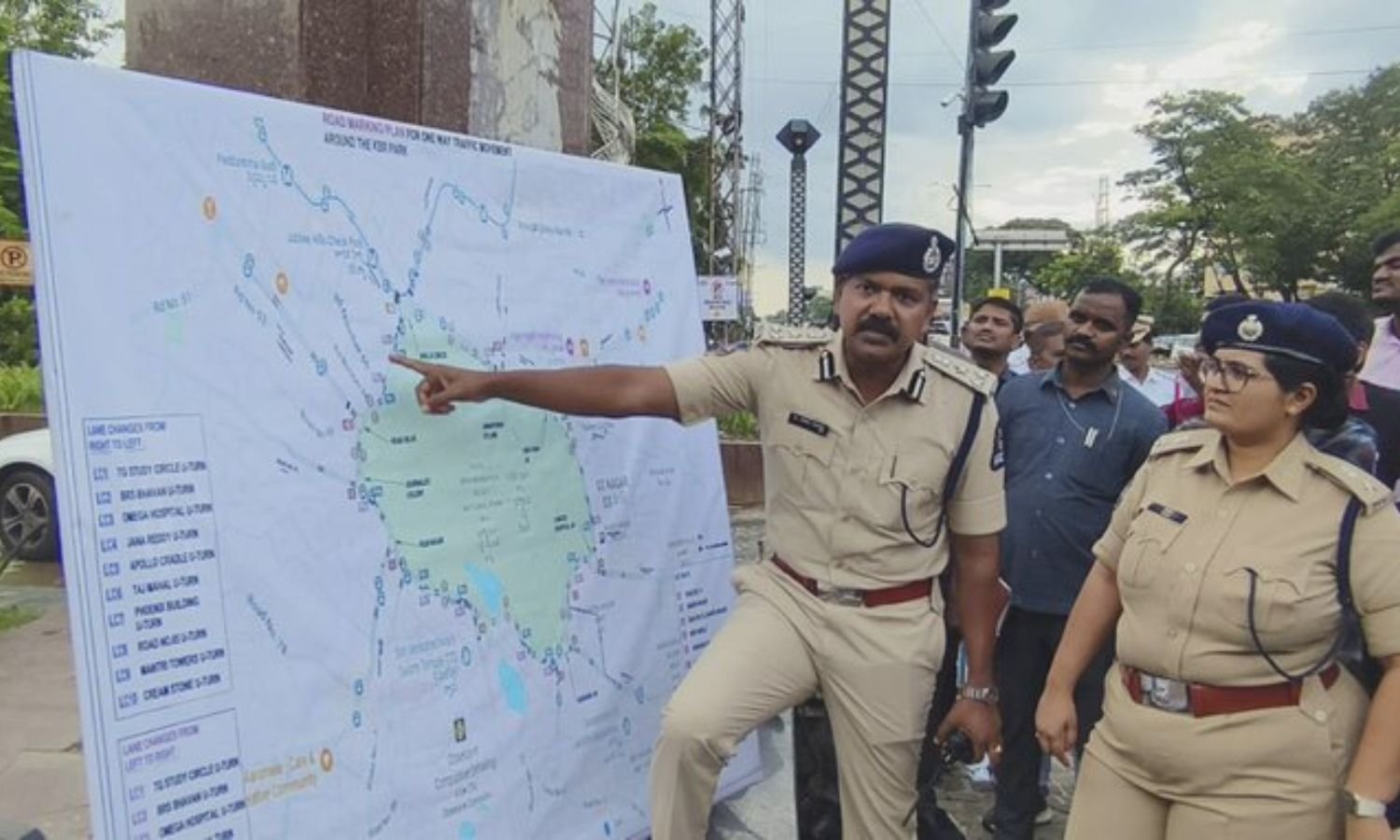
Hyderabad: KBR Park one-way system will begin on August 18 at 6:00 AM, Hyderabad Traffic Police said.
The permanent arrangement will remain until the infrastructure project around KBR Park ends. Police announced the plan after inspecting the area on August 12.
Joint CP (Traffic) D. Joel Davis, IPS, and DCP Traffic Kajal Singh, IPS, inspected the routes with other traffic officials. Davis later briefed media representatives at the KBR Park Main Gate.
The project includes 7 flyovers and underpasses around KBR Park. Construction has already started on 17 pillars along Road No. 2 and the KBR Park-Checkpost stretch.
Around 110 additional pillars and underpasses remain to be constructed. Police expect the work to continue for about 1.5 years.
Construction will reduce available road width by 30% to 40% at several locations. Therefore, traffic authorities conducted simulations and technical studies to improve road use.
Officials used drone visuals and consulted transport engineers from IBI and Arcadis during the studies. They also conducted two trial runs before finalising the one-way plan.
The first trial lasted 3 hours on April 5. A second 6-hour trial took place in June after schools and colleges reopened.
Meanwhile, GHMC, TGSPDCL, HMWSSB and executing agencies carried out corrective measures. They also completed necessary civil adjustments within the available road boundaries.
KBR Park one-way system sets new diversion routes
Under the new plan, motorists from NFCL heading towards Road No. 45, the IT Corridor or Cable Bridge cannot turn right at NTR Bhavan. Instead, they must turn left towards KBR Park and use the designated lanes.
Motorists can also travel through Journalist Colony to reach the required destinations. Police have prepared route options to manage traffic around the construction zones.
From KBR Checkpost towards NFCL, Panjagutta or Begumpet, motorists can use both lanes initially. Those destinations require drivers to move into Lane 1 through the new median opening near Gymkhana Club.
The median opening lies about 100 metres ahead of the Checkpost. Drivers can then take a free left at NTR Bhavan.
For Road No. 10, motorists from KBR Checkpost can shift left through the median near Study Circle. Drivers heading towards Road No. 12 can move left after crossing the Cancer Hospital.
Motorists travelling from NFCL towards Road No. 36 cannot use the right turn at NTR Bhavan. Instead, they can travel through Srinagar Colony T-Junction, Indiranagar Gadda and Venkatagiri Cross Roads.
The alternative route continues towards Road No. 10, Jubilee Hills, near Diamond House. Drivers can then turn right at the new median near Alcazar Plaza.
Evening restrictions will also affect access to Film Nagar from Road No. 45. Police advised motorists to use Road No. 51 and Road No. 52 instead.
Traffic personnel will remain stationed on those routes to manage vehicle movement. The police plan also includes measures for pedestrian safety near major intersections.
Because continuous one-way traffic can limit natural gaps for pedestrians, police installed signal poles. Signals will stop vehicles for about 15 seconds at selected intersections to allow safe crossings.
KBR Park receives around 1,500 to 2,500 regular visitors each day. Therefore, police have strictly prohibited roadside parking on the active carriageway.
Commercial establishments near the park cannot use KBR parking areas for their vehicles. During peak walking hours from 5:00 AM to 7:00 AM, authorities are reviewing single-lane parking.
After that period, the full carriageway will remain available for moving traffic. Police said the arrangement aims to balance pedestrian activity with vehicle movement.
The one-way system will also support emergency vehicle movement. Reduced signal gridlocks are expected to provide ambulances with faster access to Apollo Hospital, Omega Hospital and other medical centres.
The Traffic Control Room will coordinate lane priority during critical medical emergencies. Police will also deploy personnel around the clock during the initial transition.
Four shifts will cover critical merging points and intersections during the first 7 to 10 days. Officials expect this period to help commuters adjust to the new traffic pattern.
Police are also conducting awareness campaigns before implementation. Explanatory maps, videos and social media updates will help motorists understand the new routes.
𝐊𝐁𝐑 𝐏𝐚𝐫𝐤 𝐎𝐧𝐞-𝐖𝐚𝐲 𝐓𝐫𝐚𝐟𝐟𝐢𝐜 𝐒𝐲𝐬𝐭𝐞𝐦 𝐟𝐫𝐨𝐦 𝐀𝐮𝐠𝐮𝐬𝐭 𝟏𝟖 | 𝐇𝐲𝐝𝐞𝐫𝐚𝐛𝐚𝐝 𝐓𝐫𝐚𝐟𝐟𝐢𝐜 𝐏𝐨𝐥𝐢𝐜𝐞 𝐓𝐫𝐚𝐟𝐟𝐢𝐜 𝐌𝐚𝐧𝐚𝐠𝐞𝐦𝐞𝐧𝐭 𝐏𝐥𝐚𝐧
In view of the implementation of the One-Way Traffic System around KBR Park under the H-City… pic.twitter.com/65rkAi7fYH
— Hyderabad City Police (@hydcitypolice) August 12, 2026