

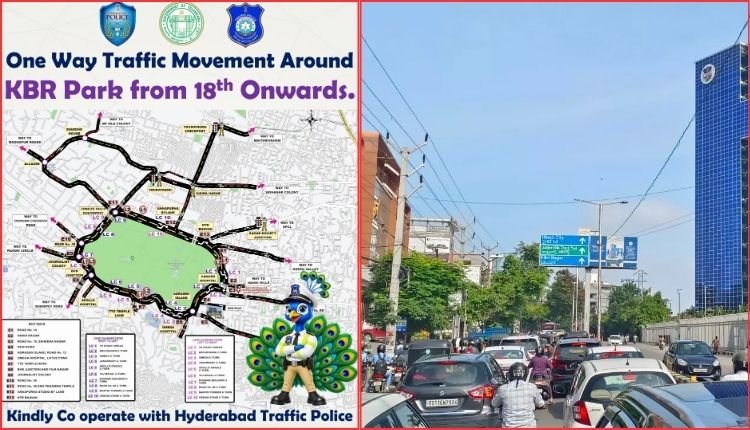
Hyderabad: The KBR Park one-way traffic system took effect at 6 a.m. on Tuesday, turning the six-lane road surrounding the national park into a large traffic rotary.
Traffic police introduced the arrangement around Kasu Brahmananda Reddy National Park on August 18. The change followed restrictions on carriageway space caused by ongoing H-CITI construction works.
Under the new system, motorists travelling from Banjara Hills Road No. 3 towards Jubilee Hills Checkpost had to turn left at the traffic signal. Drivers could no longer continue along their earlier routes at several points. Instead, motorists had to follow the circular traffic flow and use designated lane-switching locations to exit.
The changes initially resulted in confusion among some road users. However, the uninterrupted flow also increased vehicle movement speeds along parts of the stretch.
KBR Park one-way changes routes for motorists
Morning walkers who drove to KBR Park from the L.V. Prasad stretch were among the first to encounter the changes. Previously, they could proceed straight and find parking before starting their walk. On Tuesday, however, motorists had to turn left at the signal and search for parking along the revised route.
At the other end, vehicles and school buses arriving from Yousufguda faced another significant change. Police directed them along the roundabout instead of allowing the earlier right turn at the signal.
Consequently, some motorists had to travel longer distances to reach their destinations. Police deployed about 200 personnel on the roads to implement the new arrangement and guide motorists.
“There are 200 personnel on the road to guide and implement the rule. Some people are stopping and asking for clarification; others know the change,” police official Srinivas Rao said.
Rao was stationed near Jubilee Hills Checkpost, where he explained the revised route to motorists. Some drivers had to take an approximately five-kilometre detour instead of their earlier right turn.
KBR Park one-way system eliminates some U-turns
Turning left became the basic rule for motorists using the roads around the park. Meanwhile, police identified specific lane-switching points where vehicles could leave the circular route.
The revised movement allowed vehicles to travel without some of the earlier interruptions. As a result, traffic moved faster on portions of the road. However, the higher vehicle speeds created difficulties for morning walkers and employees attempting to cross roads in the area.
The KBR Park one-way arrangement also removed the U-turn near Filmnagar Junction. Another U-turn along the affected route was also eliminated. The removal of these U-turns reduced travel time for some motorists, although other road users faced longer diversions under the new arrangement.
Police personnel also encountered questions and arguments from motorists unfamiliar with the changed traffic pattern. Officers explained the new system and directed vehicles into the circular flow.
KBR Park one-way introduced during H-CITI works
Traffic police introduced the KBR Park one-way system as a traffic-management measure during the ongoing H-CITI construction works.
The construction activity had reduced available carriageway space around KBR Park. Therefore, authorities introduced the one-way arrangement to maintain smoother vehicle movement despite the restrictions.
Police said personnel would remain deployed around the clock at important locations. They would guide commuters and assist motorists in adapting to the revised traffic arrangement.