

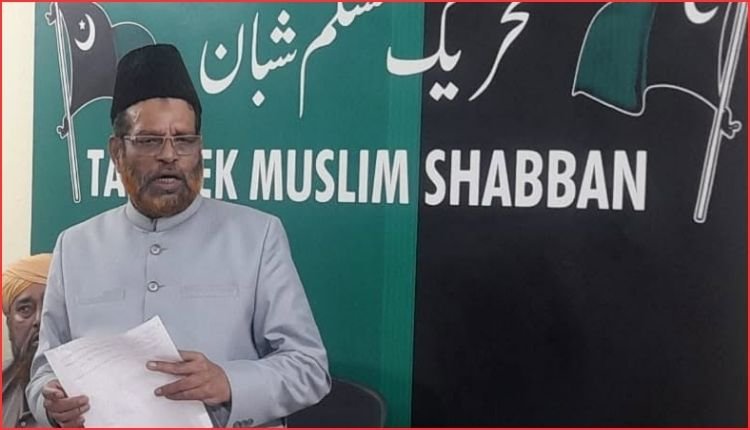
Hyderabad: Tahreek Muslim Shabban president Mohammed Mushtaq Mallik demanded a minority institutions review by the Telangana government, alleging serious gaps in their functioning and transparency. Mallik sought an urgent assessment of the Telangana State Waqf Board, Minorities Finance Corporation, Urdu Academy and Minorities Commission.
He raised the issues at a meeting of the organisation’s Majlis-e-Aala, or Central Committee, at its headquarters on Sunday. The meeting reviewed the Congress government’s record on minority issues during its 32 months in office.
Mallik alleged that institutional functioning, accessibility, transparency and Muslim political representation remained inadequate. Mallik alleged that the Telangana State Waqf Board had not met for more than two years. He said officials and those responsible for the Minorities Welfare Department had not clearly explained the reasons.
He argued that securing or handing over the Waqf record room alone would not address wider problems in Waqf administration.
Instead, Mallik demanded disclosure of the total extent and estimated value of Waqf properties across Telangana. He also sought details of properties facing litigation or alleged encroachment. Additionally, the Board should disclose the income generated from its assets, he said.
“Transparency in Waqf administration is essential. People have a right to know the status of properties worth enormous amounts and how much revenue the Board is earning from them,” Mallik said.
He referred to disputes involving Waqf properties associated with Dargah Hazrat Hussain Shah Wali, Jamia Nizamia and Guttala Begumpet. Mallik claimed properties affected by major disputes could be worth between ₹8 lakh crore and ₹10 lakh crore. He compared the figure with nearly four years of Telangana’s Budget.
He questioned who should bear responsibility for the alleged loss or alienation of such valuable properties. Tahreek Muslim Shabban had previously raised concerns about Waqf property protection and Board transparency, he said. Mallik added that the organisation would continue pursuing those issues.
Minority institutions review must cover economic support
Mallik also criticised the functioning of the Telangana State Minorities Finance Corporation. He alleged that its activities appeared largely restricted to distribution programmes such as sewing machines.
The Corporation should instead pursue meaningful economic empowerment for economically weaker minorities, Mallik said. He called for financial assistance, self-employment support and entrepreneurship programmes.
Education, skill development and livelihood assistance should also form a significant part of its work, he added. Mallik then questioned the current functioning of the Telangana State Urdu Academy.
He noted that Urdu was Telangana’s second official language. However, he alleged that the language and institutions associated with it were being weakened instead of strengthened.
The Tahreek Muslim Shabban president also demanded transparency in decisions involving valuable properties controlled by minority institutions.
He specifically referred to the leasing of Urdu Academy land. Mallik said the public often lacked information about who approved property leases or decided to defer such proposals.
He also sought clarity over the leadership and functioning of the Telangana State Minorities Commission. According to Mallik, minorities needed an effective statutory institution where people could raise grievances and seek remedies.
Minority institutions review linked to representation concerns
The meeting also examined Muslim political representation under the Congress government. Mallik alleged that Muslim representation in the Legislative Council had remained neglected for nearly two years. Former cricketer Mohammed Azharuddin was eventually nominated under the Governor’s quota, he said.
He said Muslims had previously secured greater representation in legislative bodies. At certain stages, Telangana had around three Muslim MLCs, he said. In undivided Andhra Pradesh, Muslim representation in the Council had reached as many as five members, according to Mallik.
He also said Congress had failed to elect a Muslim MLA on its ticket in Telangana for nearly 15 years. Therefore, the party needed to examine the reasons behind that record, he argued.
Mallik disagreed with Chief Minister A. Revanth Reddy’s observation that Muslims had failed to elect their own representatives. He argued that the Chief Minister had himself acknowledged on different occasions the importance of Muslim votes in the Congress victory.
According to Mallik, Muslim voters played a decisive role in nearly 20 Assembly constituencies. He claimed Congress might not have formed the government without that support.
Mallik said Muslim voters backed Congress candidates from other communities. However, he argued that the party failed to generate adequate support from other sections for its Muslim candidates.
He claimed a section of those votes instead moved towards the BJP.
“The issue that needs examination is why Muslim votes could be transferred to Congress candidates, while the party could not secure votes from other communities for its Muslim candidates,” Mallik said.
Minority institutions review should address accessibility
Mallik said the position of Muslims within the ruling establishment required serious examination. He alleged that the community lacked a strong and accessible leader who could effectively place its grievances before the government.
According to him, ordinary Muslims were finding it difficult even to meet people holding positions of responsibility in the government.
Mallik argued that minority representation should extend beyond symbolic appointments. Instead, he sought experienced leaders who understood community issues and could effectively raise them with the government. He demanded that the State government review all minority institutions and fill vacant positions.
Furthermore, Mallik called for statutory bodies to hold regular meetings and publish administrative and financial information. He also demanded an effective grievance-redressal mechanism that ordinary citizens could easily access.
Tahreek Muslim Shabban vice-president Abdul Haq Qamar, Mujahid Mushtaq, Mazhar Ali Baig and Hafiz Abdul Hafeez were among those who participated in the deliberations.