Digital Power Play: KTR’s Massive Personal Reach Challenges Congress Institutional Strength
By Shaik Ahmed Ali


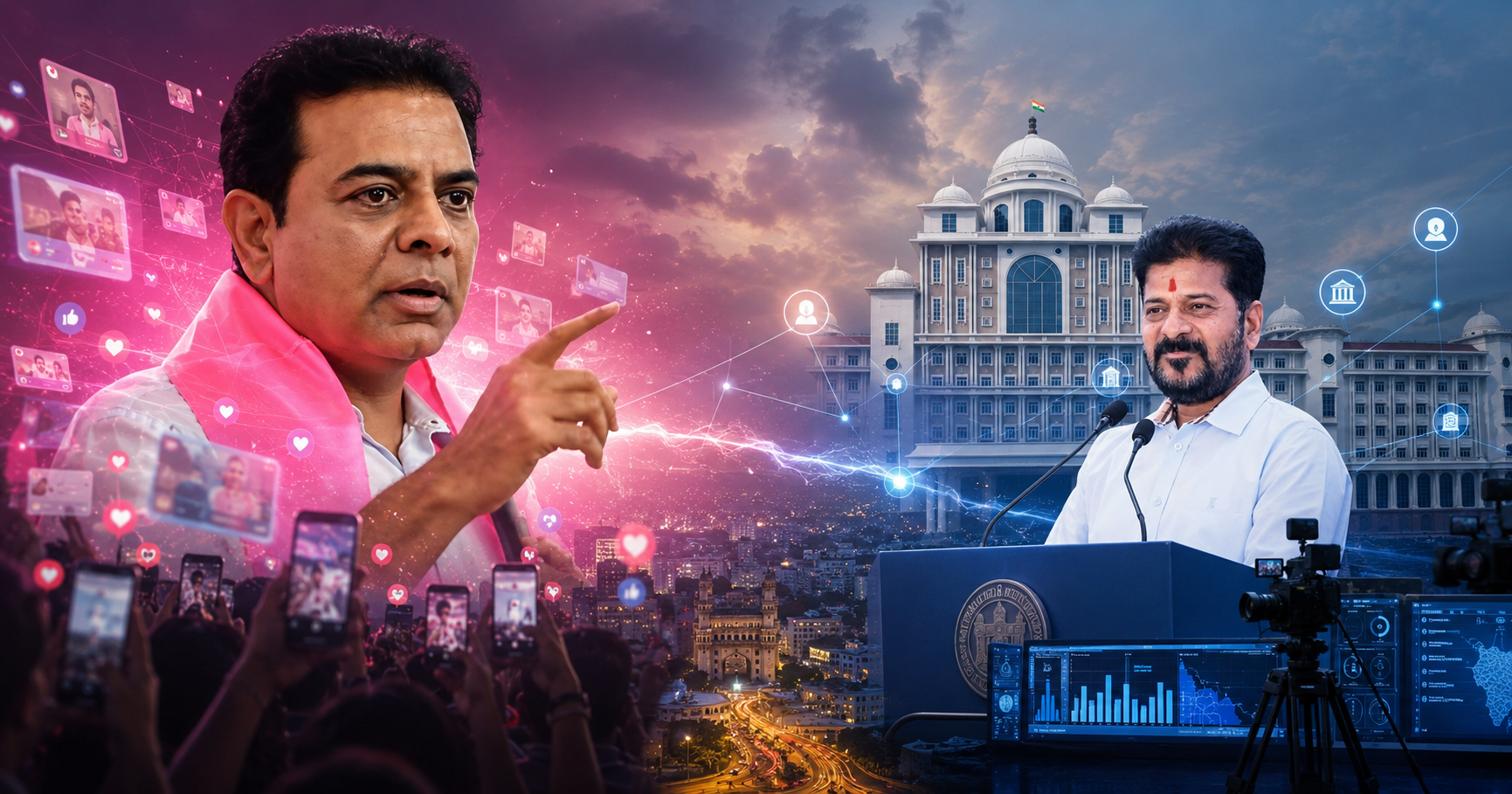
Hyderabad: There is a peculiar inversion at the heart of Telangana’s current political landscape, and it becomes visible the moment you look at a single pair of numbers. The Chief Minister of the state – the man who controls its budget, its bureaucracy, its police, its welfare machinery – has 623,000 followers on X. The leader of the principal opposition party, who holds no office, commands no ministry, and has been out of power for over two years, has 4.6 million.
That gap between Anumula Revanth Reddy and K.T. Rama Rao is not a minor statistical curiosity. It is the defining asymmetry of Telangana’s digital political landscape, and understanding how it came to exist – and what it means for the contest ahead – requires going back to the years when KTR was building his following post by post, one citizen grievance at a time.
KTR joined Twitter in 2010, when he was still a relatively unknown politician riding on the coattails of his father’s movement. What made him unusual, even then, was his willingness to engage – not just to broadcast, but to actually respond. When a constituent tweeted about a pothole, KTR would tag a municipal official. When a student needed a letter of recommendation, he would direct them to his office. This responsiveness, consistent over years, built a relationship with his online following that went beyond the transactional. People did not just follow KTR because he was powerful. They followed him because he replied.
During the COVID-19 pandemic, this quality became extraordinary. As Telangana locked down in 2020, KTR became effectively the state’s emergency helpline on social media. Requests for hospital beds, oxygen cylinders, medicines, transportation, and food arrived by the thousands. His office – a small team of personal secretaries and officers on special duty – worked around the clock to redirect each request to the appropriate authority. The result was a surge in followers and, more importantly, a surge in trust that has not dissipated even as his political fortunes have changed.
Today, @KTRBRS averages between 3,000 and 8,000 likes per post. Spikes are frequent – his April 2025 post about the BRS foundation day rally, which he described as one of the largest political gatherings in the country’s history, crossed one million views. His parallel handle, @KTRoffice, continues to function as a citizen services channel with 632,000 followers of its own, resolving everything from school admission disputes to pension delays. The @KTRoffice account is, in political communications terms, a masterstroke – it keeps KTR positioned as an active public servant even in opposition, and it generates a steady stream of positive human-interest content that softens the edges of his more combative political messaging.
The BRS party handle, @BRSparty, adds 942,000 more followers. Across X alone, the BRS ecosystem – party handle plus KTR personal account plus KTRoffice – reaches a combined audience of over 6.1 million. Every bit of it organic. Not a rupee of paid advertising since December 2023.
The Institutional Counter-Strategy
Congress has never tried to match KTR follower for follower on X. The party’s strategists understand, presumably, that trying to out-personality a politician who built his following over fifteen years would be an exercise in futility. Instead, they have pursued a strategy that leans into the one advantage that only a governing party possesses: institutional relevance.
When the Telangana government announces a new welfare scheme, it generates dozens of posts across the Congress ecosystem – the Chief Minister’s accounts, the party handle, ministerial handles, the official government communications channels. When an infrastructure project is inaugurated, the content multiplies across platforms simultaneously. When a Dalit student receives a scholarship, or a farmer’s loan is waived, or a new hospital opens in a district that hadn’t had one, there is genuine news to communicate – news that affects the lives of real people in ways that opposition content, however sharp or clever, fundamentally cannot replicate.
This institutional strategy has produced results that are easy to miss if you only look at raw follower counts. Congress’s Telangana Facebook page has the lowest likes of the three parties – 349,000 against BRS’s 1.24 million and BJP’s 707,000. But its weekly engagement ratio is 25 percent, nearly double BRS’s 12.5 percent and more than double BJP’s 11.4 percent. That means Congress generates more active interaction per follower than either of its rivals – more likes, more comments, more shares, more conversations per post. The governing party content machine is working.
On Instagram, the picture is similarly textured. Revanth Reddy’s personal account has 1.2 million followers – a strong individual presence, though it trails KTR’s 2.4 million Instagram following, which leads among all Telangana politicians on the platform. The official @inctelangana party account, with 147,000 followers and 20,000 posts, is the most prolific content producer in terms of volume. Congress has also invested steadily in paid advertising since taking power – ₹68.26 lakh across 3,426 Google and YouTube ads between December 2023 and June 2026. The spend is modest compared to BJP’s ₹6.34 crore in the same period, but the ad count – 123,004 – reflects a content-first, cost-disciplined approach rather than the micro-targeting blitz that BJP has deployed.
The Vulnerabilities Behind the Numbers
Every strength in this contest carries a corresponding vulnerability, and both parties’ strategies are brittle in ways that the current data tends to obscure.
BRS’s dependence on KTR is the most obvious structural risk. He is not merely the party’s best communicator – he is, in practical terms, its only communicator at scale. KCR himself, who governed Telangana for nine years, joined social media only in April 2024, months after losing power. His debut on X as @KCRBRSPresident was a significant moment – widely covered, warmly received by party supporters – but it came far too late to compensate for nearly a decade of personal social media absence during which the BRS’s entire digital identity had been constructed around his son. Other BRS leaders have followings that are, by the standards of a major regional party, modest at best.
The implication is uncomfortable. If KTR were to face a serious legal challenge, a health crisis, a political miscalculation serious enough to damage his personal credibility, or simply the gradual fatigue that affects even the most energetic opposition politicians over time, BRS’s digital operation would have no comparable fallback. The party’s institutional handles – @BRSparty, @BharatRashtraSamithiParty – can maintain output, but they cannot replace the personal engagement, the wit, the responsiveness, and the human connection that makes @KTRBRS what it is.
Congress’s vulnerability is different in nature but equally real. Its digital strength is contingent on governance. The institutional content engine that generates its high engagement ratios runs on a fuel that expires the moment power changes hands. When a welfare scheme is announced, Congress gets to own that story. When a road is built or a hospital opened, Congress gets the credit and the content. But all of this depends on the government functioning effectively, on schemes being implemented rather than merely announced, and on the public continuing to associate the ruling party with positive outcomes rather than unfulfilled promises.
The January 2025 Twitter poll was a small incident, but it illuminated a deeper problem. The @INCTelangana handle, attempting to generate positive content by contrasting KCR’s governance with Revanth’s, instead handed the opposition a viral moment of pure embarrassment. It was the act of a team that understood institutional communications but had not yet developed the organic digital intuition that comes from years of building a following from the ground up. BRS – whatever its other challenges – would not have made that particular mistake.
Reading the Contest Ahead
Two years before the next assembly election, the contest between KTR’s personal reach and Congress’s institutional muscle looks like a genuine strategic standoff, with neither side holding a decisive advantage. BRS has the followers, the engagement, and the zero-cost organic infrastructure. Congress has the government, the content fuel, and the Facebook engagement ratios that suggest its messaging is landing with real people rather than passive scrollers.
What will tip the balance is not clear yet. But the direction of travel for each party over the next two years – whether Revanth Reddy grows his personal following significantly, whether KTR sustains his pace, whether BRS builds secondary digital voices to reduce its dependence on a single personality – will tell us a great deal about who enters 2028 with the wind at their back.
The pixel war, as this series has called it, is very much still being fought. And in that fight, the most dangerous thing either party can do is mistake its current digital position for a guarantee of its political future.
[This is the second article in Beyond the Ballot: Telangana’s Digital Political Landscape, a ten-part data-driven series on the online political battle between Congress, BRS and BJP since December 2023.]