

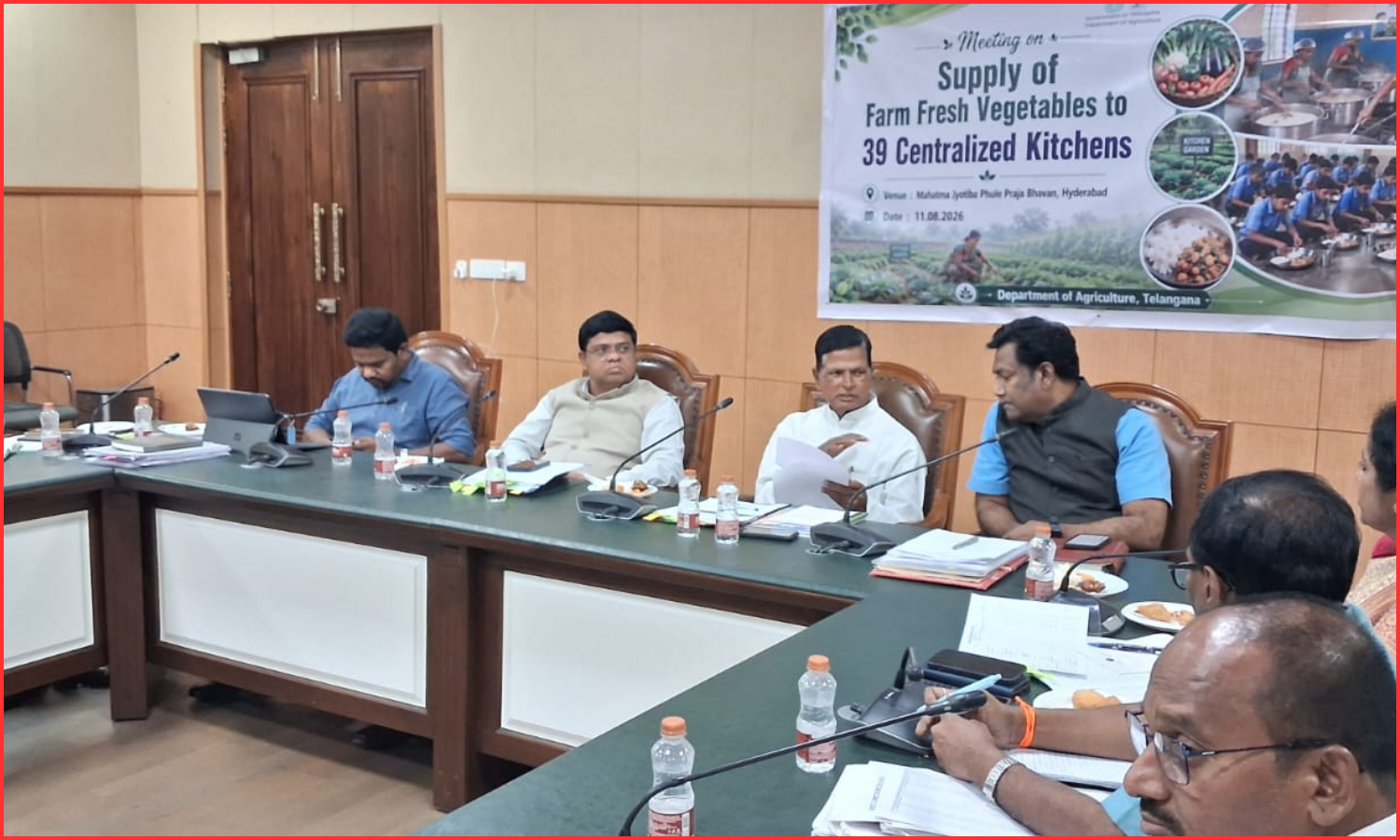
Hyderabad: Vegetable cultivation will be promoted around 39 centralised kitchens in Telangana to meet the daily needs of the State’s school breakfast programme.
A high-level meeting on the plan took place at Praja Bhavan on Tuesday. Dr. G. Chinna Reddy, Vice-Chairman of the State Planning Board and Chairman of the Expert Committee on agriculture, chaired the meeting.
The meeting followed directions from Chief Minister A. Revanth Reddy. It focused on creating a direct link between local farmers and organisations supplying food to rural school students.
The State plans to provide breakfast to about 20.50 lakh school and Intermediate students. Consequently, officials estimated that the programme would require nearly 1.20 lakh kg of vegetables every day.
The meeting examined ways to expand vegetable cultivation and establish a dependable supply chain. At the same time, it discussed measures to provide farmers with a stable market and better prices.
Officials from the Agriculture, Horticulture, Rural Development and Education departments attended the meeting. Representatives of the Hare Krishna Mission, Manna Foundation and Akshaya Patra also participated.
These organisations currently support food programmes for rural students. Therefore, officials discussed a system under which they could procure vegetables directly from local farmers.
Such direct procurement could reduce the role of intermediaries. Moreover, it could give farmers better market access and ensure a regular supply of fresh vegetables.
Vegetable cultivation plan to connect farmers with kitchens
The meeting decided to identify farmers in villages around the 39 centralised kitchens. The exercise will cover existing vegetable growers and farmers willing to take up vegetable cultivation.
Accordingly, Agriculture and Horticulture Department officials will identify suitable farmers at the field level. They will also create awareness about government schemes, subsidies and technical assistance.
Special attention will go to women farmers and rural women’s groups. In turn, the programme could create additional employment and income opportunities for them.
Field visits will take place from August 17 to 20. Agriculture, Horticulture, Rural Development and Education officials will participate in the exercise.
During these visits, officials will meet vegetable farmers, women farmers and rural women’s groups. They will assess requirements related to seeds, cultivation techniques, irrigation and marketing.
The teams will also collect details about procurement systems, expected prices and other support required for sustainable cultivation.
As a result, the field assessment will help determine vegetable availability near the kitchens. It will also indicate whether local farmers can meet their daily requirements.
District reports to guide vegetable procurement plan
District Agriculture Officers, District Horticulture Officers, District Rural Development Officers and District Education Officers will consolidate the field-level information.
The district reports must reach the State Government by August 22. Accordingly, Dr. Chinna Reddy directed officials to complete the assessment within the stipulated period.
The Expert Committee will meet again on August 22. It will examine the field reports and finalise the next course of action.
The committee will consider direct procurement from farmers and participation by women’s groups. In addition, it will examine the supply system for the 39 centralised kitchens.
Government assistance, seed availability, technical support, irrigation and other infrastructure requirements will also come under review.
Similarly, the committee will examine procurement, marketing and pricing mechanisms. The objective is to maintain a regular and uninterrupted supply of vegetables to the kitchens.
The proposed model aims to benefit farmers, women’s groups and students simultaneously. Farmers would gain a dependable market, while women’s groups could gain additional employment and income opportunities.
Meanwhile, students would receive fresh and nutritious vegetables through a reliable supply system. Food-service organisations would also gain a consistent source of raw material.
The initiative could encourage more rural farmers to take up vegetable cultivation. At the same time, direct procurement could reduce dependence on intermediaries.
Departments to coordinate action plan by August 22
Senior officials at the meeting included Agriculture Principal Secretary K. Surendra Mohan, Agriculture Director B. Gopi, Additional Director Vijay Kumar and School Education Director Naveen Nicholas.
Horticulture Joint Director Rama Lakshmi, SERP official Rajitha and representatives of the Hare Krishna Mission, Manna Foundation and Akshaya Patra also attended.
The officials discussed ways to strengthen coordination between departments and participating organisations. They also examined measures needed to make the proposed procurement system practical.
Finally, Dr. Chinna Reddy directed all departments to work together on the field-level assessment. He asked them to use the findings to prepare a comprehensive action plan by August 22.
The proposed system seeks to create a direct link between local farmers and centralised kitchens. It would also strengthen rural women’s groups while supporting the supply of nutritious food to schoolchildren.