

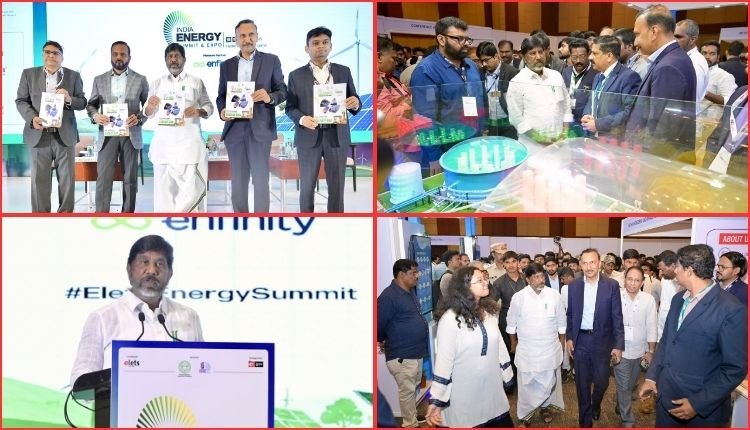
Hyderabad: Telangana planned to emerge as a major clean energy manufacturing centre while expanding solar capacity beyond 26,000 MW by 2035, Deputy Chief Minister Mallu Bhatti Vikramarka said on Tuesday.
The government also targeted 8,000 MW of energy storage capacity by 2035. Bhatti said the Telangana clean energy hub strategy would combine renewable power expansion with manufacturing, storage and emerging technologies.
He announced the targets while inaugurating the two-day India Energy Summit & Expo 2026 at HITEX and Novotel in Hyderabad. Industrialists, investors, innovators and technology experts attended the summit. During his address, Bhatti invited investors, scientists and corporate leaders to participate in Telangana’s growth.
“Investors, innovators, scientists, CEOs… I warmly invite all of you. Telangana is a state that promotes every kind of investment—it is truly a paradise for investors,” Bhatti said. “We are ready to share our growth and prosperity and welcome you wholeheartedly to grow with us,” he added.
Telangana clean energy hub targets solar expansion
Bhatti said the energy transition involved more than changing the source used to generate electricity. Instead, he described it as a transformation capable of reshaping the wider economic system.
Accordingly, Telangana wanted to move beyond being merely a consumer of clean energy. The government planned to develop the state into a global manufacturing hub for clean energy technologies.
The state had designed its energy plans to address rapidly increasing electricity demand while maintaining environmental sustainability, he said. Under the roadmap, Telangana targeted 20,000 MW of solar power capacity by 2030. Subsequently, the government planned to increase solar capacity beyond 26,000 MW by 2035.
Bhatti also stressed the role of energy storage in integrating renewable power into the electricity system. Therefore, the state planned substantial battery and pumped storage capacity. Telangana targeted 3,800 MW of energy storage capacity by 2030. The target would rise to 8,000 MW by 2035 through battery energy storage and pumped storage projects.
Telangana clean energy hub to use IT and AI strengths
The government also planned to use Hyderabad’s existing strengths in information technology and artificial intelligence to modernise the electricity network. Bhatti said the future power grid would be transformed into a digital network by leveraging IT and AI capabilities.
Meanwhile, the government planned a dedicated 100 MW renewable energy plant to support an AI data centre. The proposed facility would come up in the planned Bharat Future City.
The state also set a target to produce 400,000 tonnes of green hydrogen annually by 2030. In addition, Telangana planned to establish 12,000 electric vehicle charging stations by 2035. These targets formed part of the government’s wider strategy to expand the clean energy ecosystem while supporting new technologies and infrastructure.
Telangana clean energy hub offers manufacturing incentives
Bhatti said companies manufacturing solar, wind and battery components in Telangana would receive government incentives. The proposed support included capital assistance and reimbursement of State Goods and Services Tax. Eligible companies would also receive exemptions from electricity duty.
Additionally, the government would provide fast-track approvals through TG-iPASS to facilitate clean energy manufacturing investments in the state.
Bhatti said the Telangana clean energy hub transformation required strong cooperation between the government and private sector. He invited industrialists to partner with the state in implementing its energy transition plans.
The Deputy Chief Minister later visited various exhibition stalls at the summit. Energy Special Chief Secretary Navin Mittal and other officials also attended the programme.