

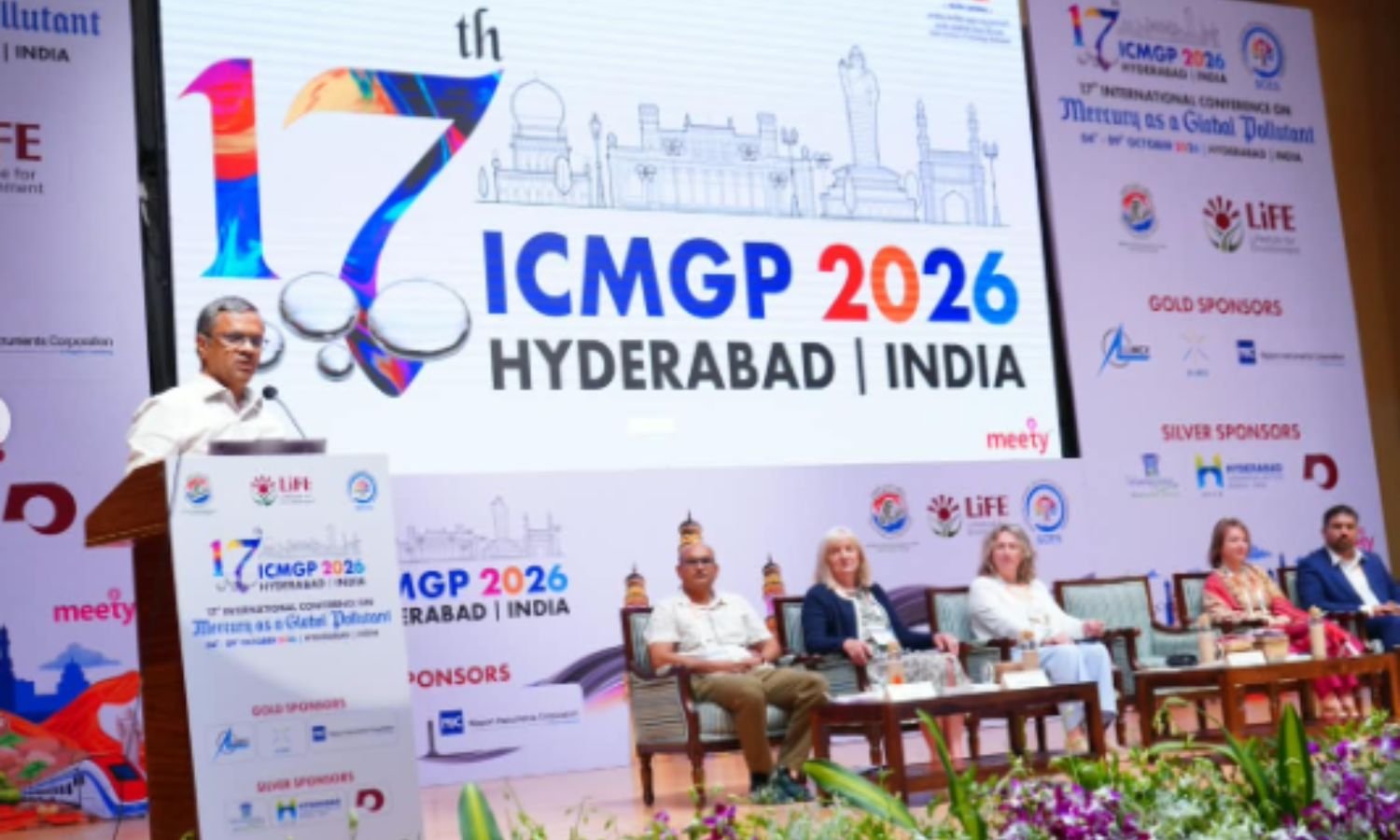
Hyderabad: A mercury pollution summit opened at IIT Hyderabad on Sunday to discuss global strategies against mercury contamination. The 17th International Conference on Mercury as a Global Pollutant, ICMGP 2026, began at the institute.
The conference will continue from October 4 to 9, bringing scientists, environmental experts and policymakers together. Researchers and representatives of international organisations from around 26 countries have joined the five-day event.
The conference is being held in India for the first time in its more than three-decade history. Participants are focusing on scientific research, environmental monitoring and policy measures to reduce mercury-related risks.
The main theme of the conference is “Minamata Convention – A Decade of Progress, Challenges and Future Action Plans”. The discussions will review the international agreement’s progress in reducing the toxic effects of mercury.
Participants will also examine strategies for the next decade. The conference aims to connect scientific findings with practical government policies and coordinated environmental action.
Professor Asif Qureshi of IIT Hyderabad, who chairs the conference, said the platform plays an important role in advancing mercury research. He said hosting the conference in India would strengthen participation from Asia and the Global South.
Qureshi also said the gathering could create new avenues for cooperation between countries and scientific disciplines. Meanwhile, conference co-chair Dr Jagannath Biswakarma, a senior British scientist and adjunct professor at IIT Hyderabad, stressed the need for policy action.
He said three decades of research had clarified how mercury moves through air, water and soil. Research has also established how mercury enters food chains and affects ecosystems and human health.
According to Biswakarma, research findings alone cannot address the problem. He said governments must convert scientific evidence into precise policies and practical action.
Mercury pollution summit examines key environmental threats
The mercury pollution summit will hold detailed discussions on mercury movement, environmental health, monitoring and modelling. Experts will examine how mercury travels through different environmental systems and reaches communities.
In particular, participants will discuss mercury use in cosmetics and small-scale traditional gold mining. The conference will also examine mercury emissions from the oil and natural gas sectors.
Another area of discussion will involve the use of mercury and lead in Ayurvedic medicine. Experts will consider the environmental and health implications of these practices during the week-long programme.
The conference will also examine mercury contamination in wetlands and its effects on glaciers. Researchers will further explore artificial intelligence and machine learning for analysing pollution patterns.
The organisers are seeking stronger links between laboratory research and government policy formulation. The discussions therefore aim to help policymakers use scientific evidence while developing environmental strategies.
The conference has brought together experts from multiple countries and scientific fields. Their discussions will focus on reviewing existing progress while identifying priorities for the coming decade.
The event also provides an opportunity to strengthen cooperation between Asian countries and the wider Global South. Researchers and policymakers are expected to exchange findings and examine possible areas for future collaboration.
By bringing scientific research and policy discussions together, the conference is focusing on coordinated responses to mercury pollution. The week-long programme will continue at IIT Hyderabad through October 9.