

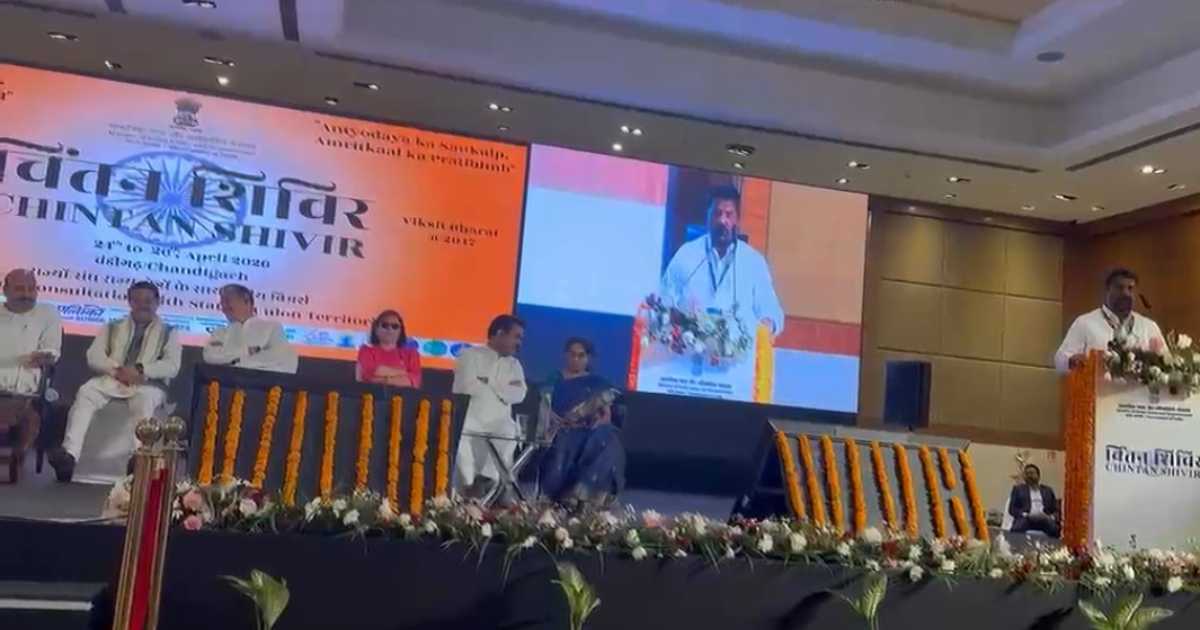
Hyderabad: Welfare Minister Adluri Laxman Kumar said the Telangana welfare model had emerged as a benchmark for other States, highlighting its scale and focus on inclusive development.
He made the remarks at the Chintan Shivir–2026, organised by the Union Ministry of Social Justice and Empowerment in Chandigarh on Sunday. The event brought together Ministers and senior officials to discuss social justice, welfare delivery, and the development of vulnerable groups.
Laxman Kumar said the Telangana welfare model was built on “equity, empowerment, and dignity” under Chief Minister A. Revanth Reddy. He added that renaming the social welfare department as the SC development department reflected a sharper focus on Dalit advancement.
The Minister stressed that education remained central to the Telangana welfare model. He said the government spent ₹574.74 crore on post-matric scholarships, benefiting 3.39 lakh students. In addition, ₹66.31 crore was allocated for pre-matric scholarships covering 73,666 students.
Telangana welfare model drives education and social support
He said the State invested ₹103.49 crore under the Dr B.R. Ambedkar Overseas Education Fund, supporting 564 students pursuing higher education abroad. Moreover, ₹24.53 crore was spent on TG SC Study Circles, enabling 2,426 aspirants to prepare for competitive examinations, including Civil Services.
Laxman Kumar said the government allocated ₹628.42 crore for SC hostels, benefiting 2.26 lakh students with free accommodation, food, and related facilities. He added that these measures strengthened access to education among disadvantaged communities.
The Minister also highlighted social welfare initiatives. He said ₹476.15 crore was disbursed under the Kalyana Lakshmi scheme, benefiting 47,539 people. Additionally, ₹43.06 crore was provided as incentives to 1,723 inter-caste couples to promote social integration.
He said the Telangana welfare model continued to prioritise marginalised groups, including Scheduled Castes, Scheduled Tribes, Backward Classes, persons with disabilities, senior citizens, and transgender persons.