

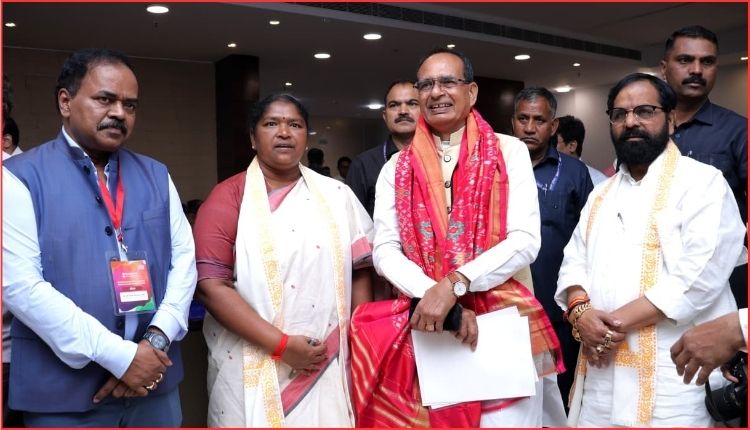
Hyderabad: Telangana on Monday urged the Centre to withdraw the proposed VBG Ramji Bill, saying several provisions would increase the financial burden on states and weaken the rights of rural workers. Rural Development and Panchayat Raj Minister Seethakka conveyed the state’s objections at a meeting of state Rural Development Ministers chaired by Union Minister Shivraj Singh Chouhan in New Delhi.
The minister also submitted a memorandum to the Union government outlining Telangana’s concerns. She said the state Cabinet would take a final decision on adopting the proposed law after reviewing the Cabinet Sub-Committee’s report on July 2.
According to Seethakka, the new funding pattern would sharply increase Telangana’s financial liability. She said the Centre had earlier borne the entire wage component under MGNREGS and 75 per cent of the material cost. However, the proposed 60:40 funding ratio would increase Telangana’s annual share to nearly Rs.2,000 crore.
VBG Ramji Bill draws Telangana objections
Seethakka said the proposed law would weaken the employment rights of rural workers. She also argued that it would reduce the powers of gram panchayats and limit the role of state governments. Moreover, she said the Centre should not centralise planning, fund allocation, implementation and monitoring.
The minister said Telangana wanted MGNREGS to continue as a rights-based programme. Therefore, the state requested the Centre to withdraw the proposed legislation.
She also opposed linking fund allocation only to the 16th Finance Commission’s recommendations. Instead, Telangana proposed that the Centre should consider actual employment demand. The state suggested giving 80 per cent weightage to employment generated during the previous five years and 20 per cent to the Finance Commission formula. She also sought special consideration for tribal, backward and Fifth Schedule areas.
VBG Ramji Bill concerns include funding and rural works
Seethakka urged the Centre to expand the list of permissible works under the proposed law. She recommended including Indiramma housing works, individual land development, post-flood restoration, nutrition gardens, bamboo plantations, vegetable cultivation structures, fodder development and work sheds. She also sought greater flexibility for states to approve projects based on local needs.
The minister opposed the proposed mandatory 60-day employment gap. She said mechanisation had already reduced rural employment opportunities. As a result, the restriction would adversely affect poor households. She also sought exemptions for tribal regions, drought-prone areas, plantation works and state housing schemes. In addition, Telangana requested a 90:10 Centre-State funding ratio for Fifth Schedule areas on the lines of northeastern states.
Telangana raises pending development issues
Apart from the VBG Ramji Bill, Seethakka raised several pending issues relating to Telangana. She urged the Centre to approve houses under PM Awas Yojana, saying the beneficiary survey had been completed two years ago.
She also sought faster forest and wildlife clearances for road projects sanctioned under the Pradhan Mantri Gram Sadak Yojana. According to the minister, delays had affected projects in Adilabad, Bhadradri Kothagudem, Mulugu, Nallamala and Kawal Tiger Reserve areas. She requested a mechanism to grant forest approvals along with road sanctions.
Further, Seethakka sought the release of pending Central funds for completed works. She said the Union Rural Development Minister had responded positively and assured discussions with the concerned ministries on forest clearance issues.
The minister reiterated that Telangana would take its final decision on the proposed law only after the state Cabinet meeting on July 2. She said the government would officially communicate its decision to the Centre after the Cabinet completed its deliberations.