
Telangana investment climate needs stronger institutions, fiscal health
By Dr Tamma Koti Reddy

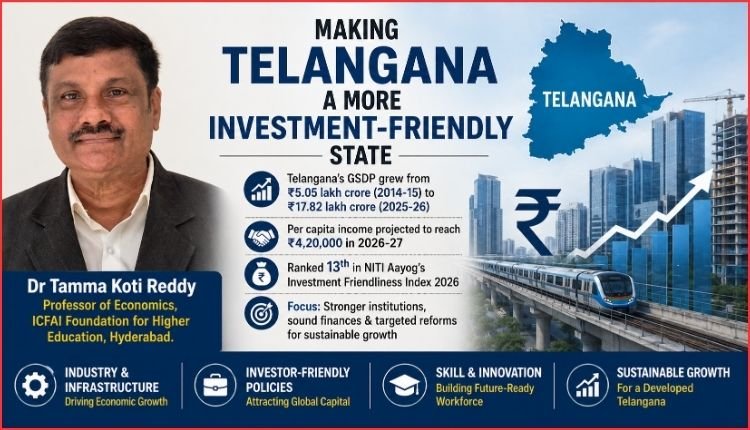
The investment -friendly environment created in Telangana state since its formation played a critical role in accelerating economic development. The average annual growth rate of GSDP in Telangana during 2014–15 to 2025–26 was 12.1% at current prices, which is higher than the national average. The service sector emerged as the fastest-growing sector with a compound annual growth rate of 14.14 percent since 2014-15. Telangana ranked sixth in FDI inflows in 2024-25, but remains well behind Maharashtra, Karnataka, Gujarat, Delhi, and Tamil Nadu. Hyderabad emerged as the major hub for FDI inflows, accounting for 93 percent of FDI inflows attracted by Telangana in 2024-25. FDI inflows into Telangana stood at 13.02 billion dollars during Oct 2019-March 2026. The major exports from Telangana are drugs & pharmaceuticals, Engineering goods, organic& inorganic chemicals, and electronic goods. Computer software and hardware, drugs& pharmaceuticals, and electronic goods occupied the lion’s share of foreign capital and export volume. After 2014, government policies resulted in significant economic growth. The Gross State Domestic Product (GSDP) increased from ₹5.05 lakh crore in 2014–15 to ₹17.82 lakh crore in 2025–26 and is expected to be ₹19,61,701 lakh crore (approximately ₹19.62 lakh crore) for 2026–27.
Per Capita Income grew from ₹1,24,104 in 2014-15 to ₹2,20,201 in 2020-21, and is projected to reach ₹4,20,000 in 2026-27. Telangana’s share in India’s GDP stood at 4.10% in 2014-15 and rose to 5.14 % in 2025-26. Telangana’s GSDP growth at current prices recorded an average of roughly 13% between 2014-15 and 2025-26. Notably, Telangana’s GSDP growth has remained consistently higher than the national average post-2014. To strengthen its ecosystem, the Telangana government has focused on the development of metro rail, futuristic future cities, and industrial hubs, with the aim of accelerating Telangana’s transition towards a developed economy through increased investment inflows.
NITI Aayog’s Investment Friendliness Index 2026:
Keeping in mind the importance of promoting competitive and co-operative federalism, the Union government has announced in the Union Budget 2025-26 for the development of an Investment Friendliness Index. The index comprises indicators across 8 pillars with a highest weightage of Infrastructure (25%), followed by business climate (20%), resources (15%), regulatory ease (12%), government policy (10%), financial health (7%), institutional environment (6%), and environment resilience (5%).
The states and union territories have been classified into 4 categories based on their performance, such as top performers (scores above 50), front-runners (45-50), emerging performers(40-45), and aspiring states(below 40). The Investment Friendliness Index shows considerable variation in the performance of States and Union Territories. Gujarat is in first place with a score of 56.6, Maharashtra comes next at 53.7, and Tamil Nadu is at 53.3. Goa is fourth with 53.1, Odisha is fifth with 52.4. Delhi is sixth with a score of 49.9, and Madhya Pradesh follows at 48.9. Andhra Pradesh and Karnataka are both in eighth position, each having a score of 48.7. Rajasthan is tenth with 48.1, while Uttarakhand and Chhattisgarh share the eleventh position with 47.5. Telangana is thirteenth with a score of 47.3 and thus is among the leading states.
The Telangana state’s performance was driven by time-bound industrial approvals, availability of land and other resources, higher own tax revenue (17 percent of GSDP) than the national average of 9.8 percent of GDP, better Infrastructure, a favorable business environment, enrollment in STEM education higher than the national average, and industrial development in and around Hyderabad City.
Telangana performed well in indicators such as Infrastructure, business climate, resources, regulatory ease, government policy, and environmental resilience, but its performance on indicators like institutional environment and financial health was relatively weaker. These two indicators prevented the state from being placed in the top performers category. High cybercrime rate and high economic crime rate reduced Telangana’s institutional environment score, while outstanding liabilities and fiscal deficit reduced the financial health score.
To improve its overall rating and aim to be the best-performing state in the Investment Friendliness Index in the coming years, the Telangana government should strengthen its institutional framework and improve key financial health indicators. The institutional framework could be strengthened by introducing more effective measures to prevent cybercrime and economic offenses, and the government’s financial position could be improved by practicing sound fiscal management, such as reducing both its existing liabilities and the fiscal deficit. These measures would enhance investor confidence, strengthen the state’s economic fundamentals, and create a more conducive environment for investment and sustainable growth. Telangana needs to further strengthen its respective areas of comparative advantage and should identify the dimensions in which it performs relatively poorly and establish clear, measurable, and time-bound reform targets to address these weaknesses. This Index should be viewed not merely as a ranking table but as a mirror reflecting the progress and shortcomings of states in their reform journey.
–The Author of the article is a Financial and Economic Expert