

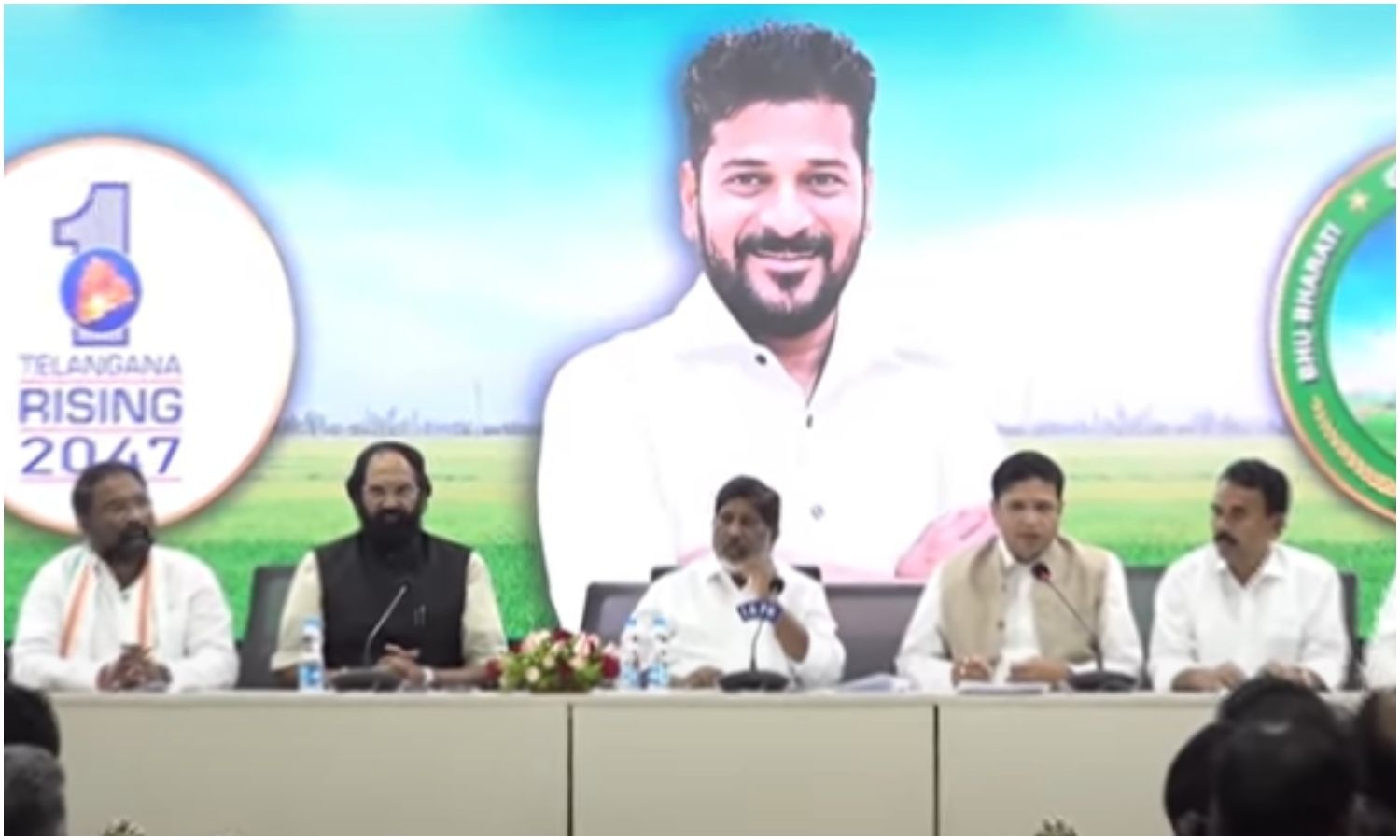
Hyderabad: Telangana cabinet decisions on Tuesday brought major changes to urban governance and the power sector. The cabinet, chaired by Chief Minister Revanth Reddy at Dr B.R. Ambedkar Telangana Secretariat, approved the merger of 27 urban local bodies with the Greater Hyderabad Municipal Corporation. It also cleared projects that reshape electricity distribution, renewable procurement, and industrial power policy.
The government moved to integrate municipalities and municipal corporations located inside and around the Outer Ring Road with GHMC. It also initiated amendments to the GHMC Act and the Telangana Municipal Act to support the merger. Ministers Mallu Bhatti Vikramarka, D. Sridhar Babu, N. Uttam Kumar Reddy, Jupally Krishna Rao, Vakiti Srihari, and Adluri Laxman later explained the decisions to the media.
Power reforms under Telangana cabinet decisions
The cabinet approved an underground electricity cable network for Hyderabad. The project carries an estimated cost of ₹14,725 crore. Authorities will execute the work in three segments based on existing electricity circles. The government expects the new system to improve supply stability and reduce weather-related disruptions.
The cabinet also created a third distribution company. NPDCL and SPDCL will continue to function, while the new DISCOM will handle agricultural power, lift irrigation schemes, Mission Bhagiratha, safe drinking water projects, and Hyderabad Metropolitan Water Supply and Sewerage Board power needs.
The cabinet reviewed long-term demand forecasts and renewable-energy requirements. It resolved to increase green-energy use as per central guidelines. Because of this, the government will invite tenders for 3,000 MW of solar power through five-year supply agreements. It will also call tenders for 2,000 MW of pumped-storage power under similar terms.
The cabinet cleared permissions for companies seeking to set up pumped-storage plants. It directed officials to study existing MoUs. Further, it approved plans for pumped-storage projects totalling 10,000 MW. The government will allot land and water to interested firms. These plants must supply power first to state DISCOMs under agreed conditions.
Industry policy changes under Telangana cabinet decisions
The cabinet expanded the clean and green energy policy to attract new industries. Units may now produce their own power. Approvals for captive generation will be issued immediately. There is no cap on generation capacity.
The cabinet approved an 800-MW unit at Ramagundam Thermal Power Station under NTPC supervision. It also asked officials to assess NTPC-led options at Palvoncha and Makthal.
The government allotted 20.28 acres at Peddanallabelli in Dummugudem mandal of Bhadradri Kothagudem district for an SC, ST, BC Young India Integrated Residential School. It also allotted 40 acres for a sports school at Jaggannapet in Mulugu district. In addition, six ITIs, including one at Jubilee Hills, will move to Advanced Training Centre status.