

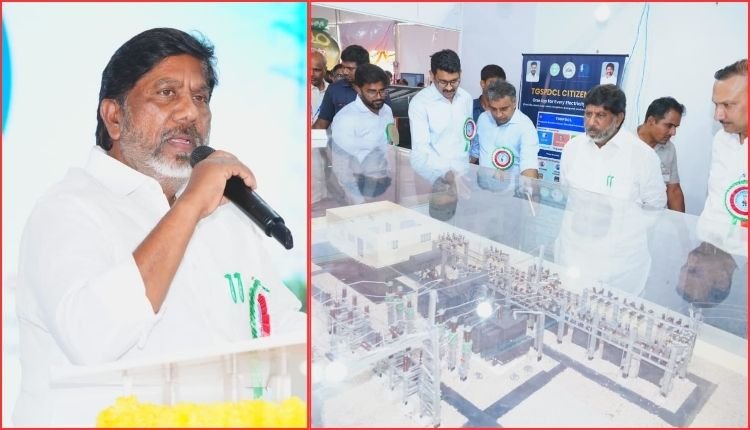
Hyderabad: Deputy Chief Minister Bhatti Vikramarka on Saturday said the government would strengthen Telangana power infrastructure to meet rising industrial demand and support its $3 trillion economy target by 2047.
He said Telangana had emerged as one of the country’s preferred investment destinations. Therefore, the government had committed to providing industries with adequate power, water and other essential infrastructure.
Bhatti invited companies and investors from across India to invest in Telangana’s manufacturing and services sectors. He said the government was preparing long-term plans to anticipate electricity requirements before demand increased further.
The plans covered thermal, solar and hydel power generation. They also included pumped storage and battery storage systems to strengthen generation and supply capacity. The Deputy Chief Minister made the remarks after inaugurating Power Exhibition–2026 at People’s Plaza on Necklace Road in Hyderabad. SPDCL organised the exhibition.
Telangana power infrastructure planned up to 2047
Bhatti said officials had received instructions to prepare Telangana power infrastructure plans with targets extending up to 2047. He said advance preparation was essential because electricity demand would continue rising alongside industrial and economic growth.
According to him, the government wanted the power sector to prepare for future requirements rather than react after demand increased. Telangana’s peak electricity demand had earlier stood at about 13,000 MW, he said. However, it had now crossed 18,000 MW.
Despite that sharp increase, Bhatti said the government had continued to provide uninterrupted electricity without major difficulties for consumers. He credited improvements in the transmission network, advance planning and timely power procurement for maintaining supply.
As a result, power utilities had handled the increased load without interruptions, he said. Bhatti said stronger transmission capacity remained an important part of the government’s strategy.
In addition, officials were assessing future generation and procurement requirements to ensure adequate supply.
Power planning linked to industrial growth
Bhatti said infrastructure expansion had to keep pace with industrial development. Therefore, the government had linked electricity planning with its broader economic targets. The administration was working towards transforming Telangana into a $3 trillion economy by 2047, he said.
Bhatti added that a stronger power network would be necessary to support manufacturing, services and other expanding sectors. He said the government wanted industries to invest in Telangana without concerns over power or water shortages.
Accordingly, he invited investors from different parts of the country to consider Telangana for manufacturing and service-sector projects. He said the government would provide the infrastructure required for industrial expansion.
Telangana power infrastructure to include green energy
Bhatti said the government was expanding Telangana power infrastructure through both conventional and renewable energy sources. Thermal power would remain part of the energy mix, while the government would also give priority to green energy, he said.
Accordingly, the state was taking steps to increase solar and hydel generation capacity. The government was also planning greater pumped storage capacity. In addition, battery storage systems formed part of its future electricity strategy.
Bhatti said these measures would help Telangana prepare for changing power requirements. They would also strengthen the electricity system’s ability to respond to rising consumption.
He said future planning would cover both generation and supply capabilities. Therefore, officials had been asked to begin preparations now instead of waiting for demand to rise further.
Power Exhibition highlights reforms and technology
Bhatti said Power Exhibition–2026 aimed to increase public awareness about the electricity sector. He said the exhibition particularly sought to familiarise students with the achievements of the Power department.
It also highlighted reforms in the sector and showcased the use of modern technology. The Deputy Chief Minister appreciated Power department employees for their contribution to Telangana’s development.
He said their work often remained outside public attention. However, their services played an important role in supporting the state’s growth. Bhatti said reliable electricity supported households, industries and wider economic activity.
He again cited the rise in peak demand from nearly 13,000 MW to more than 18,000 MW. However, improved transmission, timely procurement and advance planning had helped the state maintain uninterrupted supply, he said.
Long-term capacity expansion on agenda
Bhatti said the government had instructed officials to assess electricity needs up to 2047. Those projections would guide future expansion of generation, transmission and storage facilities.
The long-term strategy would combine thermal generation with solar, hydel, pumped storage and battery storage capacity, he said. Bhatti maintained that stronger Telangana power infrastructure would be critical as the state attracted new industries and pursued its long-term economic target.