

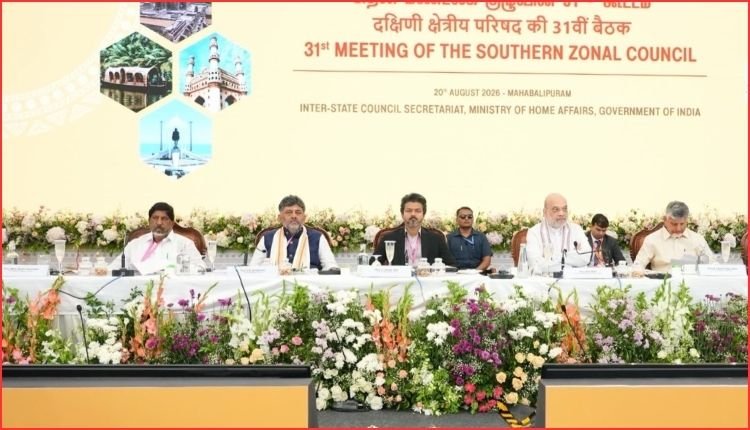
Hyderabad: Deputy Chief Minister Bhatti Vikramarka Mallu sought time-bound and legally sustainable resolution of Telangana issues at the 31st Southern Zonal Council in Mahabalipuram. He also pressed for fair Krishna water rights and Central assistance for major irrigation projects.
Bhatti said Telangana wanted pending interstate disputes to move beyond prolonged discussions towards final decisions and effective implementation. He stressed that established legal mechanisms should determine issues where legitimate interests of states differed.
The Deputy Chief Minister described the Southern Zonal Council as an important institution of cooperative federalism. He said it provided a forum to resolve issues between the Centre and states and among states themselves.
Referring to Mahabalipuram’s enduring monuments, Bhatti said a strong structure did not require every part to be identical. Instead, every part needed to carry its share of the weight.
He said India’s federal structure should operate on the same principle. A federation was not truly tested when everyone agreed, he added. Rather, its strength emerged when legitimate interests collided and institutions still found a fair solution.
Telangana issues require fair federal mechanisms
Bhatti said states naturally competed for investment, industries, employment and talent. However, he stressed that such competition needed to coexist with cooperation. Several major challenges crossed state boundaries, he said. Rivers, power grids, workers and businesses all moved across borders.
“Problems cross borders faster than government files do,” Bhatti observed while highlighting the need for effective interstate institutions. Therefore, he said forums such as the Southern Zonal Council remained necessary because of the growing interdependence among states.
For Telangana, cooperative federalism had a practical meaning. Bhatti said rules should remain clear, dispute-resolution institutions should command respect and the same rules should apply to every state.
He said disagreement was natural in a democracy. However, the real test was whether governments could convert disagreement into decisions.
Telangana issues include fair Krishna water entitlement
Bhatti said Telangana had not sought any special privilege over Krishna waters. Instead, the state wanted its fair entitlement through legal mechanisms already established for resolving the dispute.
Telangana also sought protection against unilateral actions that could prejudice the rights of downstream states. The Deputy Chief Minister said established adjudicatory mechanisms should be respected. Moreover, authorities should apply the same principles to all riparian states.
On the Palamuru-Rangareddy Lift Irrigation Scheme and Nakkalagandi Lift Irrigation Scheme, Telangana reiterated its lower-riparian rights over surplus waters.
The allocation of Krishna waters between Telangana and Andhra Pradesh was already before the Krishna Water Disputes Tribunal-II. Therefore, Telangana wanted the dispute addressed through the established legal and adjudicatory process.
Telangana issues cover Central irrigation support
Bhatti sought Central financial support for the Kaleshwaram project and the Palamuru-Rangareddy Lift Irrigation Scheme. Regarding Kaleshwaram, he said Telangana was pursuing rehabilitation of the barrages. The state was also taking forward the revival of the Pranahita-Chevella project at Tummidihetti.
For Palamuru-Rangareddy, Telangana sought Central assistance to complete the remaining works. It also requested support to make the irrigation project fully operational. The state placed these demands before the council as part of its broader position on irrigation development and water security.
Bhatti said several matters remained unresolved 12 years after the Andhra Pradesh Reorganisation Act, 2014. Telangana wanted these disputes closed according to the Reorganisation Act and applicable law. It also sought solutions that would allow both successor states to move forward.
The Deputy Chief Minister opposed allowing the process to continue through endless correspondence. He also cautioned against introducing fresh interpretations of the issues every few years. Instead, Telangana wanted the long-pending reorganisation matters to reach final decisions and move into implementation.
One unresolved matter involved the division of government companies and corporations listed under Schedule IX of the Reorganisation Act.
Differences over headquarters and related questions had delayed the division of these institutions. Telangana had already submitted its views concerning 23 Schedule IX institutions to the Union Home Ministry.
The state expressed willingness to settle the issue under the Andhra Pradesh Reorganisation Act, 2014. It also agreed to proceed based on the approach suggested by the Home Ministry and Union Home Minister.
However, Telangana maintained that any early settlement must remain within the statutory framework. Bhatti also raised the bifurcation dispute involving institutions listed under Schedule X.
Andhra Pradesh had sought division of the assets of certain Schedule X institutions. However, Telangana maintained that the Reorganisation Act did not support those claims, except for continuation of facilities under Section 75.
The dispute was also pending before the Andhra Pradesh High Court. Therefore, Telangana sought a resolution through the legal process and in accordance with the provisions of the Reorganisation Act.
The state’s broader position was that statutory provisions and established legal mechanisms should guide the settlement of bifurcation disputes.
Southern states urged to deepen cooperation
Bhatti said cooperation among southern states would become increasingly important as they confronted a new generation of common challenges.
He identified water security, energy, climate resilience and urbanisation among the major issues crossing state boundaries. Logistics and economic competitiveness would also require greater interstate coordination.
Southern states would consequently need to cooperate even while competing economically, he said.
“If southern India grows together, India grows faster,” Bhatti said.
His broader argument was that cooperative federalism did not require states to have identical interests. Instead, it required institutions capable of reconciling competing interests fairly, legally and effectively.
Telangana offers to host next Southern Zonal Council
Bhatti also offered Hyderabad as the venue for the 32nd Southern Zonal Council meeting. He noted that meetings held since Telangana’s formation had taken place in Andhra Pradesh, Kerala and Karnataka. Andhra Pradesh and Kerala later hosted the council again, while Tamil Nadu hosted the present meeting.
Telangana, therefore, offered to host the next meeting in Hyderabad. Bhatti expressed hope that the venue issue could be settled “without a tribunal, without a committee, and perhaps even without another round of correspondence.”
Telangana also assured the participating states of warm hospitality and genuine cooperative federalism. Overall, Bhatti presented Telangana’s position as firm on protecting the state’s legitimate interests while remaining constructive in finding solutions.
He sought fair protection of Telangana’s Krishna water rights and Central support for major irrigation projects. In addition, he demanded time-bound closure of unresolved reorganisation matters.
The Deputy Chief Minister also stressed strict adherence to the Andhra Pradesh Reorganisation Act and established legal mechanisms. He called for equal application of rules to all states.
At the same time, Telangana advocated stronger southern cooperation on water, energy, climate, urbanisation, logistics and economic competitiveness.
Bhatti said the Southern Zonal Council should ultimately move from discussion towards decisions and implementation while resolving Telangana issues and other interstate matters.