

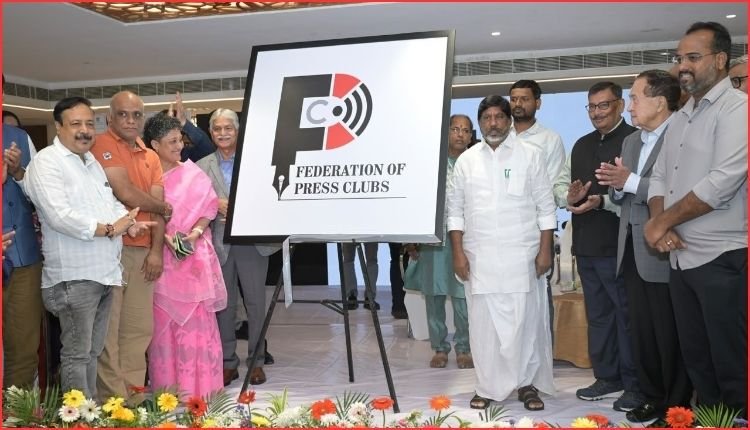
Hyderabad: Deputy Chief Minister Mallu Bhatti Vikramarka on Saturday said a free press democracy framework was essential to hold those in power accountable and protect democratic institutions. He said governments must have the courage to accept criticism from journalists.
Bhatti made the remarks while formally launching the Federation of Press Clubs in Hyderabad. The Federation brought together representatives of eight Press Clubs from different parts of the country.
He urged journalists to question governments and public authorities without compromising professional standards. “Do not spare those in power. Hold us accountable, but never compromise on professional standards. Ultimately, the benefit must go to the citizen,” Bhatti said.
Free press democracy rooted in India’s history
Bhatti said the tradition of free press democracy had deep roots in India’s freedom movement. He recalled the role played by Mahatma Gandhi, Dr. B.R. Ambedkar and Bal Gangadhar Tilak through journalism and public communication.
According to him, journalism had served as an important force during the struggle against colonial rule. Bhatti also referred to former Prime Minister Jawaharlal Nehru’s message to cartoonist Shankar.
He cited the well-known remark, “Don’t spare me, Shankar,” to underline the importance of criticism in public life. Bhatti said journalists should continue questioning people in authority with the same independence.
However, he stressed that professional standards should remain central to all reporting. The Deputy Chief Minister said credibility had become journalism’s most valuable asset in the digital and artificial intelligence era.
He said misinformation could spread rapidly through online platforms. In addition, he warned that deepfakes had created new challenges for journalists and news organisations. Bhatti said these developments made verification and credibility more important than ever.
He urged journalists to maintain accuracy and public trust while adapting to new technologies. According to him, journalism would retain its democratic value only when citizens trusted the information it provided.
Federation urged to protect journalists
Bhatti also asked the Federation of Press Clubs to focus on the safety, dignity and welfare of journalists. He particularly referred to reporters working in districts and rural areas. The Deputy Chief Minister described local journalists as the government’s “best early warning system” when authorities were willing to listen.
He said district and rural reporters often identified public problems at an early stage. Therefore, governments could benefit from paying attention to issues highlighted through local journalism.
Bhatti said the Federation should work to strengthen support systems for journalists operating outside major cities. He stressed that their working conditions and welfare required sustained attention.
Free press democracy must challenge discrimination
Bhatti also raised concerns over continuing social discrimination while speaking about the role of free press democracy. He referred to reports of a “purification” ritual after Congress president Mallikarjun Kharge attended a meeting at Ramlila Maidan in Haldwani.
Bhatti questioned why such discrimination persisted decades after Independence. He said journalism had a responsibility to expose practices that undermined equality and constitutional values.
The Deputy Chief Minister maintained that journalists should challenge those in power while keeping citizens’ interests at the centre of their work. He said criticism, accountability and professional integrity strengthened democratic governance.
Bhatti added that a fearless press remained necessary as technology transformed the way information reached the public. He said journalists should protect credibility while confronting misinformation, deepfakes and other emerging threats.
The Deputy Chief Minister reiterated that governments should accept scrutiny instead of resisting it. He said a strong free press democracy culture ultimately benefited citizens by improving accountability and public administration.