
India’s Fiscal Federalism in Comparative Perspective: Lessons from Developed and Emerging Economies
Dr Tamma Koti Reddy

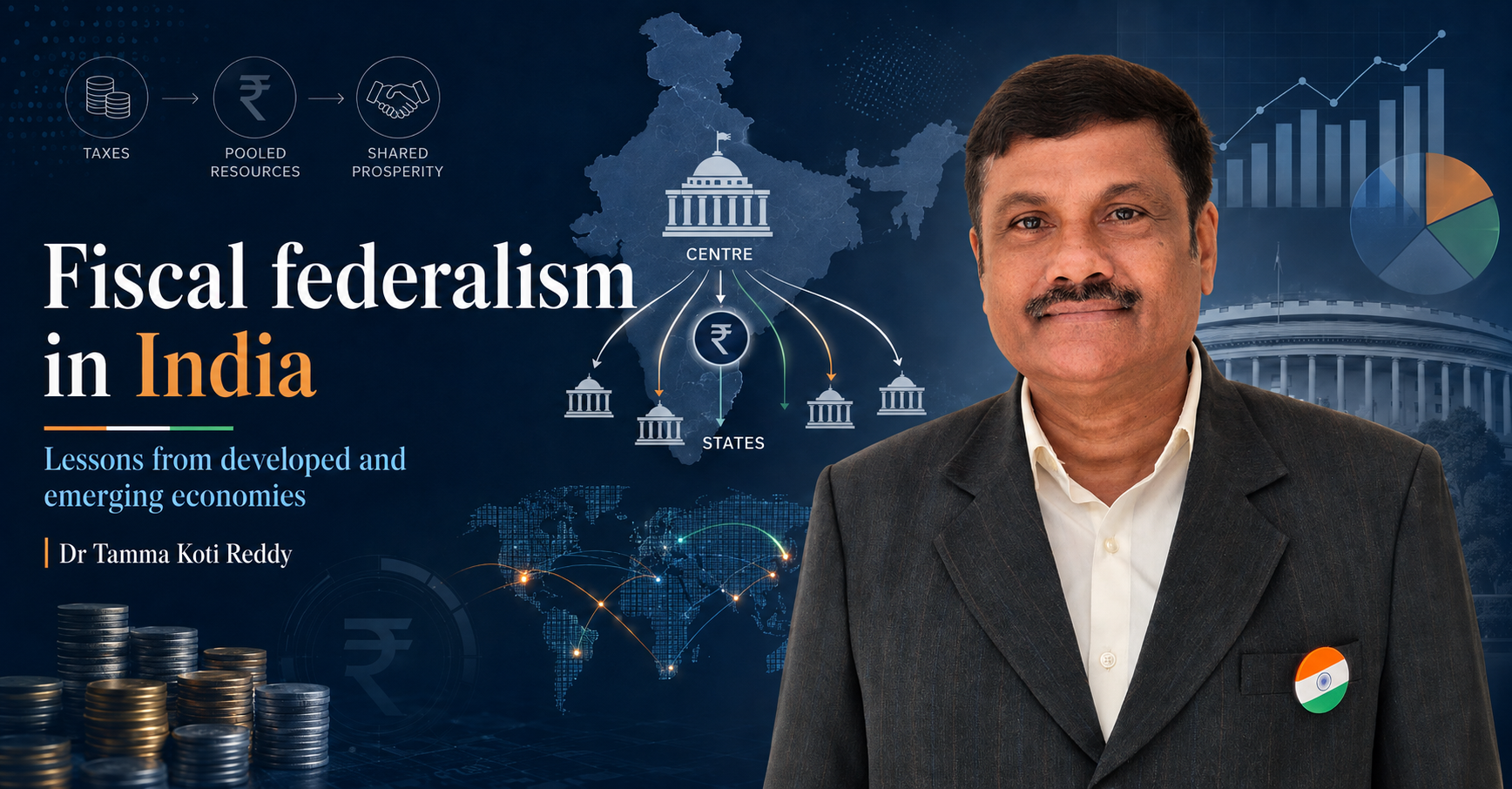
The features of Fiscal Federalism differ across economies due to variations in economic development, constitutional design, distribution of tax revenue and spending powers, equalization, mechanisms, and political backgrounds. Fiscal Federalism determines the raising and sharing of resources, as well as the allocation of expenditures across different levels of government.
In India, legislative and fiscal powers are divided between the Union list, the State list, and the Concurrent list. The central government controls more productive sources of taxation, and the responsibility of spending on key areas such as Agriculture, Rural development, health, education, and public delivery services was left to the state governments. Indian states have less fiscal autonomy and depend heavily on the central transfers. The Finance Commission is a structured transfer system in India that recommends tax sharing between the Union and State governments, recommends grants-in-aid to states, determines the distribution of funds across states, and suggests measures to improve the finances of local bodies.
India’s fiscal system is relatively centralized as compared with Developed and Emerging economies such as the USA, Canada, Germany, Australia, and Brazil. The effective Fiscal Federalism assumes significance during the post-reform period as the states emerged as key drivers of economic growth. The fiscal federal framework of India can be strengthened by adopting successful practices followed in Developed and emerging economies.
Fiscal Federalism Framework in Developed Countries:
In the Developed economies like the USA, Canada, and Germany, there was a great tax autonomy to states and provinces. The sub-national governments in these countries can raise a larger proportion of their own revenue, whereas in India, states depend heavily on central transfers. The most decentralized fiscal systems exist in the USA as compared with those of Developed economies. Tax on Income, Corporate, and Imports is levied by the Federal government and redistributed across the states in the form of Grants. Grants in the USA can be categorized as Categorical grants(for specific purposes) and Block grants, which involve few rules, allowing the states to decide and spend on various activities. In the USA, the revenue sources of local governments include local sales tax, local income tax, which is allowed by some states, and property tax.
Canada is one of the most developed systems of intergovernmental fiscal relations in the world. The federal government in Canada collects personal income tax, corporate income tax, GST, excise duties, and customs duties. The federal government transfers funds to provinces under the Equalization program, the Canada Health Program, and the Canada Social Transfer. The provincial governments in Canada collect provincial income taxes, provincial sales tax, and resource royalties, etc. Municipalities depend heavily on property taxes and also transfers from the federal government. Germany is considered one of the strongest fiscal equalization systems in the world and follows an integrated fiscal system. Germany relies heavily on shared taxes, and local governments are financially strong. The main strength of the country is Cooperative Federalism and fiscal equalization. Revenue from personal income tax, corporate tax, and value-added tax(VAT) will be distributed between the Federal government, states, and local governments. In Germany, though the states have limited taxation power, cooperative decision-making assumes significance.
Fiscal Federalism in Emerging Economies:
Fiscal Federalism differs significantly among the quasi-federal systems of India, Brazil, and South Africa. In Brazil, states and Municipalities have greater tax autonomy, whereas in South Africa, provinces depend heavily on national transfers. In both these economies, there was greater flexibility for sub-national governments with regard to managing expenditures and local development priorities. South Africa is a unitary state with decentralized fiscal governance based on the Constitution of 1996 and the principle of cooperative governance. The National government collects huge revenue through personal income tax, corporate tax, VAT, excise, and customs duties.
Provinces in South Africa have very limited powers in terms of raising their own revenue. Municipalities in South Africa collect service charges, local levies, and property taxes. The national government redistributes funds through the Division of Revenue Act, guided by the Constitution. Transfers from the National government can be categorized as equitable share(unconditional on formula-based), conditional(for specific national priorities), and infrastructure and special-purpose grants. In South Africa, though the revenue is centralized, the spending responsibilities are decentralized. The cooperative governance mechanism of South Africa coordinates budgets and policies among the national government, provinces, and municipalities.
Strengthening India’s Fiscal Federalism:
From the above analysis, it is inferred that India needs reforms to strengthen cooperative Federalism and improve developmental outcomes. To achieve the goals like efficiency in resource allocation, fiscal equalization, fiscal autonomy, fiscal discipline, macroeconomic stability, and transparency in administration, an effective system of fiscal Federalism is essential. India’s federal fiscal structure shows stress due to vertical fiscal imbalances, raising the national debt, and overlapping responsibilities. There is a need to correct the vertical fiscal imbalances between the union and states in India. Appropriate steps, such as the rationalization of GST rules and more autonomy in terms of tax on fuel and property, are required for enhancing the state government’s revenue sources. For accountability and efficiency, strengthening the state government’s own tax revenue is essential. India should consider formula-based transfers in a similar line to Canada to reduce political discretion.
Rationalizing the center-state schemes(specifying the responsibilities clearly), implementation of the 73rd and 74th constitutional amendments, introducing countercyclical borrowing rules, improving transparency in off-budget borrowing, improving a technology-based tax compliance system, shifting from line-item budgeting to performance budgeting, improving ease of doing business at the state level, and stronger independent fiscal councils are the steps needed to have a transparent and accountable federal structure in India. The fiscal federalism system will be effective when states and local governments exercise real revenue power and ensure that decentralization doesn’t worsen the regional imbalances. Though India follows an equalization mechanism through the Finance Commission, there is a need to reduce ad hoc transfers from various Ministries to some of the states in India on political grounds.
The principle of equalization should focus on guaranteeing comparable standards in socio-economic indicators across the regions of the country. The central transfers to states and local governments prioritizing the service delivery should be linked to defining the minimum benchmarks in education, health, and basic infrastructure. India should consider the fiscal federalism characteristics of Germany to strengthen the cooperative institutions and also predict the fiscal sharing accurately. In similar lines to South Africa, India should focus on empowering the local governments, equalization of public services across the regions, and formulating better outcome-based budgeting. States should be treated as equal partners in the federal structure of India to accelerate inclusive growth
[Dr Tamma Koti Reddy is the Vice Chancellor (In-charge), ICFAI Foundation for Higher Education, a deemed-to-be university in Hyderabad.]