
Decentralised water management key to Hyderabad’s future: GHMC Commissioner

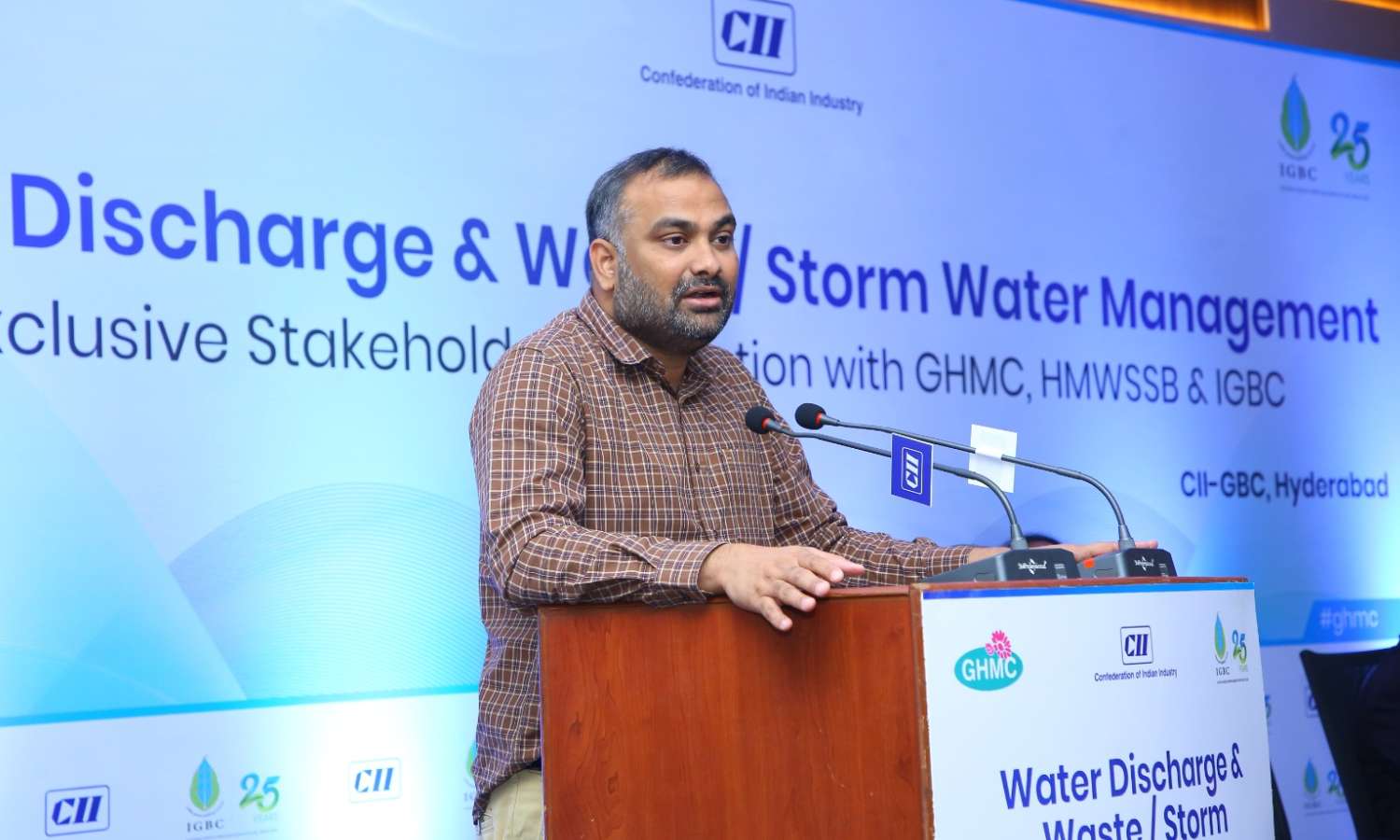
Hyderabad: Greater Hyderabad Municipal Corporation (GHMC) Commissioner R.V. Karnan on Thursday said decentralised water management is crucial for Hyderabad’s long-term water security, flood control, and environmental protection.
Speaking at a stakeholder interaction and brainstorming session jointly organised by GHMC and the Indian Green Building Council (IGBC) at the CII–Sohrabji Green Business Centre, Karnan emphasised the need to manage stormwater and sewage through decentralised systems. The session focused on practical solutions for wastewater reuse, rainwater harvesting, and reduced load on city drains.
Residential and commercial projects must evolve into water hubs
The Commissioner said that residential and commercial projects can no longer remain just consumers of municipal services. “They must function as water producers, storage hubs, and reuse centres. If properly managed, they can act as buffers during intense rainfall and reduce flood risk. If neglected, they will burden public infrastructure,” he warned.
The session was attended by representatives from CREDAI, NAREDCO, IPA, IIA, UFERWAS, NGOs, technical experts, and domain specialists, who shared actionable suggestions on policy, STP (sewage treatment plant) challenges, and incentive-based models to promote decentralised practices.
Karnan also highlighted the need for upgrading drainage systems, protecting lakes and nalas, and improving the city’s resilience through inclusive planning. He noted that GHMC had already invested heavily in strengthening stormwater drains and sewage infrastructure in recent years. However, he said infrastructure alone cannot tackle rapid urbanisation and climate change impacts.
“In decentralised systems, stored and reused water becomes our first shield against floods. Developers, industries, RWAs, and facility managers must step forward together. Livability will soon be Hyderabad’s defining indicator,” Karnan said.
IGBC, GHMC to deepen engagement on policy and training
GHMC Additional Commissioner Anuraag Jayanti said public-private collaboration is vital to sustainable urban governance. “Many implementable ideas were proposed by stakeholders today. We will study them in detail and work with IGBC to host more brainstorming and training sessions. RWAs must take the lead in expanding sustainable practices,” he said.
The government is expected to conduct further consultations to convert these stakeholder inputs into actionable frameworks.