

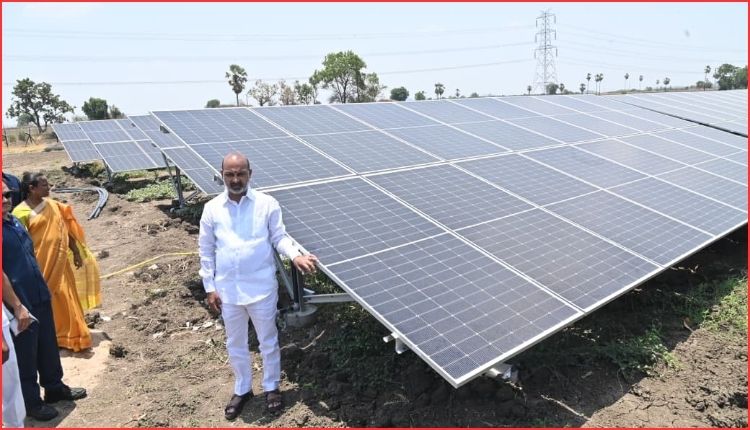
Hyderabad: Union Minister Bandi Sanjay Kumar urged cooperative societies across Telangana to establish PM-KUSUM solar plants, stating that a 1-megawatt project can generate nearly ₹50 lakh in annual income.
During a visit to Choppadandi, he inspected a solar power plant under development and reviewed project financing and implementation details.
The minister said the Centre is encouraging cooperative societies to invest in renewable energy projects. He added that NABARD is providing financial assistance to support such initiatives. According to Bandi Sanjay, the Choppadandi project is the first cooperative solar plant in the Karimnagar Parliamentary constituency.
PM-KUSUM solar plants offer low-interest financing
Explaining the financial model, the minister said a 1-MW solar plant requires an investment of ₹3.80 crore. Under the scheme, a cooperative society contributes ₹40 lakh. NABARD finances the remaining ₹3.40 crore through loans.
The loan carries an interest rate of 4 percent. However, societies that make regular EMI payments receive a 3 percent rebate. As a result, the effective interest rate drops to just 1 percent.
Furthermore, Bandi Sanjay said individual entrepreneurs can also access loans. They can avail financing at 9 percent interest and receive a 3 percent rebate for timely repayments.
PM-KUSUM solar plants create rural income opportunities
The minister said the Choppadandi facility will generate 1 MW of electricity. DISCOMs will purchase the power at ₹3 per unit. He noted that Telangana currently has only five cooperative solar plants. One operates in Choppadandi, while four are located in Peddapalli district.
Moreover, he said a 3-acre land parcel is sufficient for establishing a 1-MW solar plant. Therefore, he encouraged cooperative societies and landowners to take advantage of the scheme. Bandi Sanjay said renewable energy projects can provide stable income while supporting clean energy generation in rural areas.
Earlier, he visited a Jan Aushadhi Kendra in Choppadandi and encouraged people to use affordable medicines available through the Central government’s initiative. He said both healthcare and renewable energy programmes are designed to improve public welfare and create sustainable economic opportunities.