

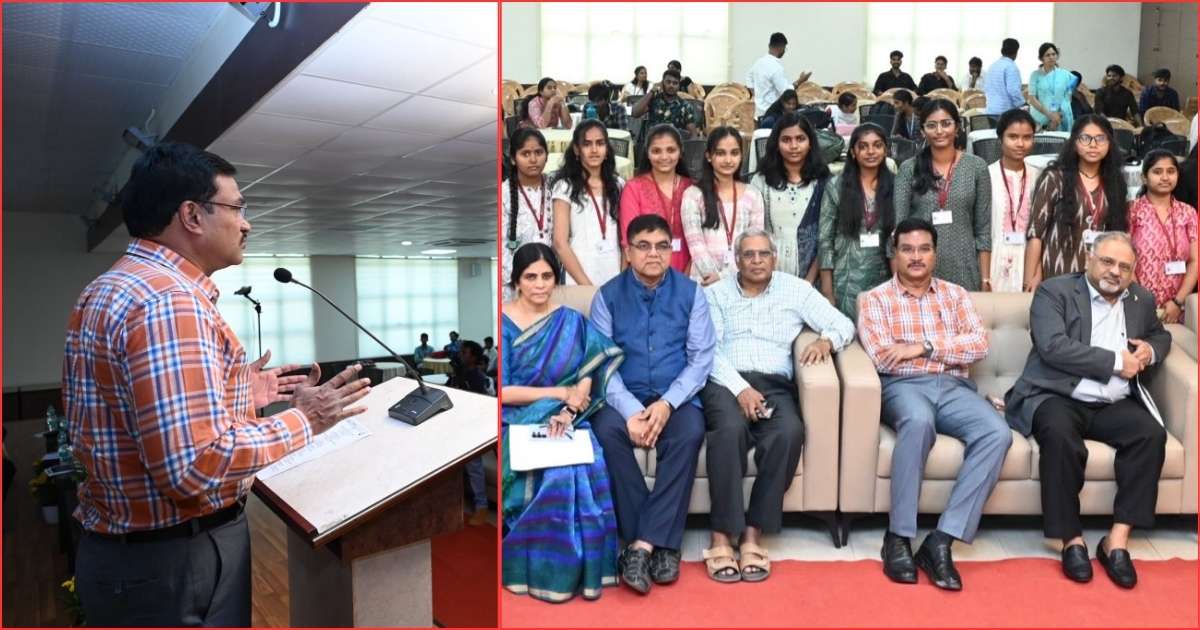
Hyderabad: HYDRAA Commissioner A.V. Ranganath warned of future water conflicts and stressed urgent protection of water resources while outlining ongoing lake restoration efforts in the city.
Ranganath spoke at World Water Day events held at JNTU in collaboration with the Open Geospatial Consortium and the Indian Society of Geomatics, Hyderabad chapter. He said conflicts over oil were ongoing globally and cautioned that similar disputes over water could emerge if resources were not protected.
He urged authorities and citizens to act early to prevent such a scenario. He said water resources protection must become a shared responsibility.
Water resources protection linked to urban growth challenges
Ranganath said Hyderabad’s population stood at 1.6 crore and could cross 3 crore by 2050. Therefore, the city must expand infrastructure in line with rising demand.
He said the state government decided to restore the chain of interconnected lakes to address this challenge. HYDRAA has already begun work under a phased plan.
In the first phase, work started on three out of six lakes, while the remaining three were ready for launch. In the second phase, authorities planned restoration of 18 more lakes.
He said rapid urbanisation turned the city into a concrete landscape. As a result, floods during monsoon and water scarcity in summer became common. However, lake restoration would help control flooding and improve groundwater levels.
Water resources protection drives action against encroachments
Ranganath cited data from the National Remote Sensing Centre showing that 61% of lakes disappeared between 1975 and 2023. He warned that remaining water bodies could vanish within 15 years if no action was taken.
Out of nearly 1,300 lakes, about 700 have already disappeared, while 60% of the remaining lakes face encroachment. He said earlier orders to remove encroachments were not enforced effectively.
He cited Thammidikunta lake in Madhapur as an example. HYDRAA removed encroachments and expanded the lake area from 14 acres to 29 acres.
He said initial criticism later turned into public support. Many restored lakes now serve as recreational spaces, attracting visitors.
He added that awareness about full tank level and buffer zones increased due to HYDRAA’s actions. Consequently, real estate developers now avoid construction in these areas, and buyers show caution.
Water resources protection central to sustainable city vision
Ranganath said HYDRAA aimed to build an environmentally sustainable city. He said authorities cleared encroachments and protected 1,350 acres of government and public land.
He stressed that ignoring encroachments would threaten long-term survival. Although some faced inconvenience, the measures benefited lakhs of residents.
He said HYDRAA collaborated with institutions such as JNTU, NRSC, and Survey of India for technical support. He added that clearing encroachments along Patny nala in Secunderabad prevented flooding in 27 colonies.
Similarly, desilting of drains in Ameerpet reduced waterlogging during rains.
JNTU Vice Chancellor T. Kishan Kumar Reddy, Principal G.V. Narasimha Reddy, and other experts also highlighted the need for water conservation. They appreciated HYDRAA’s efforts in lake restoration and encroachment removal.
-నీటి యుద్ధాలు రాకముందే మేల్కొందాం
-జలవనరుల పరిరక్షణ అందరి బాధ్యత
-చెరువులను పునరుద్ధరిస్తున్నామన్న హైడ్రా కమిషనర్
-జేఎన్టీయూలో వరల్డ్ వాటర్ డే వేడుకల్లో హైడ్రా కమిషనర్🔷 ప్రస్తుతం ఆయిల్ కోసం యుద్ధాలు జరుగుతున్నాయి. జలవనరులపై యుద్ధాల వరకూ… pic.twitter.com/dGvD8ougOH
— HYDRAA (@Comm_HYDRAA) March 23, 2026