From Power Transfer to Pixel Wars: How Telangana’s Parties Rewrote Their Digital Playbooks
By Shaik Ahmed Ali

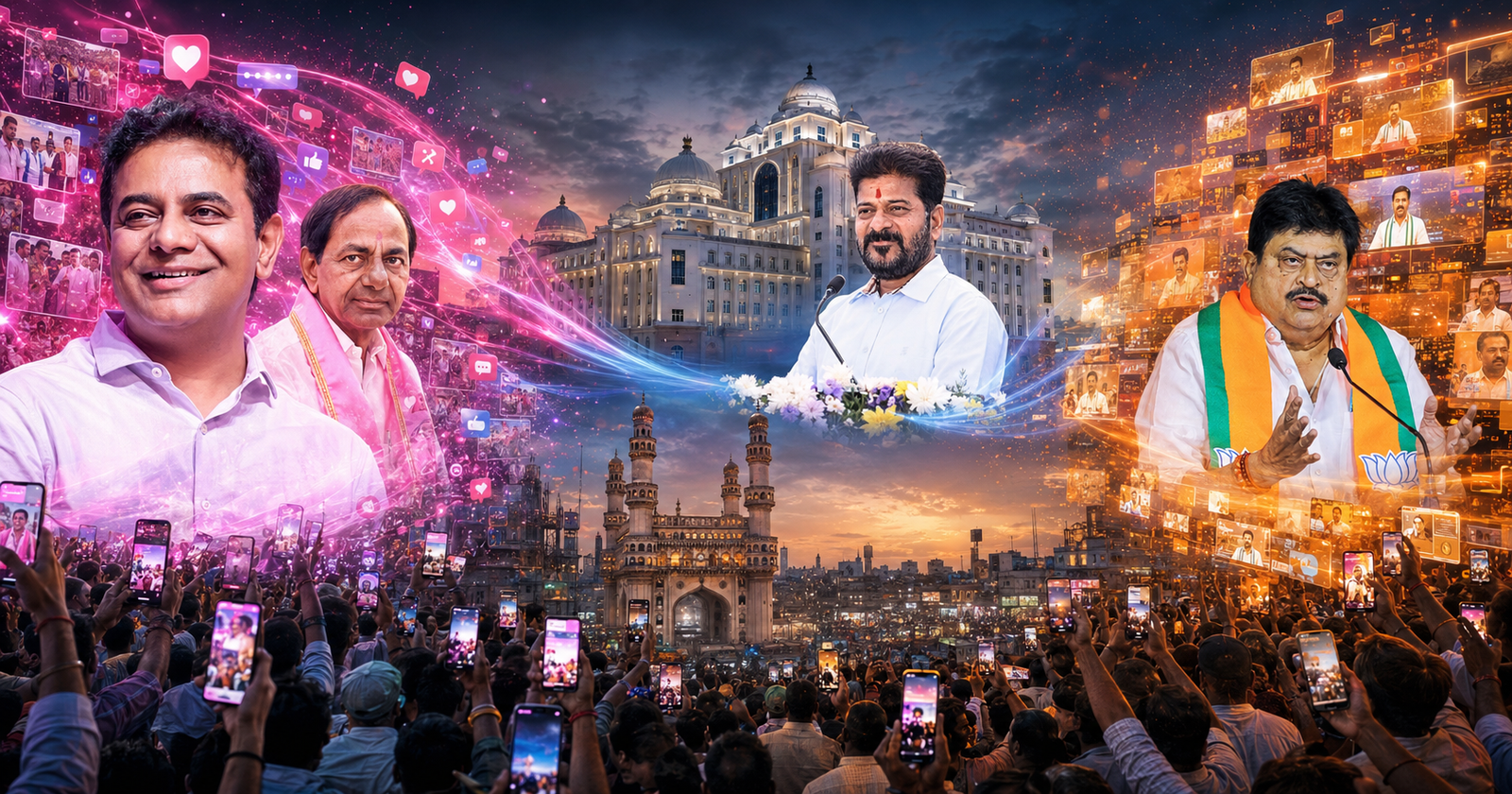
On the morning of December 7, 2023, Anumula Revanth Reddy stood at the Lal Bahadur Shastri Stadium and took his oath as Telangana’s second Chief Minister. The crowds were enormous. The symbolism was charged. A party that had waited a decade for this moment had finally arrived. But even as the ceremonial formalities unfolded in the open air of Hyderabad, a quieter, less visible transfer of power was already in motion – one that would take not days but months to fully reveal itself, and whose consequences are still being felt two and a half years later.
That transfer was digital. And unlike the one at the stadium, it remains fiercely contested.
The story of Telangana’s political landscape since December 2023 is, in many ways, the story of three parties confronting a shared question with three entirely different answers: in a world where public opinion is formed as much on timelines and feeds as it is in town halls and temples, what does it mean to win the internet? The Bharat Rashtra Samithi, which governed the state for nearly a decade, had one answer. The Indian National Congress, newly in power with a mandate to deliver on six ambitious guarantees, had another. And the Bharatiya Janata Party, quietly positioning itself as the dominant force of the future, had a third – one that, when examined through data, turns out to be the most surprising of all.
To understand what has happened, it helps to begin not with the parties themselves, but with the numbers they have produced.
BRS today commands 942,000 followers on X, 1.24 million likes on Facebook, 632,000 followers on Instagram across 29,000 posts, and an estimated five million YouTube views every month. These are, by any measure, the dominant digital numbers in Telangana politics. They are also the numbers of a party that has not held power for over two years, has won zero Lok Sabha seats, and, most strikingly, has not spent a single rupee on Google or YouTube advertising since the day it lost the election. Every follower, every view, every share has been earned entirely through organic content. No paid amplification. No government machinery. Just content, community, and the considerable force of personality of its working president, K.T. Rama Rao.
Congress, by contrast, came to power with electoral momentum but a digital footprint that lagged significantly behind BRS. Its Telangana Facebook page had 349,000 likes – less than a third of BRS’s. Its party X handle was active but uneven. Its Instagram presence, while growing, lacked the volume and consistency of its rival. What it did have was Revanth Reddy’s personal Instagram account, which had been carefully cultivated during the campaign and now stands at one million followers, now stands at 1.2 million followers, the second highest among Telangana politicians on the platform — behind KTR, whose personal Instagram account has 2.4 million followers. And it had the single most powerful content engine available to any political party: the machinery of government itself, generating a daily cycle of announcements, inaugurations, and welfare deliveries that no opposition party can manufacture from scratch.
BJP’s situation was different again. It entered the post-2023 period with the smallest organic digital base of the three – a Facebook page with 707,000 likes, an Instagram account with 374,000 followers, a YouTube channel still building its audience. But what BJP lacked in organic reach, it was aggressively compensating for in paid reach. Between December 7, 2023 and June 2026, the party ran 123,005 ads on Google and YouTube platforms in Telangana, spending ₹6.34 crore. That works out to an average spend of just ₹515 per ad – a micro-targeted, hyper-volume operation almost certainly driven by the national BJP digital machinery, which began treating Telangana as a priority state after the party’s remarkable performance in the 2024 Lok Sabha elections, where it won eight of the state’s 17 seats.
To appreciate how different these three trajectories are, consider what the pre-election period looked like by comparison. Between June 2023 and January 2024 – the run-up to the Telangana assembly polls – BRS spent ₹11.91 crore on Google and YouTube ads across 1498 advertisements. Congress spent ₹9.43 crore across 835 ads. BJP spent ₹1.88 crore across 12,646 ads. BRS outspent Congress. BRS ran far fewer ads than BJP but at dramatically higher spend per ad, suggesting premium placements and longer video formats rather than the scatter-shot micro-targeting that BJP favoured even then. And yet, when the votes were counted, it was Congress that formed the government.
That outcome – the party that outspent its rival on digital advertising losing the election – is the first and most important data point in this entire series. It establishes, from the outset, that social media reach and electoral outcomes are not the same thing. They overlap, they influence each other, they matter enormously for narrative and morale and the long game of political positioning. But they do not automatically translate into votes. The party that wins the internet does not necessarily win the election.
What the data from the past two and a half years reveals, however, is something more nuanced than a simple disconnect between digital power and political power. It reveals three parties in the middle of profound strategic reinvention – each adapting, in real time, to a political environment that has changed more dramatically since December 2023 than at any point in Telangana’s decade-long history as a state.
Telangana politics moved into data wars
BRS went from ruling party to opposition overnight. It lost its institutional voice – the government press releases, the official social media handles of ministries, the amplification that comes from controlling the state apparatus – and had to rebuild its communications operation entirely on organic foundations. The fact that it has done so with such apparent success, maintaining enormous follower counts and high engagement with no paid advertising whatsoever, is a testament to the digital infrastructure it built during its years in power. But it is also a story that carries significant risks, chief among them the dangerous concentration of the party’s entire online identity in a single person.
Congress faced the opposite challenge. It gained the institutional megaphone but had to learn how to use it without losing the scrappy, challenger energy that had made its digital campaign so effective. It has not entirely succeeded. The January 2025 Twitter poll – in which the @INCTelangana handle invited followers to compare KCR’s governance style with Revanth’s “Praja Palana,” and the majority voted for KCR – was an unforced error that revealed the limits of institutional social media management. Running a governing party’s social media is a fundamentally different skill from running a campaign’s, and Congress has not always made that transition smoothly.
BJP, quietly and methodically, has been doing something else entirely. It has been buying its way into Telangana’s digital conversation at a scale that its organic numbers don’t reveal, building message recall and name recognition through a volume of advertising that dwarfs its rivals. Whether that investment translates into electoral gains in 2028 is the most interesting open question in Telangana politics today.
The pages that follow in this series will examine each of these stories in depth – the personalities, the strategies, the data, the blunders, and the patterns that may tell us something about where Telangana is headed. This opening article has set the table. The real feast begins with the numbers.
[This is the first article in Beyond the Ballot: Telangana’s Digital Political Landscape, a ten-part series examining how Congress, BRS and BJP are fighting for political power in the social media age. Data sources include Google Ads Transparency Center, X/Twitter public profiles, Instagram, Facebook, YouTube analytics tools, and Speakrj. Ad spend figures cover official party pages and may not include spending by allied or proxy entities.]