

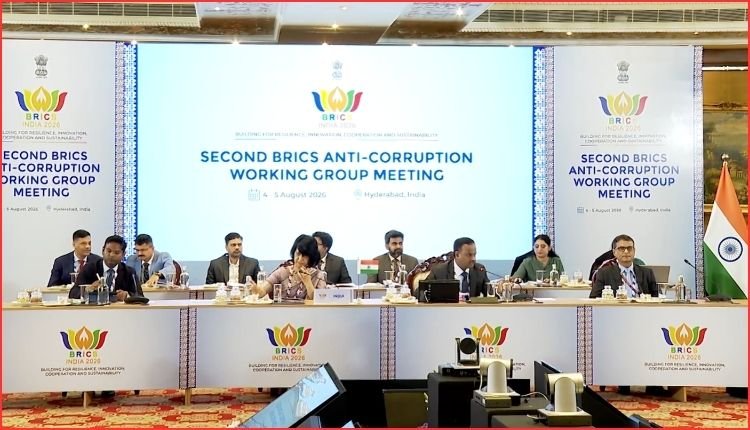
Hyderabad: The two-day BRICS anti-corruption meeting opened in Hyderabad on Tuesday, with senior officials discussing stronger international action against corruption, fugitive economic offenders and stolen assets.
The second BRICS Anti-Corruption Working Group meeting brought together representatives from member countries. They examined practical ways to improve cooperation across borders. Department of Personnel and Training Secretary Rachna Shah inaugurated the meeting. She said corruption remained a major barrier to sustainable development.
Shah said corruption diverted public resources from healthcare, education and infrastructure. Moreover, she said it weakened public confidence in institutions. She stressed that individual countries could not tackle corruption alone. Therefore, she called for coordinated global action against illicit financial flows.
BRICS anti-corruption meeting focuses on global cooperation
Shah urged BRICS countries to strengthen extradition cooperation and recover stolen assets more effectively. She also called for measures to prevent jurisdictions from becoming safe havens for economic offenders.
The meeting examined mechanisms to trace fugitives wanted in corruption-related cases. Delegates also discussed stronger cooperation among law enforcement agencies. Shah highlighted India’s technology-driven governance reforms during her address. She cited the Government e-Marketplace as one measure that improved transparency.
She also referred to Direct Benefit Transfer, faceless taxation and digital public services. According to her, these systems reduced opportunities for corruption and improved accountability. Furthermore, Shah called for technology-enabled vigilance and data-driven monitoring. She also stressed the need for stronger grievance-redressal systems.
The BRICS anti-corruption meeting included discussions on emerging financial risks. Delegates examined the misuse of financial technology and virtual digital assets. Officials discussed how offenders could use such instruments to move or conceal corruption proceeds. Therefore, the working group considered stronger information-sharing and coordinated responses.
BRICS anti-corruption meeting reviews fugitive tracking
The agenda included the proposed BRICS Repository for tracing fugitive offenders. Delegates also reviewed the BRICS Network of Law Enforcement Practitioners. The meeting examined asset recovery mechanisms and practical cooperation between member countries. Officials aimed to improve the speed and effectiveness of cross-border investigations.
Earlier, BRICS Anti-Corruption Working Group Chair J. Ashok Kumar outlined the group’s priorities for the year. He said the working group had focused on developing practical cooperation mechanisms. However, he added that BRICS members wanted to avoid duplicating existing international frameworks.
Ashok Kumar said the progress achieved in recent months reflected the value of sustained dialogue. He also pointed to a shared commitment among BRICS countries. According to him, the member nations wanted to strengthen cooperation against corruption through practical and coordinated measures.
The discussions also covered the recovery of assets linked to corruption cases. Delegates examined ways to improve cooperation between investigative and enforcement agencies. Officials said stronger coordination could help trace offenders, support extradition proceedings and recover illegally transferred funds.
Hyderabad meeting to conclude on August 5
The Hyderabad session marked the second meeting of the BRICS Anti-Corruption Working Group. Participants continued discussions on institutional cooperation, digital risks and enforcement coordination throughout the first day.
The meeting also sought to turn policy commitments into operational mechanisms. Officials focused on tools that member countries could use in actual investigations. The BRICS anti-corruption meeting was scheduled to conclude on August 5.
Delegates were expected to consolidate their discussions on fugitive tracking, asset recovery and technology-related corruption risks. The meeting also aimed to strengthen long-term cooperation among BRICS members. Officials said sustained engagement remained essential because corruption increasingly crossed national borders.