

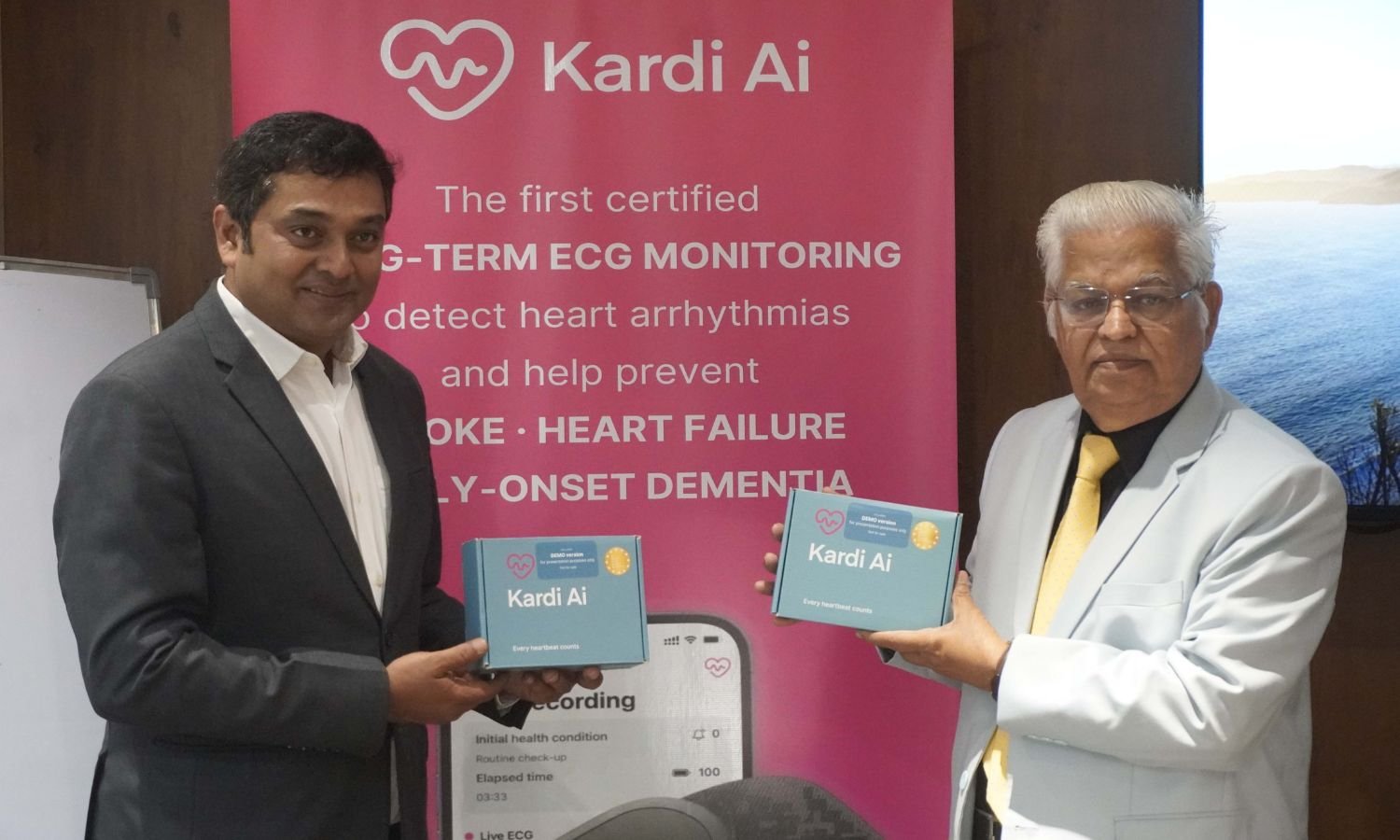
Hyderabad: AI-powered cardiac monitoring technology Kardi Ai will be officially launched in India on September 26 in Hyderabad. The system is designed to give physicians a longer period to monitor intermittent heart-rhythm abnormalities.
The announcement was made by Dr Ramana Jagarlamudi, Director–International Operations and Authorised Representative–India, Kardi Ai. Dr Raghavendra Rao, Scientific Adviser and Co-Founder of Eurasia Medical Technologies LLP, also spoke at a press conference at FTCCI on Friday.
Developed by Czech HealthTech company Kardi Ai, the system combines a wearable ECG chest strap, mobile connectivity and AI-supported ECG analysis. Unlike a conventional ECG, which records a brief snapshot, the technology is designed for longer ECG observation during a patient’s normal daily activities.
The system also differs from a typical 24-hour Holter monitor by extending cardiac observation beyond a single day. The company said this longer monitoring period could help identify rhythm abnormalities that might not appear during shorter recordings.
The company said the device has an MD-15 licence for import and sale in India. It is also CE marked and classified as an EU MDR Class IIa medical device. Its quality-management processes are aligned with ISO 13485.
Kardi Ai launch focuses on long-term cardiac care
The India launch is being facilitated by Hyderabad-based Eurasia Medical Technologies LLP. It will bring together cardiologists, electrophysiologists, physicians and healthcare technology professionals for discussions on arrhythmia detection and long-term ECG monitoring.
The discussions will also cover remote cardiac care and AI-assisted clinical decision support. The launch is scheduled at Daspalla Hotel in Jubilee Hills from 6.30 pm on September 26.
The representatives highlighted the difference between conventional short-duration monitoring and the new system. “ECG is a snapshot, Holter is a 24-hour recording, while Kardi Ai enables long-term observation of heart rhythm,” they said.
They said the technology was focused on detecting heart-rhythm abnormalities that could otherwise go unnoticed during shorter monitoring periods. The system combines wearable monitoring, mobile connectivity and AI-supported analysis as part of its long-term ECG approach.