

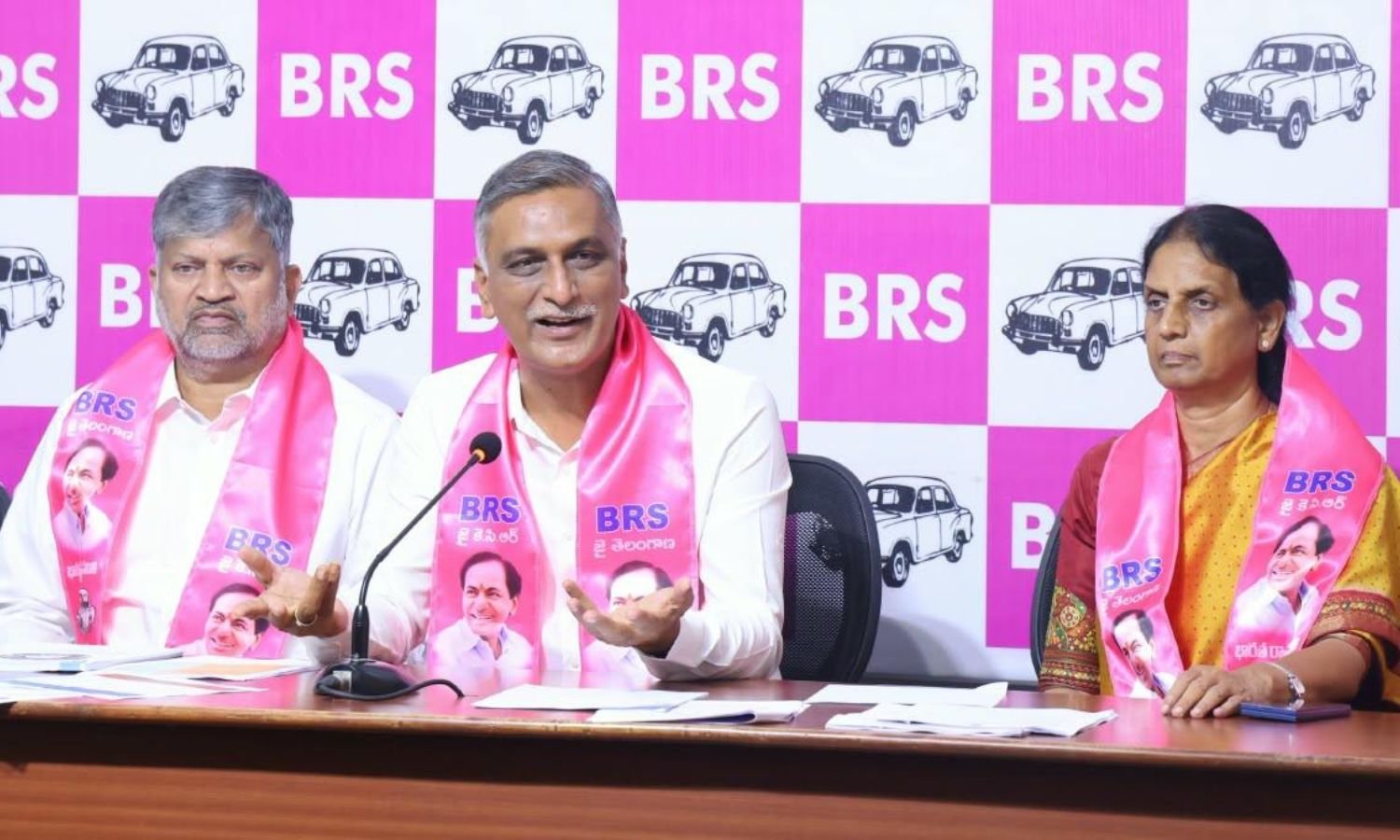
Hyderabad: Senior BRS leader T. Harish Rao on Saturday blamed the Congress government’s administrative failures for irrigation water and power shortages in Telangana. He rejected the government’s contention that El Niño was responsible for the situation.
Addressing a press conference at Telangana Bhavan, Harish Rao described the situation as a “man-made drought created by Chief Minister A. Revanth Reddy’s administration.”
Harish Rao, the BRS Legislature Party Deputy Floor Leader, said he was raising the issue because of the difficulties faced by farmers. He cited his experience as a statehood activist, seven-term legislator and farmer’s son.
“As a statehood activist, a seven-term legislator, and a farmer’s son, I am speaking out of responsibility, not politics,” he said. He added that the suffering of farmers across Telangana could not be ignored.
Harish Rao alleged that the recent Assembly debate had exposed attempts by the government to conceal operational failures.
He also disputed statements made in the Assembly by Irrigation Minister N. Uttam Kumar Reddy regarding the use of Srisailam water. Harish Rao demanded an account of the water drawn from the project.
“The Minister claimed Telangana used 84 TMC from Srisailam this year. If so, where did that water go?” he asked. He also questioned which reservoirs had been filled and which agricultural fields received irrigation.
Harish Rao said the Palamuru-Ranga Reddy pumps had remained idle among the major lift schemes dependent on Srisailam. He claimed only around 8 TMC had been lifted through the Kalwakurthy project.
Irrigation power crisis blamed on management failures
Citing Central Water Commission figures, Harish Rao claimed Telangana had recorded its lowest utilisation of Krishna waters in recent years under the present government.
He then turned to the State’s power situation and accused the Congress government of failing to maintain the power-surplus position achieved during the BRS tenure.
Harish Rao alleged that more than 3,300 MW of installed thermal power capacity remained unutilised because of poor management.
He maintained that the problems in the irrigation and energy sectors were caused by administrative shortcomings rather than natural factors. He also rejected the government’s attempt to attribute the situation primarily to El Niño.