

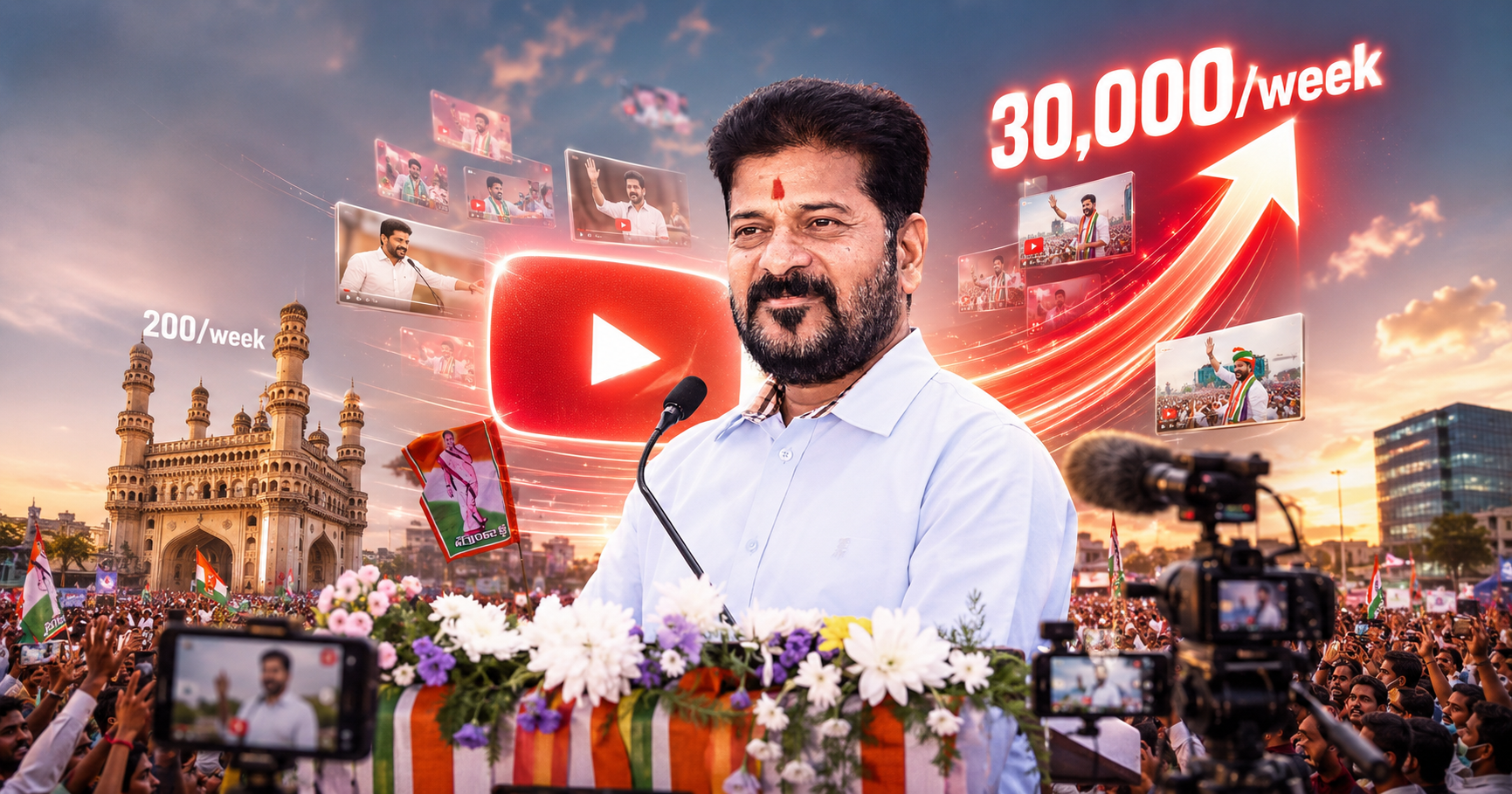
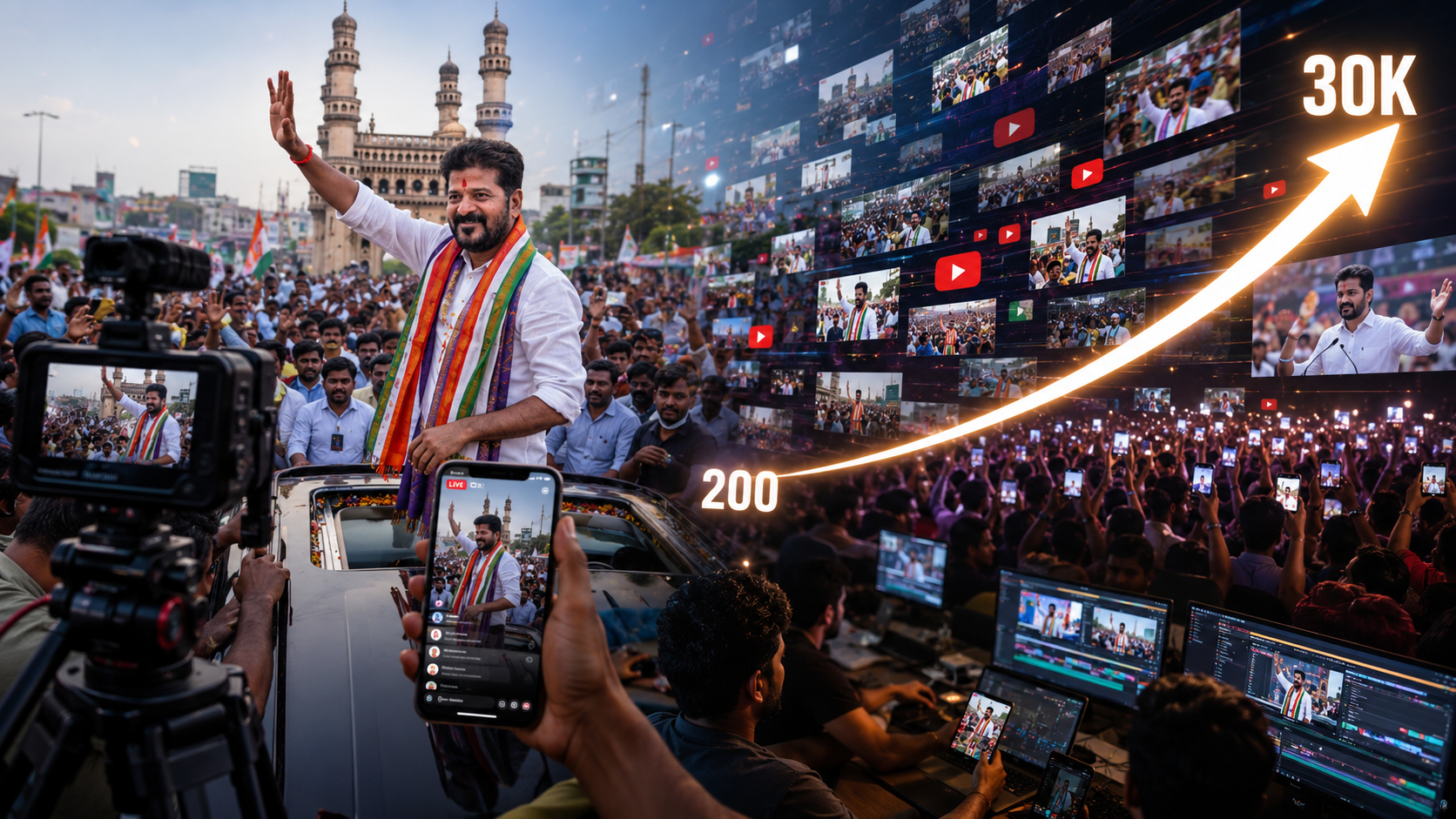
In May 2023, Anumula Revanth Reddy’s YouTube channel was gaining approximately 200 new subscribers per week. In the crowded, competitive landscape of Indian political YouTube – where national party channels had millions of subscribers and regional politicians in far smaller states commanded six-figure audiences – 200 was a number that suggested a presence more symbolic than strategic. By December 2023, the same channel was gaining more than 30,000 subscribers a week.
The seven months between those two numbers contain one of the most instructive stories in recent Indian political communications – a story about how a campaign team identified the right medium, built the right content operation, and used a single platform to transform a candidate’s digital profile from an afterthought into the primary vehicle for an electoral narrative.
Understanding what happened requires starting not with the technology but with a decision about Telugu audiences.
The Telugu YouTube Insight
Telugu audiences are among the most active YouTube users in India. The Telugu-language entertainment and news ecosystem on the platform is enormous – news channels, film trailers, web series, educational content, political commentary – and has created viewing habits that no other platform has matched in the Telugu-speaking world. A well-optimised political YouTube channel in Telugu can reach audiences that X, Instagram, or even Facebook cannot access, because it appears in recommendations alongside content those audiences are already watching.
Congress’s campaign team understood this and built accordingly. An SEO-trained YouTube manager was hired specifically to optimise the channel’s performance. GoPro cameras and tripods were deployed at public events, enabling low-cost, high-frequency content production – every rally, every press conference, every constituency visit became uploadable material within hours. Most significantly, the Revanth Reddy channel was designated the primary video source for media outlets covering the campaign. Journalists and television channels looking for clips and sound bites were pointed to YouTube rather than traditional press distribution systems. Every time a broadcast channel used footage from the YouTube channel, it drove traffic and subscribers back to the source.
The algorithm rewarded this consistently. High upload frequency, strong watch times, and increasing external referrals from news outlets told YouTube’s recommendation system that the channel was authoritative content on Telangana politics – and it surfaced it to people who had not actively sought it.
The Money Behind the Momentum
The organic strategy was underwritten by disciplined paid advertising. Between June 1 and January 1, 2024 – verified directly through Google’s Ads Transparency Center – Congress spent ₹9.43 crore on Google and YouTube advertising in Telangana across 835 ads. At an average of ₹11.29 lakh per ad, with 78 percent of the budget allocated to video formats (₹73.6 million), this was not a scattergun approach. Congress was investing in substantive video narratives – content designed to build the Revanth Reddy story over weeks and months, not to generate a spike and disappear.
The contrast with BRS’s approach is revealing. BRS spent ₹11.92 crore across 1,498 ads – more total investment, more individual ads, but a similar video-first philosophy (83.5 percent video). BJP spent ₹1.88 crore across 12,646 ads, with a significantly higher proportion going to image formats (41.4 percent) – a multi-format, high-volume strategy built for broad reach rather than narrative depth.
Three parties, three philosophies. BRS: premium long-form video, maximum investment, narrative storytelling. Congress: substantial long-form video, disciplined targeting, candidate-as-protagonist. BJP: high volume, mixed format, message frequency over message depth.
Congress won. This outcome – the party with the second-largest digital budget defeating the largest spender – establishes something important about the nature of political digital investment. Money spent on advertising is not the same as voters moved. The quality and targeting of content, and how it is integrated with organic channel-building, matters more than the total budget.
The Revanth Story as Content
The Revanth Reddy YouTube channel’s growth was also, fundamentally, a product of narrative. His personal story – a politician from Mahbubnagar who had fought his way to the leadership of the Telangana Pradesh Congress Committee against considerable resistance – translated naturally to the medium. His combative style on the campaign trail, his willingness to directly confront KCR and KTR in their own constituencies, his physical energy at rallies – these qualities are visible and compelling on video in a way they cannot be on text-based platforms.
The channel did not merely broadcast political programme and policy commitments. It told a story about a specific person in a specific struggle. By the time December 2023 arrived and Revanth Reddy took his oath at LB Stadium, the weekly subscriber surge to 30,000 was partly organic momentum and partly the feedback loop of electoral victory – people who had not followed the channel during the campaign now wanted to know who this new Chief Minister was.
What the Victory Built – and What It Didn’t
The YouTube campaign of 2023 produced a strong foundation but not a sustainable ruling-party digital operation. Since coming to power, Congress has spent ₹68.26 lakh on Google and YouTube advertising across 3,426 ads – a significant step down from campaign-period investment, though 86.8 percent of the budget continues to go toward video, maintaining the format commitment. The channel functions as the Chief Minister’s primary video platform, but the explosive subscriber growth has normalised to a more moderate pace.
This moderation reflects a structural reality that every ruling party faces: campaign content and governing content are fundamentally different. A campaign is a story – an underdog fighting an establishment, heading toward a single decisive moment. A government is a process – schemes, inaugurations, reviews, press conferences that individually lack the narrative energy that drove the campaign’s viral growth. The content team that won an election on YouTube is now doing a different job, and the subscriber curve reflects that.
The lesson of the 2023 Telangana campaign is ultimately not about Revanth Reddy specifically. It is about the Telugu YouTube ecosystem as a political battleground, the compound effect of combining organic channel-building with disciplined paid investment, and the underappreciated power of narrative content – the kind that tells a story about a person – in a media environment saturated with impersonal political messaging.
[This is the 3rd article in Beyond the Ballot: Telangana’s Digital Political Landscape. Ad spend data from Google Ads Transparency Center (verified screenshots, June 2026). YouTube campaign strategy details from Rest of World reporting (February 2024].