

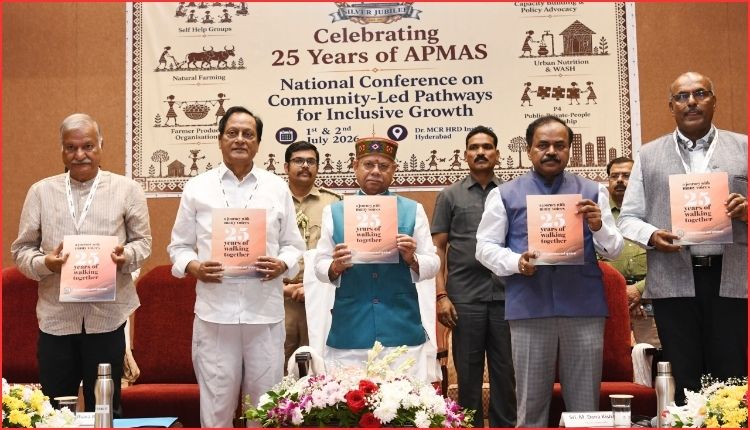
Hyderabad: Governor Shiv Pratap Shukla on Wednesday said women’s empowerment remained the strongest foundation for building a developed and inclusive India. He urged governments, community institutions and civil society to work together. Together, they should ensure that economic growth benefited every section of society.
The Governor addressed the inaugural session of a two-day national conference on community-led pathways for inclusive growth. The event marked the silver jubilee celebrations of the Andhra Pradesh Mahila Abhivruddhi Society (APMAS) at the Dr. MCR HRD Institute in Hyderabad.
He congratulated APMAS on completing 25 years of promoting community institutions and strengthening rural livelihoods. According to him, the milestone reflected dedicated service, innovation and social transformation.
Women’s empowerment strengthened through SHGs
Shiv Pratap Shukla said the Self-Help Group (SHG) movement had become one of the world’s largest social development initiatives. As of March 31, 2025, more than 170 million rural families had joined the SHG network across India.
He added that 14.3 million SHGs had established links with banks. Together, they had accessed credit exceeding ₹3.04 lakh crore. He said this achievement reflected financial inclusion, stronger women’s leadership, rural entrepreneurship and community development.
The Governor said APMAS had helped strengthen more than six lakh women’s SHGs, 23,000 federations and nearly 6.7 million women members in Telangana. In addition, he acknowledged the organisation’s contribution to establishing Stree Nidhi, a community-owned financial institution supporting rural women.
He said Stree Nidhi had disbursed loans exceeding ₹25,000 crore to nearly 3.2 million members as of March 31, 2026.
Women’s empowerment linked to rural growth
The Governor said APMAS was supporting 86 Farmer Producer Organisations. As a result, nearly 40,000 small and marginal farmers had benefited through stronger agricultural value chains.
Referring to the Telangana Rising–2047 vision, he called for greater focus on natural farming, water conservation and value addition in agriculture. He also stressed the need for climate-resilient technologies and stronger Farmer Producer Organisations. These measures, he said, would support sustainable rural development.