

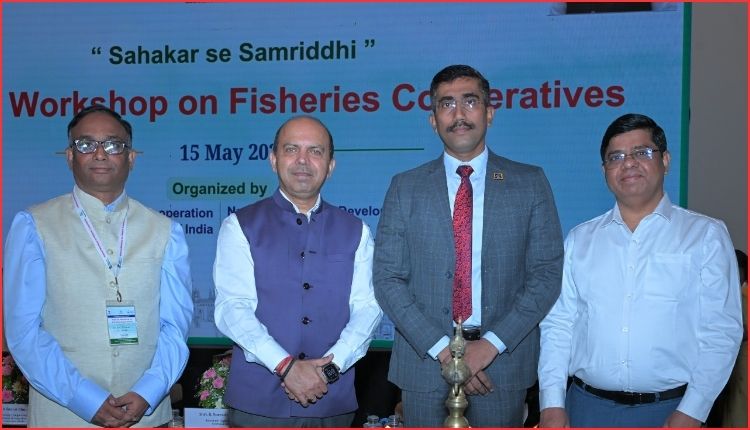
Hyderabad: The National Fisheries Development Board on Friday organised a fisheries cooperatives workshop in Hyderabad to discuss measures for strengthening fisheries cooperatives and improving fisher livelihoods.
NFDB conducted the national workshop in collaboration with the Department of Fisheries and the Ministry of Cooperation at the Sheraton Hotel.
Senior officials, cooperative leaders, financial institutions and sector experts attended the programme under the theme “Sahakar se Samriddhi.”
Fisheries cooperatives workshop discusses expansion roadmap
Addressing the workshop virtually, Department of Fisheries Secretary Dr Abhilaksh Likhi announced a roadmap to establish 6,000 new multipurpose fisheries cooperative societies by 2028-29.
He also said authorities planned to strengthen 5,500 existing cooperative societies during the same period.
Likhi highlighted support available through schemes such as the Pradhan Mantri Matsya Sampada Yojana and Pradhan Mantri Matsya Kisan Samridhi Sah-Yojana.
Furthermore, he stressed the importance of inclusive and cluster-based development in the fisheries sector.
Fisheries cooperatives workshop focuses on fisher welfare
Ministry of Cooperation Secretary Dr Ashish Kumar Bhutani said the ministry had launched more than 150 initiatives during the last five years to strengthen the cooperative sector.
He underlined the need for better credit access, stronger marketing linkages and improved cold-chain infrastructure for fishers.
NFDB Chief Executive Dr Bijay Kumar Behera said Uttar Pradesh, Uttarakhand, Chhattisgarh, Telangana and Punjab had surpassed cooperative formation targets.
However, he said authorities needed to focus on regions that were lagging behind in cooperative formation.
Participants also highlighted the credit gap faced by small and marginal fishers. They said many fishers continued to depend on informal lending systems because of limited access to formal banking services.
Around 150 delegates attended the workshop physically, while nearly 1,250 participants joined virtually from 34 states and Union Territories.