

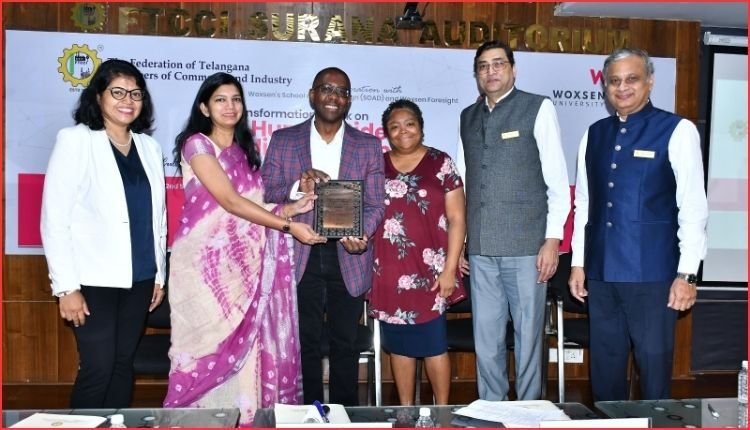
Hyderabad: Businesses adopting artificial intelligence should combine technological efficiency with human-centred growth, entrepreneur and author Ramon Ray said on Tuesday.
Ray said technology could help companies move faster, improve efficiency and serve millions of customers. However, organisational culture determined whether employees, customers and partners felt respected, trusted and valued.
The New York-based global keynote speaker and five-time entrepreneur addressed a session at Federation House in Hyderabad. The Federation of Telangana Chambers of Commerce and Industry (FTCCI) organised the programme with Woxsen’s School of Arts & Design and Woxsen Foresight.
The session focused on “The Human Side of Building a Company – Culture, Resilience, and Human-Centred Growth in the Age of AI.” Drawing on 25 years of entrepreneurial experience, Ray said companies owned buildings, technology, systems, processes and intellectual property. However, people activated all those assets.
“A company is fundamentally a system of human relationships,” he said. Ray said employees, customers, suppliers, partners and leaders were all part of that system. Therefore, businesses needed to look beyond competing merely on price or speed.
Instead, he urged companies to examine whether they were creating experiences that people would remember.
Human-centred growth requires trust alongside technology
Ray cited examples from United Airlines, Ritz-Carlton, Microsoft, Zappos, Chick-fil-A, Zoho, Keap/Infusionsoft and Savannah Bananas. He said appreciation, empowerment, empathy and personal connections could become important elements of organisational culture.
“Technology builds capacity. Culture builds trust,” Ray said. According to him, technology could deliver speed, scale, consistency, personalisation and routine transactions. However, human interaction remained important when situations involved emotion, complexity, vulnerability, judgement and significant decisions.
Ray described culture as “how people behave when the leader is not in the room.” He said leaders shaped culture through the conduct they repeatedly modelled, rewarded, tolerated and corrected. Referring to Microsoft under Satya Nadella, Ray said the company’s transformation extended beyond the adoption of new technologies.
He said it also involved changes in how employees thought, learned and worked together. The transition from “Know-it-Alls to Learn-it-Alls” encouraged greater collaboration, empathy and customer focus, he said.
Ray argued that the example showed how cultural transformation could complement technological change. He also referred to Ritz-Carlton’s practice of empowering frontline employees to address customer problems. According to Ray, organisational culture became more effective when employees received the trust and authority to act.
Human-centred growth did not mean lower standards
Ray said a human-centred approach did not require companies to tolerate poor performance or avoid difficult decisions. Nor did it mean eliminating automation or attempting to satisfy every customer.
“It means treating people with dignity, clarity and care, even when the answer is no,” he said. He urged organisations to examine their practices involving both employees and customers.
Companies should assess whether employees felt seen, heard, trusted and appreciated, he said. They should also consider whether customers could reach a person when a human conversation was genuinely necessary.
Ray presented a HUMAN Framework for organisations seeking to strengthen their workplace culture. Under the framework, “H” represented hearing employees and customers before making assumptions. “U” stood for understanding their experiences through empathy.
“M” represented modelling the desired culture through leadership behaviour. “A” called for authorising employees to act and solve problems. Finally, “N” represented noticing and reinforcing humanity by recognising conduct that made people feel valued.
Ray said businesses did not face a choice between technology and humanity. Instead, the strategic challenge was to become technologically efficient while remaining deeply human. He concluded by asking business leaders to identify an employee policy, customer interaction or business process they could make more human.
FTCCI stressed people-first approach to AI
FTCCI president K.K. Maheshwari said artificial intelligence was transforming how organisations operated, innovated, communicated and competed.
“Technology can automate processes, analyse enormous amounts of data and improve efficiency. But it cannot replace the importance of trust, empathy, leadership, creativity, resilience and human connection,” he said.
Maheshwari said companies were ultimately built by people. He added that organisations succeeded when their employees felt valued, empowered and inspired. “As entrepreneurs and business leaders, we must ask ourselves not only ‘How can we use AI?’, but also ‘How can we use technology while remaining human-centred?’” he said.
He said technology alone could not create a strong organisational culture. Instead, shared values, responsible leadership and an environment supporting learning and innovation shaped workplace culture. Maheshwari also stressed the importance of allowing people to take calculated risks.
FTCCI Women Empowerment Committee chairperson Dr. Tasneem Shariff delivered the theme address. She cited Southwest Airlines as an example of an employee-first organisational culture. Shariff raised the question of whether companies should prioritise shareholders, customers or employees.
She referred to Southwest founder Herb Kelleher’s philosophy of putting employees first. Under that approach, well-treated employees provided better customer service, while returning customers ultimately benefited shareholders.
Shariff said Southwest continued to describe its culture through the principle that people came first. She said the company’s employee promise included a stable working environment and opportunities for learning and personal growth. It also emphasised extending concern, respect and care to employees.
According to Shariff, Southwest had supported that philosophy through employee recognition, training, development, benefits, empowerment and growth opportunities. She said employee development and retention remained priorities for the company. Its programmes covered learning, career development, employee feedback, health and wellbeing, she added.
Shariff cited a 96% employee retention rate while discussing Southwest’s employee-first approach. She said the broader lesson remained relevant to human-centred growth in the AI era. Technology could improve organisational efficiency, while people created the culture, relationships and trust that retained customers.
FTCCI Senior Vice President Srinivas Garimella also attended the programme. The event brought together entrepreneurs, business leaders, professionals, educators and members of the business community. Discussions covered AI, organisational culture, leadership, resilience and human-centred growth.