

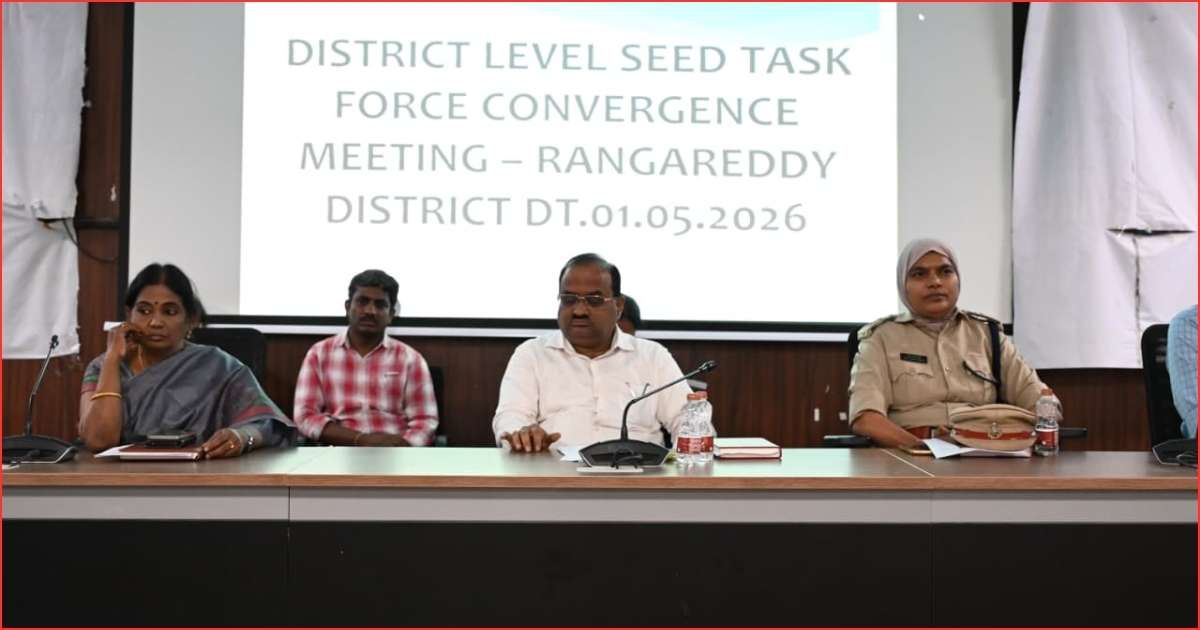
Hyderabad: Rangareddy district authorities had held a task force meeting to implement strict measures for fake seeds curb and prevent spurious seed sales across the district.
Officials said the meeting aligned with the state government’s goal of making Telangana free from fake seeds. Therefore, key decisions were taken to strengthen enforcement and monitoring.
The task force included officials from the agriculture department, police, seed corporations and transport department. Authorities formed three district-level teams, six divisional teams and 26 mandal-level teams for enforcement.
Fake seeds curb through coordinated enforcement
Officials said the district had 474 retail seed shops, nine seed processing units and 224 licensed seed holders. However, cotton and chilli crops faced a higher risk of fake seeds.
Therefore, the task force decided to conduct strict inspections throughout the agricultural season. Authorities defined fake seeds as those produced without licences, sold illegally or packed without proper labels.
Expired seeds and low-quality seeds were also classified as fake. As a result, officials planned continuous inspections through task force teams.
They also decided to collect seed samples for testing and strengthen surveillance at district borders. In addition, cases would be registered against offenders under relevant laws, including cheating provisions and essential commodities regulations.
Fake seeds curb with farmer awareness and legal action
Officials stressed the need for farmer awareness alongside enforcement. They advised farmers to purchase seeds only from licensed shops.
Farmers were asked to collect bills for all purchases. Moreover, officials warned against buying seeds from unauthorised sellers.
Authorities said training programmes would be conducted through farmer platforms. These programmes would help farmers identify genuine seeds and avoid fraud.
The meeting also discussed herbicide-tolerant cotton seeds. Officials said these were genetically modified seeds not approved by the central government.
Therefore, their cultivation remained illegal under environmental protection laws. Officials warned that violations could attract penalties.
They also cautioned against the use of chemicals such as glyphosate. According to officials, such substances posed risks to both health and the environment.
Officials concluded that strict enforcement alone would not be sufficient. Instead, farmer cooperation would play a crucial role in achieving effective fake seeds curb across the district.