

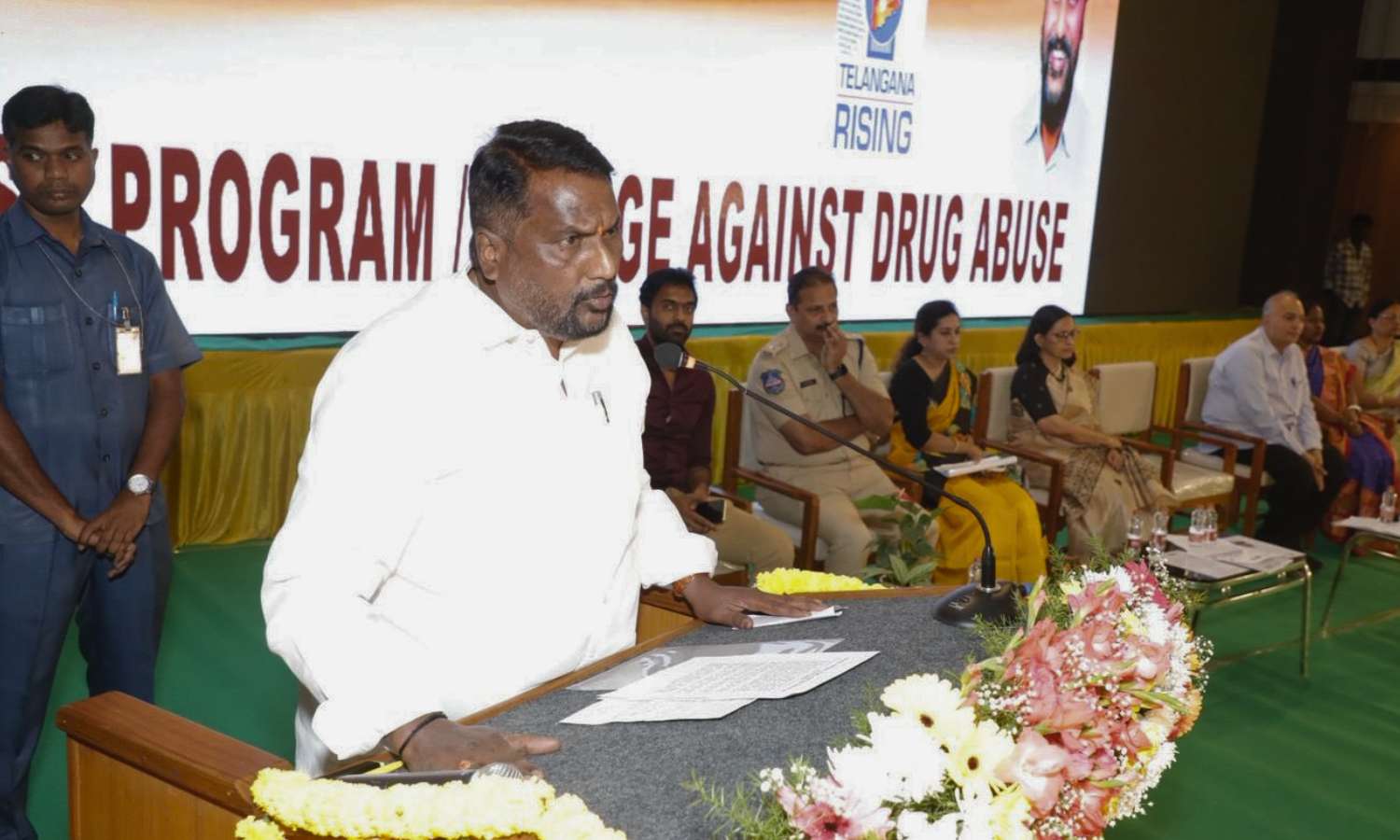
Hyderabad: Minister for SC, ST, Disabled & Transgender Welfare Adluri Lakshman Kumar on Tuesday said Telangana’s anti-drug campaign had reached a critical stage, marked by stronger policing and direct outreach to young people across the state.
He was speaking at the fifth anniversary of the Nasha Mukt Bharat Abhiyan (NMBA) at Gandhi Medical College in Hyderabad. Addressing students and officials, he emphasised the campaign’s focus on participation, vigilance, and education as key pillars of a long-term solution to drug abuse.
Kumar said the Eagle Special Unit, created under the leadership of Chief Minister A. Revanth Reddy, had made a measurable impact by cracking down on narcotics distribution networks. “The Chief Minister has given clear orders to dismantle drug cartels with full force,” he said. “Shielding our youth from addiction is vital to protecting the future of Telangana.”
He warned that substance use often begins as casual experimentation but can quickly turn into a destructive habit. “Drug addiction is not a personal weakness alone it is a wildfire that can consume entire families,” he cautioned.
The Minister urged students to concentrate on academic success, job readiness, and personal discipline. He said the government sees it as a core responsibility to help youth avoid harmful influences and instead pursue stable, goal-oriented lives.
Telangana’s campaign reaches over 1.45 crore people
Kumar noted that under the NMBA initiative, Telangana had held 7,018 drug-awareness events across 15,891 educational institutions. These efforts have reached 1.45 crore individuals, placing the State among the top performers nationally in preventive outreach.
To deepen the campaign’s impact, Telangana has formed NMBA Committees and Anti-Drug Clubs in schools and colleges. These student-led bodies play a key role in spreading awareness and reporting risky behaviours early.
During the event, the Minister administered the De-addiction Pledge 2025 to students and urged them to become advocates for a drug-free future. He also recognised the efforts of volunteers who have played an active role in promoting clean-living values across districts.
The programme featured cultural performances and street plays that explored the risks of drug use through relatable stories and visual theatre. These presentations, designed to resonate with young minds, earned praise for their clarity and emotional reach.
Kumar concluded by reaffirming the government’s commitment to tackling drug abuse through long-term policy, local partnerships, and consistent outreach. “We will not allow drugs to destroy the potential of our youth,” he said. “This fight is about every school, every village, and every student.”