
Telangana’s 3,241 junior colleges face major restructuring under new education system

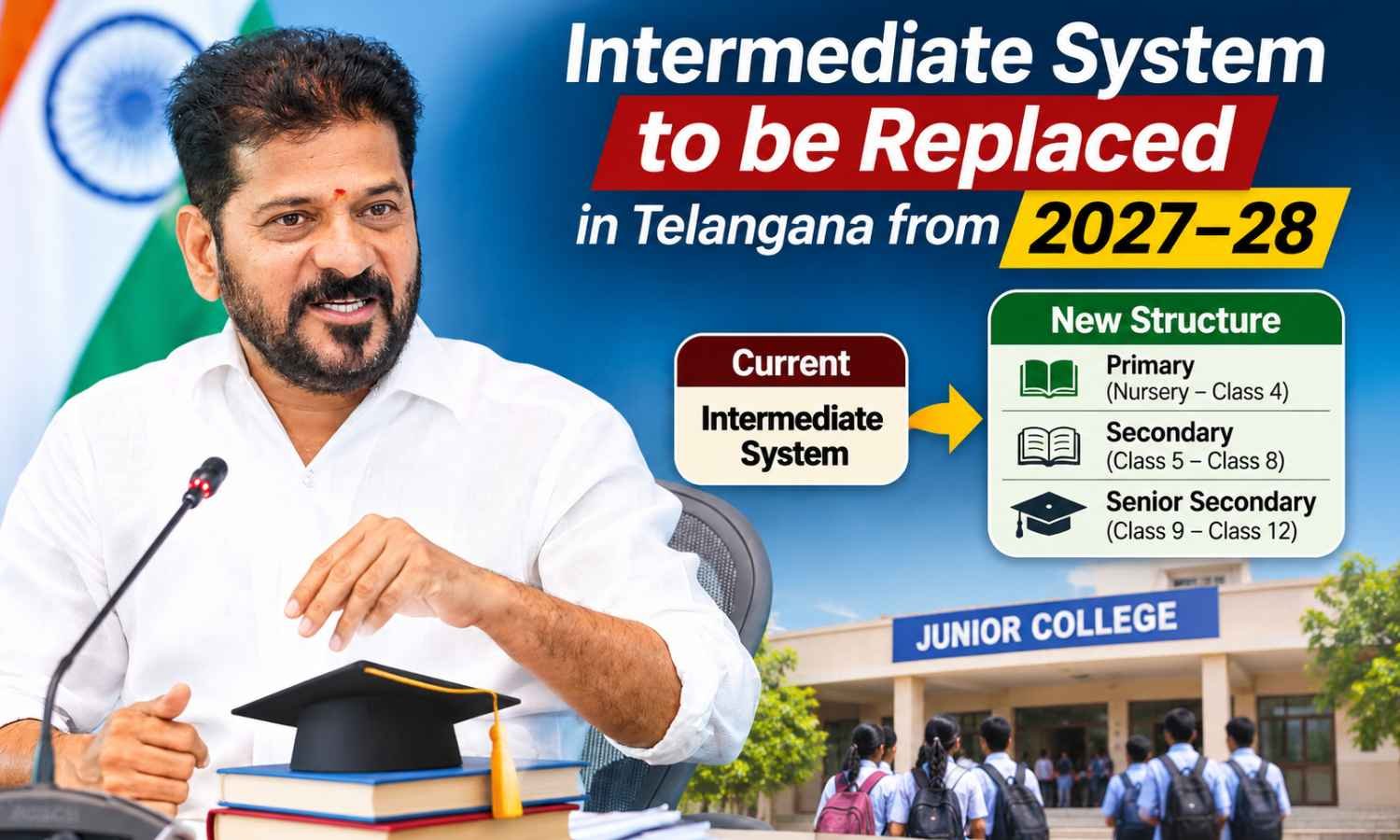
Hyderabad: The future of 3,241 Telangana junior colleges has come into focus following the state government’s decision to replace the separate Intermediate education system with a continuous school structure from the 2027-28 academic year. The proposed reform, which will bring Classes 11 and 12 under the School Education Department, is expected to transform an educational framework that has operated in the region for more than five decades.
Chief Minister A. Revanth Reddy, who also holds the Education portfolio, directed officials during a review meeting at the MCR HRD Institute on Wednesday to prepare for the transition. Under the proposed structure, education will be divided into Primary from Nursery to Class 4, Secondary from Classes 5 to 8, and Senior Secondary from Classes 9 to 12. The separate Board of Intermediate Education is proposed to be discontinued as part of the restructuring.
The government’s primary objective is to reduce the number of students discontinuing education after Class 10 and improve academic continuity. However, the announcement has raised several practical questions about the future of existing junior colleges, particularly private institutions, and the arrangements required to protect students and employees during the transition.
According to a clarification issued by the Telangana Board of Intermediate Education (TGBIE) on October 25, a total of 3,241 junior colleges received formal admission permissions for the 2026-27 academic year. The Board had reported 3,349 affiliated colleges in 2025-26. These figures represent institutions operating under different management structures, including government, private and residential education systems.
The government’s decision does not necessarily mean that the existing colleges will close. Instead, the proposal envisages incorporating Intermediate education into the senior secondary framework. However, detailed guidelines have not yet been announced on whether these institutions will continue operating independently, be attached to existing schools or require fresh recognition under the School Education Department.
Future of Telangana junior colleges raises infrastructure concerns
One of the biggest challenges in restructuring Telangana junior colleges will be the difference between their existing infrastructure and the facilities required for senior secondary education. Several private junior colleges operate from buildings designed primarily for classroom instruction and examination preparation. They may not have the playgrounds, laboratories, libraries and other facilities generally associated with full-fledged schools.
If the government introduces new recognition requirements, college managements may have to make substantial investments in infrastructure. This could prove difficult for smaller institutions, particularly those operating with limited financial resources. The government has not clarified whether existing institutions will be granted transitional recognition or provided additional time to meet revised standards.
Government schools could face similar challenges if they are expected to accommodate Classes 11 and 12. Many high schools may require additional classrooms, science laboratories, specialist teachers and other facilities before they can offer higher secondary courses. The government will also have to decide whether every existing high school will be upgraded or only selected institutions will provide education up to Class 12.
The infrastructure issue has acquired additional significance because junior colleges are already facing scrutiny over affiliation and safety requirements. In its October clarification, TGBIE stated that inspections had identified 65 junior colleges that submitted fake fire-safety no-objection certificates. Another 12 institutions were undergoing scrutiny over changes in premises or incomplete documentation. Private college managements have disputed aspects of the Board’s regulatory action and raised concerns about compliance procedures.
Any change in affiliation rules could therefore have major consequences for the existing college network. Institutions that currently meet Intermediate Board requirements may have to comply with different standards if they are brought under the School Education Department.
The proposed transition also raises questions about the future of junior college lecturers, principals and non-teaching employees. Their qualifications, recruitment procedures, pay structures and service conditions differ from those applicable to schoolteachers. Although the Chief Minister has assured that employment and retirement benefits will be protected, the government has not yet explained how employees will be transferred or accommodated within the proposed structure.
The Telangana Education Commission had recommended creating a dedicated teaching cadre for Classes 9 to 12. However, implementing this proposal would require clarity on seniority, promotions, transfers, subject specialisation and the status of existing lecturers. These issues are particularly important because higher secondary teaching involves specialised instruction in science, mathematics, commerce and other subjects.
What the education reforms mean for students and parents?
For students, the immediate concerns relate to admissions, examinations and the continuation of existing Intermediate courses. Telangana currently follows a system in which students complete Class 10 under the Secondary School Certificate framework before entering junior colleges offering subject combinations such as MPC, BiPC, MEC and CEC.
The government has not yet clarified whether these combinations will continue unchanged or whether the proposed senior secondary framework will introduce greater flexibility in subject selection. There is also uncertainty over the future of first-year Intermediate public examinations and the authority responsible for issuing Class 12 certificates.
The Telangana Education Commission had recommended merging the SSC and Intermediate examination boards and discontinuing first-year Intermediate public examinations. However, these remain commission recommendations unless specifically adopted through government orders. The authorities will also need to clarify the examination arrangements for students who enter their second year during the proposed transition in 2027-28.
Another important issue concerns junior colleges offering integrated coaching for JEE, NEET and other competitive examinations. Telangana has a large network of institutions combining Intermediate education with preparation for engineering and medical admissions. The Education Commission recommended separating competitive examination coaching from regular junior college education, but the government has not announced how such programmes will function under the new system.
Affordability could also become an important consideration. Private junior colleges currently charge different tuition and other fees depending on their courses and facilities. It remains unclear whether the proposed restructuring will bring these institutions under a different fee-regulation framework. Students from economically weaker families will also need clarity on scholarships, fee reimbursement, hostel facilities and other support.
The government believes that bringing Classes 11 and 12 into a continuous school structure could encourage more students to complete higher secondary education. However, educational continuity will also depend on the availability of nearby institutions, affordable transport, financial assistance and adequate teaching facilities.
The proposed reform has the potential to simplify educational administration and strengthen public schooling. Nevertheless, its success will depend on how smoothly the government manages the transition from the existing Intermediate system. Clear guidelines on college recognition, infrastructure, examinations, employee protection and student admissions will be essential before the 2027-28 academic year begins.
For thousands of Telangana junior colleges and the families depending on them, the most important question is no longer whether the Intermediate system will change, but how the government intends to implement that change without disrupting education.