
Muslim reservation in Gujarat puts BJP’s stand on Telangana’s 4% quota under scrutiny
By Shaik Ahmed Ali

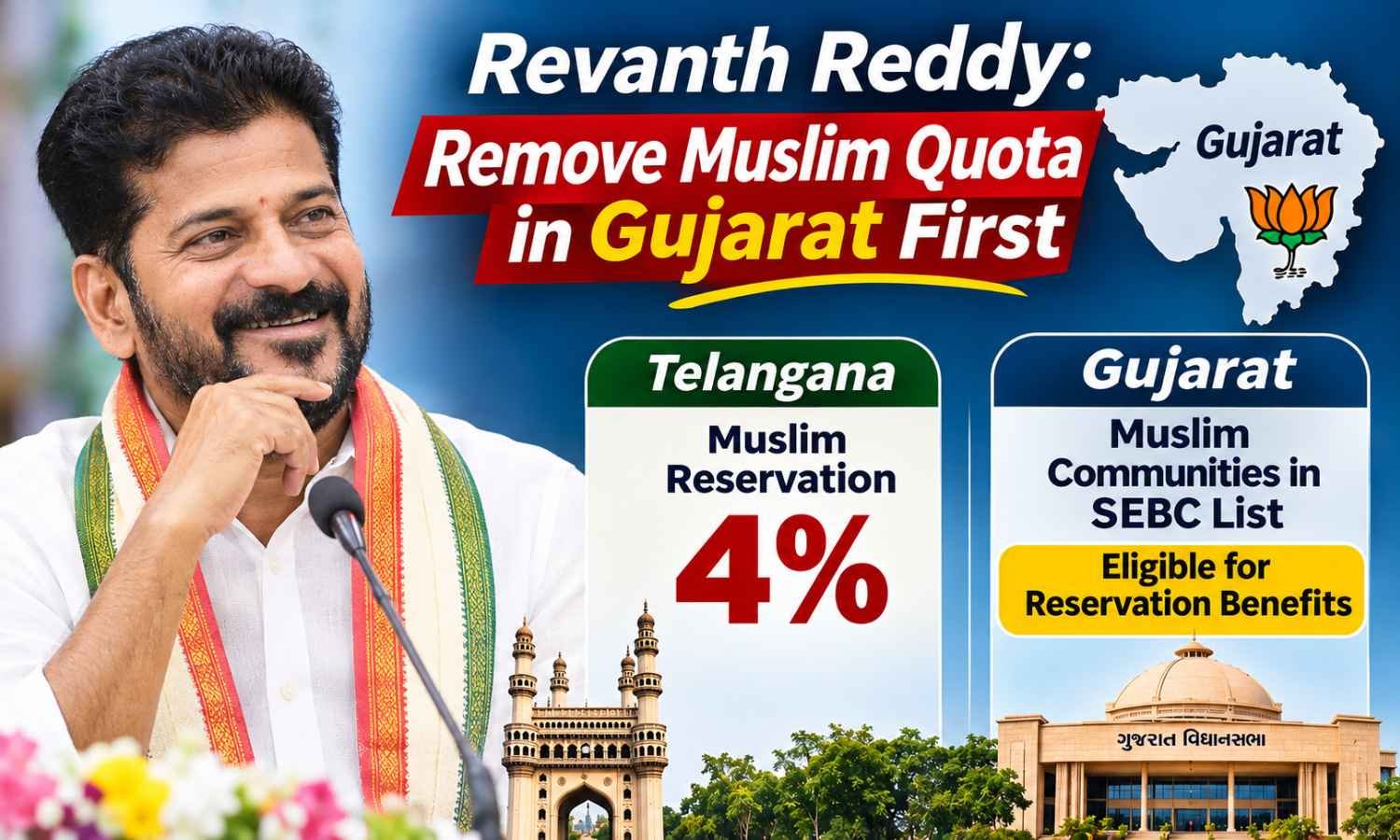
Hyderabad: Muslim reservation in Gujarat has emerged as a significant issue in the political debate over Telangana’s 4% quota after Chief Minister A. Revanth Reddy challenged the BJP to first remove reservation benefits available to Muslim communities in the western state. His remarks have brought attention to an important distinction often overlooked in political arguments: reservation benefits available to identified Muslim backward classes are not necessarily the same as reservations granted solely on the basis of religion.
Addressing National Education Day and Minorities Welfare Day celebrations in Hyderabad on Wednesday, November 11, Revanth Reddy strongly defended the 4% reservation introduced under the Congress government headed by Dr Y.S. Rajasekhara Reddy in undivided Andhra Pradesh. He accused the BJP of threatening to abolish the quota and challenged its leadership to implement a similar policy in Gujarat before demanding changes in Telangana.
The Chief Minister maintained that the reservation had benefited lakhs of eligible Muslims in education and government employment. He referred to opportunities created in medicine, engineering, police services and other professional fields. He also criticised the BRS for failing to fulfil its promise of increasing Muslim reservation to 12%, despite governing Telangana for nearly a decade.
The Gujarat comparison has considerable political significance because the state has been governed by the BJP for decades and its official Socially and Educationally Backward Classes (SEBC) list includes numerous Muslim communities. These groups are eligible for benefits under the state’s backward-class reservation framework, subject to applicable conditions.
However, Gujarat does not have a separate 4% Muslim sub-quota equivalent to Telangana’s BC-E system. This distinction is essential to understanding both the Chief Minister’s political challenge and the constitutional issues surrounding reservation policies.
Muslim reservation in Gujarat and other states
According to the Gujarat government’s Social Justice and Empowerment Department, several communities explicitly identified as Muslim are included in the state’s SEBC list. These include Bafan, Fakir, Gadhai, Galiara, Ghanchi, Hingora, Julaya, Jat, Makrani, Miyana, Pinjara and other occupational and social groups.
Some entries cover communities belonging to more than one religion, while others specifically identify Muslim groups. Their inclusion allows eligible members to compete for reservation benefits within Gujarat’s broader backward-class framework.
These classifications are not a recent development. The Gujarat government records several communities as having been included under resolutions dating back to April 1978, while other groups were added through subsequent notifications. The recognition of Muslim backward classes therefore predates the BJP’s long period in power in Gujarat.
This historical background makes Revanth Reddy’s challenge politically relevant. BJP leaders have repeatedly opposed what they describe as religion-based reservations in Telangana and elsewhere. However, the continued presence of identified Muslim communities in Gujarat’s backward-class list demonstrates that eligibility for OBC benefits is not necessarily determined by religious identity alone.
At the same time, the Gujarat arrangement differs from Telangana’s reservation structure. Gujarat provides benefits to recognised Muslim communities within the general SEBC framework. Telangana specifically earmarks 4% reservation for identified socially and educationally backward groups among Muslims under the BC-E category.
Other states also maintain different arrangements for Muslim backward classes. Tamil Nadu provides a 3.5% sub-quota for Backward Class Muslims within its broader reservation system. Karnataka has historically provided a 4% Category 2B reservation for Muslims, which became the subject of legal and political controversy after the previous BJP government attempted to restructure it in 2023. Kerala also recognises Muslim backward classes through its state-specific reservation arrangements.
In several other states, including Uttar Pradesh, Bihar, Maharashtra and Madhya Pradesh, identified Muslim occupational and social communities are included in backward-class lists. At the national level, specified Muslim communities also appear in the Central OBC List and can access the 27% reservation available to eligible backward classes in central government employment and educational institutions.
These arrangements do not establish a nationwide reservation for Muslims as a religious community. Eligibility depends on the particular groups recognised by the Centre or the respective state governments, the applicable backwardness criteria and the prevailing legal framework.
Constitutional basis and legal challenges to Telangana’s 4% quota
The constitutional basis of backward-class reservations is found principally in Articles 15(4) and 16(4). These provisions permit special measures and reservations for eligible disadvantaged classes, subject to constitutional requirements.
The Supreme Court’s landmark judgment in “Indra Sawhney v. Union of India” in 1992 established important principles governing backward-class identification, the exclusion of the creamy layer and the general 50% ceiling on reservations. The constitutional framework does not automatically exclude a community from backward-class benefits because its members follow a particular religion. However, religion alone cannot establish eligibility for such benefits.
This distinction is central to Telangana’s reservation policy. The Congress government headed by Y.S. Rajasekhara Reddy initially attempted to introduce 5% reservation for Muslims in 2004. The proposal encountered legal challenges, and subsequent measures were also examined by the judiciary over the procedure followed and the evidence used to establish backwardness.
The government eventually introduced a revised 4% reservation for specified socially and educationally backward Muslim groups through legislation enacted in August 2007. The policy was framed to provide educational and employment opportunities to identified backward communities rather than every member of the Muslim population.
The Andhra Pradesh High Court subsequently struck down the legislation, but the Supreme Court permitted the 4% reservation to continue through an interim arrangement pending final adjudication. The policy continued in Telangana and Andhra Pradesh after the bifurcation of the state in 2014.
Consequently, eligible students and job applicants have continued to receive benefits, although the underlying constitutional validity of the legislation remains subject to final judicial determination. Revanth Reddy’s declaration that nobody can remove the 4% reservation reflects his government’s political commitment, but the legal position ultimately depends on the Constitution and judicial decisions.
An important historical clarification also arises from the Telangana government’s official account of Wednesday’s National Education Day programme. The government referred to the introduction of the 4% reservation in connection with the Sachar Committee’s recommendations. However, the original reservation initiative began before the Committee was constituted.
The Rajasekhara Reddy government initiated its 5% Muslim reservation measure in 2004, whereas the Sachar Committee was constituted by the Union government on March 9, 2005. The Committee submitted its report on November 17, 2006. Although the subsequent 4% legislation was enacted in 2007, the original initiative cannot be described as having been launched on the basis of the Sachar Committee’s findings.
This chronology is important because the reservation policy developed through a separate process involving government decisions, backward-class assessments, legislation and judicial review.
Recent legal disputes in other states have also reinforced the importance of following constitutionally valid procedures while identifying backward classes. Courts have examined whether governments relied on sufficient objective material, followed the required administrative process and applied reservation principles consistently.
The political debate over Telangana’s 4% quota must therefore be distinguished from its legal status. The existence of Muslim communities in Gujarat’s OBC list does not automatically establish the validity of Telangana’s separate BC-E reservation. Equally, the fact that a reservation benefits members of Muslim communities does not, by itself, establish that it is unconstitutional.
Revanth Reddy’s challenge has brought this distinction into sharper focus. If Muslim communities in Gujarat receive backward-class benefits under the constitutional framework, the political argument against similar benefits elsewhere requires a more precise explanation than a general objection to Muslim reservations.
At the same time, every reservation arrangement must satisfy the constitutional requirements applicable to its structure, beneficiaries and justification.
The Gujarat comparison may create political discomfort for the BJP, but it does not resolve Telangana’s pending legal questions. The larger issue remains whether backward-class benefits are based on demonstrable social and educational disadvantage and supported by constitutionally valid procedures.
That principle applies equally to Congress-governed Telangana, BJP-governed Gujarat and every other state in India.