
Musi River history offers an interesting answer to CM Revanth Reddy’s question

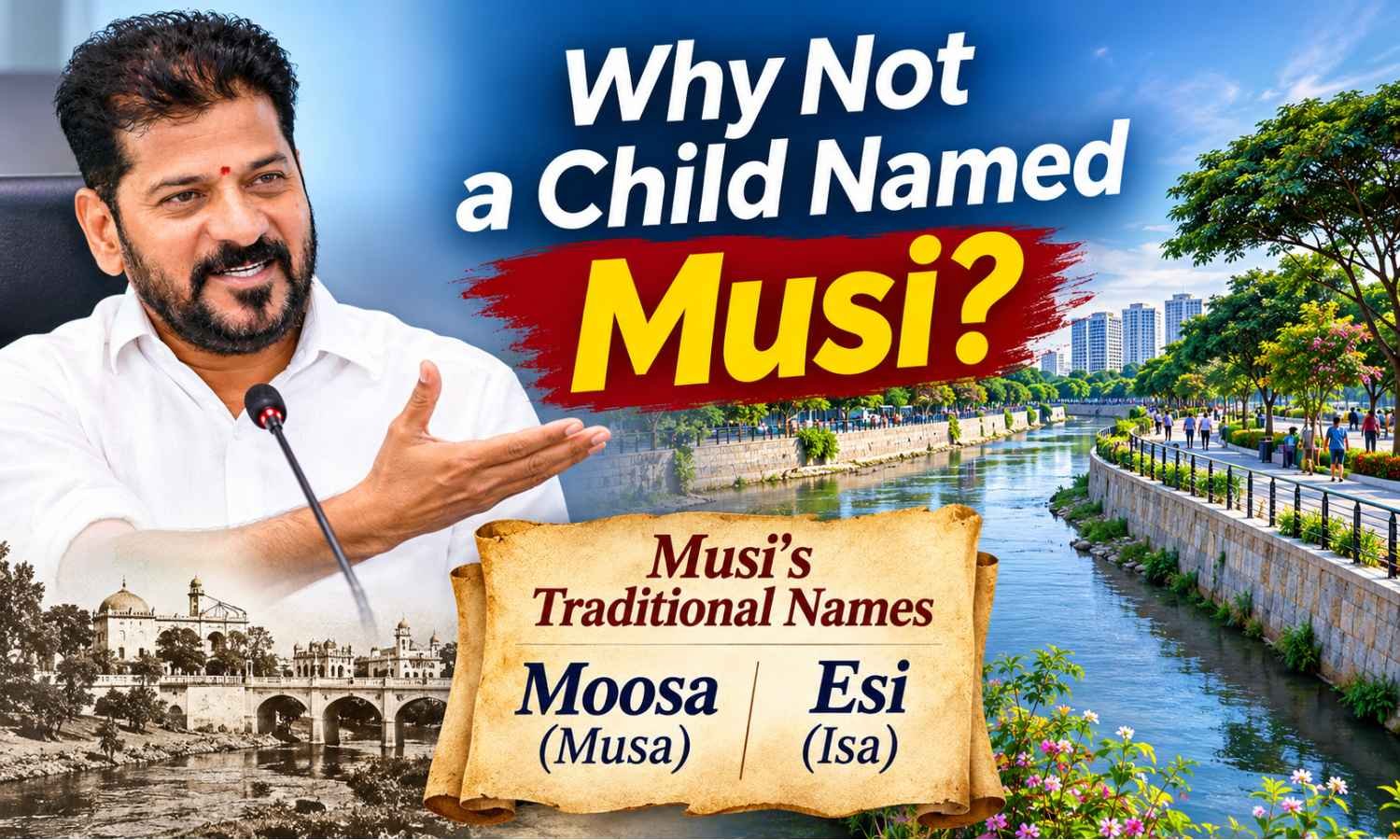
Hyderabad: Chief Minister A. Revanth Reddy has often wondered why parents happily name their children after rivers such as Ganga, Yamuna, Krishna, Godavari and Kaveri, but nobody appears willing to name a child after Hyderabad’s Musi. His question, repeatedly raised while defending the Musi Riverfront Development Project, makes a valid point about the river’s present condition. However, Musi River history offers an interesting response that the Chief Minister might find worth exploring.
The river that has become synonymous with pollution and neglect is traditionally associated with two watercourses known as Moosa and Esi, names that are also linked in popular accounts to Prophet Moses and Jesus Christ. Interestingly, Moosa or Musa and Esa or Isa are well-established personal names among Muslims and have been used by families for generations. The modern name Musi may not have found many takers among parents, but the names associated with the river’s traditional identity have never faced such a problem.
Revanth Reddy raised the question prominently during the controversy over the Musi rejuvenation project in October 2024. Referring to the practice of naming children after revered rivers, he asked why nobody appeared interested in giving their children the name Musi. He attributed this reluctance to the river’s polluted condition and argued that rejuvenation was necessary to restore its dignity.
The argument was certainly unusual. Governments normally justify river-cleaning projects by discussing sewage treatment, environmental protection, flood management and public health. Revanth Reddy introduced another consideration: whether a river had become respectable enough to inspire parents choosing names for their children.
The comparison made his point memorable, although it also opened the door to an intriguing historical discussion. After all, not every river needs to become a popular personal name to establish its cultural importance.
Musi River history and the names Moosa and Esi
According to the Musi Riverfront Development Corporation, an agency established by the Telangana government, the Musi is formed by two tributaries, Esi and Musa, which meet at Bapu Ghat in Hyderabad. Historical and geographical accounts also identify their confluence in the Langar Houz area, with the precise location described differently in some references.
The two watercourses are associated in local tradition with the names Moosa and Esa. The names are familiar in the Abrahamic religious traditions, where Moses and Jesus are recognised as major prophetic figures. In Islamic usage, they are commonly known as Musa and Isa. It is therefore not surprising that these names have long been used by Muslim families, including those living in Hyderabad.
However, the association between the tributary names and the prophets should be distinguished from a conclusively established etymology. Historical accounts offer different explanations for the origin of the name Musi. The river was also known as Muchukunda or Muchkunda, a name associated with a king and sage in Hindu tradition. These different traditions reflect the historical and cultural layers surrounding the watercourse.
The significant point is that Moosa and Esi are not names invented to suit a contemporary political argument. They are recognised geographical names, and the Telangana government’s own riverfront development agency identifies the tributaries by these names.
This provides an amusing response to the Chief Minister’s observation without necessarily disproving it. Revanth Reddy was speaking specifically about the modern name Musi, rather than its tributaries or their traditional associations. His observation that Musi is not a commonly used personal name remains reasonable. But the river’s naming history is considerably richer than the comparison with other rivers might suggest.
The distinction also explains why a clean river does not automatically become a popular personal name. Naming traditions develop through religion, language, literature, family customs and cultural associations. Ganga, Krishna and Godavari are familiar personal names for reasons extending beyond the physical condition of the rivers. Similarly, Moosa and Isa are widely used because of their religious significance, not because of any particular watercourse.
Rejuvenating Musi means restoring more than its name
The Musi has played a central role in Hyderabad’s development for centuries. Muhammad Quli Qutb Shah founded Hyderabad on its banks in 1591, and the river helped shape the city’s geographical expansion. The historic Old City developed to its south, while settlements expanded on the northern side over time. Bridges, markets, residential neighbourhoods and public institutions emerged around the river.
The Musi also witnessed one of Hyderabad’s worst natural disasters when devastating floods struck the city in September 1908. Thousands of people lost their lives, and large parts of Hyderabad suffered extensive damage. The catastrophe led to major flood-control and water-supply measures, including the construction of Osman Sagar and Himayat Sagar during the Nizam’s rule.
For generations, the river supported settlements, agriculture and the city’s water-related needs. However, rapid urbanisation, untreated sewage, industrial pollution and encroachments gradually damaged its ecological condition. Several stretches now carry polluted wastewater, while communities living along the river and farmers dependent on downstream water face continuing environmental concerns.
Revanth Reddy has made Musi rejuvenation one of his government’s major urban development priorities. On Wednesday, November 11, he announced that work on the first 21-km stretch of the proposed project would begin soon. He said the necessary approvals had been secured and the project had reached the tendering stage. The Chief Minister maintained that the objective was to clean and restore the river rather than merely beautify its surroundings.
The government has also linked the project to the development of Hyderabad’s riverfront, tourism, public spaces and economic activity. However, the proposals have generated political controversy over expenditure, possible displacement and rehabilitation of families living along the river. Opposition parties have questioned aspects of the project, while the government has defended the need for rejuvenation and assured protection for affected residents.
These concerns demonstrate that restoring the Musi involves far more than improving its reputation. A meaningful revival would require controlling untreated sewage, preventing industrial pollution, restoring the river’s ecological functions and ensuring that development does not impose an unfair burden on vulnerable communities.
The Chief Minister’s ambition to make the Musi a river that parents would proudly name their children after may therefore be an appealing way of describing the desired transformation. Yet the actual measure of success will be cleaner water, healthier surroundings, effective flood management and improved living conditions for people along its banks.
Whether Hyderabad’s parents eventually begin naming their children Musi is a question that only future generations can answer. They may continue choosing names such as Krishna, Godavari, Moosa and Isa, or find entirely different inspirations.
For now, the city’s history offers a gently ironic response to Revanth Reddy’s question. The river may be waiting for rejuvenation, but some of the names associated with its traditional identity have already been finding their way into people’s homes for centuries.
And unlike the riverfront project, that particular tradition has never required a government budget, tenders or a completion deadline.