

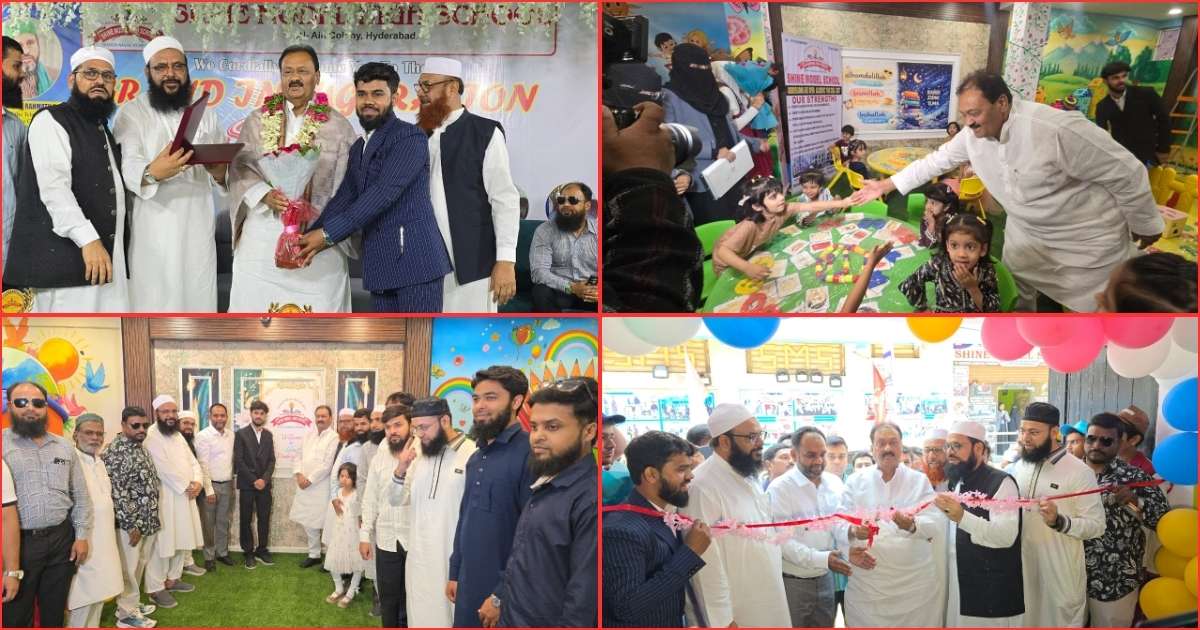
Hyderabad: Telangana Government Advisor Mohammed Ali Shabbir on Monday said behavioural change in the Muslim community remained essential for long-term progress, stressing that education and discipline must guide social advancement.
He spoke after inaugurating ‘Shine Kindergarten’, an initiative of Shine Model High School, at Al-Ain Colony in Shaheen Nagar. The event was attended by Bahelmi Educational Board CEO Mohammed Abdul Junaid Bahelmi and school group chairman Syed Nooruddin Ali Abid, along with parents and community leaders.
Behavioural change Muslim community linked to education
Shabbir Ali said the first verse of the Quran emphasised education. However, he noted that the community still lagged in modern learning. He added that families must prioritise education and career planning to improve outcomes.
He stressed that progress depended on awareness and education rather than identity. He said higher education created better opportunities and ensured economic stability.
The advisor highlighted that the 4 per cent reservation for Muslims in education and jobs, implemented in 2004-05, had benefited over 22 lakh poor Muslims in Telangana and Andhra Pradesh. He said the scheme enabled students to pursue courses such as medicine and engineering through fee reimbursement.
Behavioural change Muslim community needed for youth discipline
Shabbir Ali said the benefits of educational policies were now visible. He cited MBBS admissions for 2024-25, where 1,226 Muslim students secured seats across 65 medical colleges in Telangana. These colleges together offered 8,965 seats. The intake included 485 boys and 741 girls, with 638 admissions under the BC-E quota.
He said daughters of auto drivers and daily wage workers were becoming doctors due to reservations and scholarships. He also referred to two Muslim girls who completed MBBS and higher studies. He said major hospitals such as NIMS, Gandhi Hospital and Osmania Hospital were competing to recruit them.
However, he raised concern over declining interest in education among Muslim boys. He attributed this to indiscipline, late-night habits and distractions. He urged students to follow routines and advised parents to guide their children closely.
Shabbir Ali said welfare schemes alone could not ensure progress without responsibility. He called on the community to use educational opportunities more effectively and to focus on skills and democratic participation.
He added that sustained behavioural change, along with education and government support, would improve representation in fields such as healthcare, law and administration, ensuring long-term socio-economic progress.