

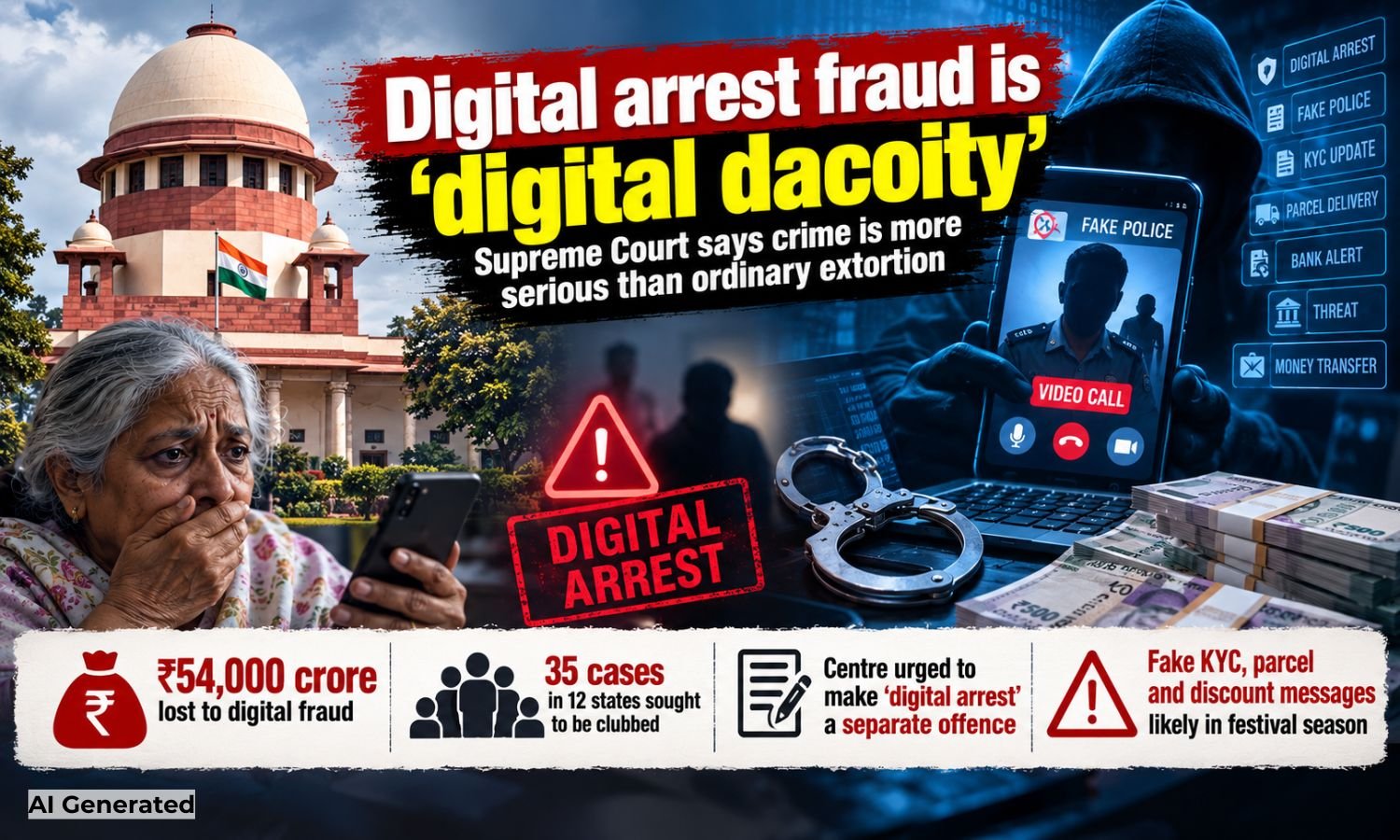
New Delhi: The Supreme Court has described digital arrest fraud as “digital dacoity”, with Chief Justice of India Surya Kant saying the crime is more serious than ordinary extortion.
The CJI said fraudsters were using video calls to target people, especially the elderly, and that such ruthless offenders must be dealt with very firmly. The court went as far as to say that if the law allowed punishment before trial, that option should also be used.
Petitioners sought to club 35 cases filed in 12 states
The remarks came from a Bench of CJI Surya Kant, Justice Joymalya Bagchi and Justice V. Mohana, which was hearing a petition filed by Gaurav Kumar Saha and Nidhi Bhandari.
The two had asked the court to bring together 35 cybercrime cases registered against them in 12 States. It is alleged that their company’s bank account was used to receive fraud money and pass it on.
The petitioners argued that they were themselves victims of fraud and that their account had been used without their knowledge. The Bench responded that victims could not be made to travel to Delhi for the convenience of the accused, and that investigations under way in different States could not be allowed to suffer.
The Bench also said that in such cases, the property of an accused could be frozen once an opinion is formed on the basis of solid evidence.
Centre asked to make digital arrest fraud a separate offence
On July 28, 2026, the Supreme Court had said the Centre should consider formally defining digital arrest in criminal law and making it a separate offence carrying stringent punishment.
On Monday, the court described the Rs 54,000 crore lost to digital fraud as dacoity and loot, observing that the amount was larger than the budgets of several small States. It has asked the Central government to frame guidelines to deal with the problem.
Fake KYC and parcel messages likely in festival season, says Arctic Wolf
Cyber security firm Arctic Wolf has warned that the risk of online fraud could rise during festivals, as more people shop online, make digital payments and book travel.
According to the firm, fraudsters may send fake messages offering big discounts or posing as parcel delivery notices, bank alerts, KYC update requests or electricity bill reminders. Links sent through SMS, WhatsApp and email can be used to steal personal details, and fake apps can capture passwords and OTPs.
The firm advised people not to open unknown links or install suspicious apps, and to check any message about payments or KYC only through the official website or app.