

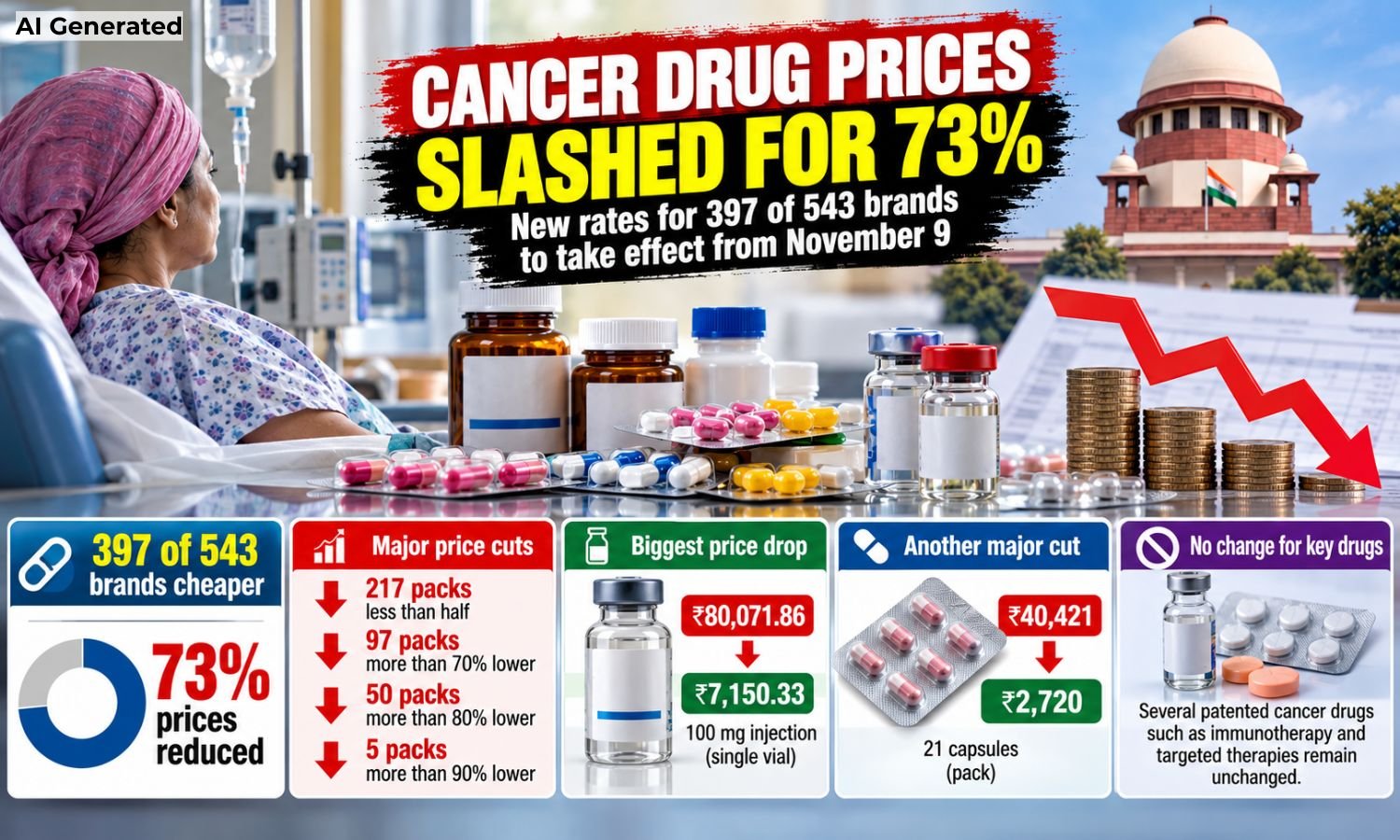
Hyderabad: Cancer drug prices have come down for 397 of the 543 brands and packs whose maximum retail price (MRP) was revised after a decision by the National Pharmaceutical Pricing Authority (NPPA), with the new rates coming into force on November 9.
The 397 packs make up 73% of the list. For 217 of them, the price has fallen to less than half. The cut is more than 70% for 97 packs, more than 80% for 50, and more than 90% for five.
The revision follows a government order capping the trade margin on 137 anti-cancer drugs (salts) at 30% of the MRP. Drug companies then informed the authority of their new prices.
Thiotepa injection falls from Rs 80,071.86 to Rs 7,150.33
The steepest drop is in Samtepa, a 100 mg single-vial injection of thiotepa. Its price has gone down from Rs 80,071.86 to Rs 7,150.33.
Palbopro, a brand of palbociclib, is another major gainer for patients. A pack of 21 capsules now costs Rs 2,720, down from Rs 40,421.
Keytruda, ribociclib among 146 packs with no change
Prices of 146 brand packs on the list remain the same, and these include several costly patented medicines.
Keytruda, an immunotherapy drug used to treat more than 21 types of cancer, still costs Rs 2,16,500. Ribociclib, used in breast cancer treatment, is unchanged at Rs 24,435. There is also no change in the prices of Tagrisso, Tecentriq, Darzalex and Imfinzi.
According to the report on the revision, patented drugs pose a practical difficulty because they involve new technology and are protected by patent rights, and companies could cut back or stop supplies to India if their prices are forced down. It says margins need to be applied sensibly, so that patients are not overcharged but companies do not stop supplying medicines either.
The report also points to gaps in the government’s Trade Margin Rationalisation (TMR) policy. It says the TMR formula allows a margin of up to 42.8% on the price to stockist, which becomes a very large sum on expensive drugs, while cancer drugs often pass through only one or two intermediaries or go straight to hospitals. Medicines given free under patient assistance programmes were left out of the TMR calculation, it notes, and including them could have lowered the prices of patented drugs.
The report argues that patients would have gained more had the 16% margin cap on drugs scheduled under the DPCO been applied to cancer drugs as well. It adds that the NPPA has no firm data on prices across the supply chain, and that companies have been allowed to set prices and report them without independent checks.
Supreme Court had called high cancer drug prices genocide
The gap in cancer drug prices had also come up before the Supreme Court. At a hearing on September 29, a Bench of Justice Vikram Nath and Justice Sandeep Mehta asked the Centre why a cancer drug costing Rs 2,700 carried an MRP of Rs 27,000. Expressing displeasure over drug pricing, the court described it as genocide.
The Bench was hearing petitions on drug prices and generic medicines, with Solicitor General Tushar Mehta appearing for the government. The court asked how such a wide gap between a drug’s purchase price and what patients are charged could be justified, and raised concern over the rising cost of treatment and the system for controlling drug prices.
It also asked the government why, if margins could be fixed for cancer drugs, prices of other medicines were not being controlled. According to the report, the court had recently also questioned how a Rs 13,000 injection came to be sold for more than Rs 1 lakh.