
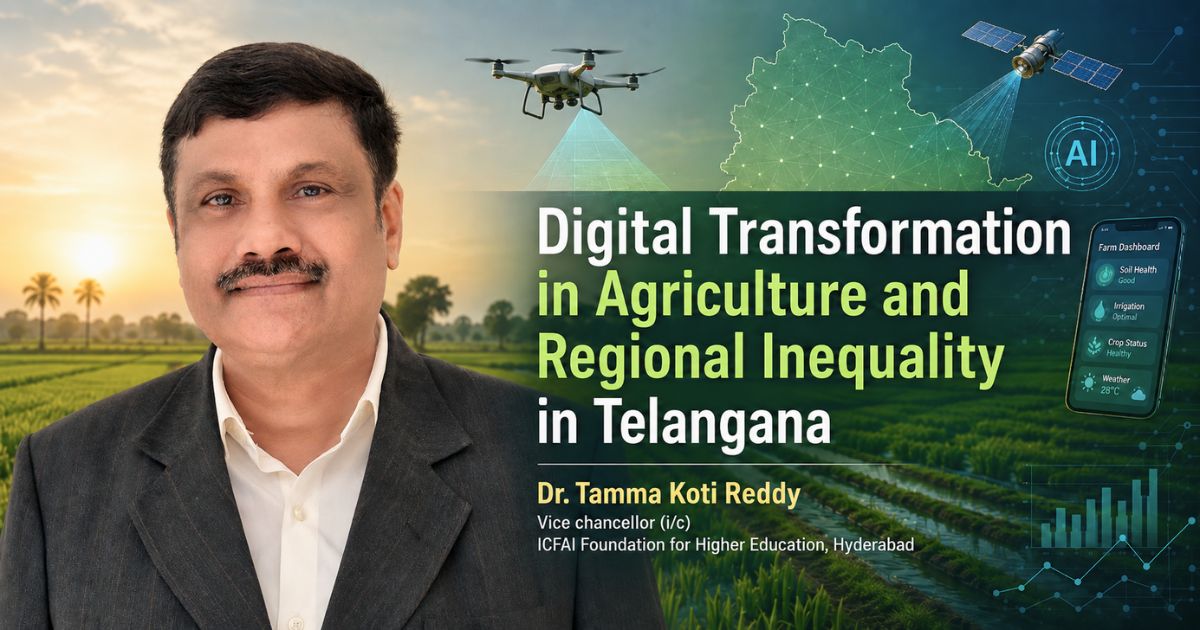
Digital Transformation in Agriculture and Regional Inequality in Telangana
Dr Tamma Koti Reddy

Hyderabad: The state government has been placing special emphasis on agriculture since the formation of Telangana in 2014, with increased irrigation facilities and improved infrastructure in rural areas, and several programs supporting farmers’ welfare. The extensive investments in lift irrigation schemes and large irrigation schemes have greatly expanded the irrigation area and dramatically changed the state’s agricultural landscape. The financial and operational support provided to farmers through schemes such as Rythu Bandhu, Rythu Bima, etc., and the 24-hour free power supply to agriculture have helped increase agricultural production. This has led Telangana to become one of India’s top rice producers.
Yet, despite all the progress, agriculture in Telangana still faces structural issues in crop diversification, resource utilization, and sustainability. The future of food transformation is now associated with the use of digital technologies. In response, the state government has launched various AI-driven digital agriculture initiatives, such as mobile apps for farmers, a digital farm records system, online fertilizer booking, smart irrigation solutions, digital marketing portals, and AI crop advisory services. There were 70.60 lakh operational landholdings, of which small and marginal farmers accounted for about 91.4 percent. Digital agriculture is expected to benefit small and marginal farmers by reducing cultivation costs, increasing productivity, and enabling access to markets and government services. The Telangana government is thinking of conducting a massive scientific land survey in 373 villages of the 25 districts. To accurately and timely map land boundaries and to establish digital land records, the project will utilize cutting edge technology and equipment, such as drone mapping and rover-based surveying systems.
Digital Agriculture:
Digital agriculture is emerging as a key enabler of Indian agriculture’s transformation, enhancing productivity, market access, and resource efficiency. The central government has promoted the use of technologies, such as artificial intelligence, mobile applications, drones, satellite mapping, smart irrigation, and digital land records. Meanwhile, the government has also been taking steps to increase agricultural output. The central government has been pushing the adoption of technologies like artificial intelligence, mobile apps, drone mapping, satellite mapping, smart irrigation, and digital land records, and the state governments have been encouraging technologies that boost agricultural production. Andhra Pradesh, Karnataka, Maharashtra, Punjab, Haryana and Telangana have taken a creative path to develop digital initiatives for farmers.
The digitization of the agriculture sector has also been further strengthened by various national programs like e-NAM, PM-KISAN, Soil Health Cards, and the Digital Agriculture Mission, in the rural areas. As a result of these activities, transparency has been improved, access to information and subsidies has been enhanced, intermediate actors have been reduced and efficient farming and sustainable practices have been encouraged.
District-wise Disparities in Digital Agriculture Adoption:
Digital agriculture is not evenly distributed throughout Telangana. The adoption of digital technologies is substantial and there are large regional differences in uptake, which are consistent with other inequalities in irrigation access, infrastructure, income and institutional support.
Irrigated areas in the north and central Telangana , like Karimnagar, Peddapalli, Nizamabad, Siddipet, Sangareddy, Medchal–Malkajgiri, and Rangareddy, are now at the forefront of digital agriculture. These districts have several positive attributes, like assured water supply, commercial farming, enhanced internet connectivity, improved farm earnings, robust farmer-producer organizations (FPOs), and linkages with agri-tech companies and value chains. In these districts, farmers are increasingly accessing digital advisory services, online input management systems, precision farming methods, and market-linked platforms.
Another set of districts, Nalgonda, Jangaon, Warangal, Khammam, Mahabubnagar, Suryapet, and Kamareddy, is undergoing a slow transition towards digitalization. While awareness of digital farming is expanding, these areas still face challenges with limited internet connectivity, limited institutional outreach, and limited access to technologies among small farmers. Adoption is still limited and not common.
Tribal, forest, and drought-affected districts like Adilabad, Komaram Bheem Asifabad, Mulugu, Jayashankar Bhupalpally, Nagarkurnool, Wanaparthy, Narayanpet, and Mahabubabad, on the other hand, are still lagging behind in the digital agriculture transition. The areas have poor mobile and broadband connectivity, weak extension services, low digital literacy, fragmented land holdings, lack of markets and financial institutions. In many of these, subsistence agriculture is still very much alive and no advanced technology has been adopted for use; there is therefore little scope for investment.
Digital agriculture is not uniform, and has implications for policy. While technology provides benefits to farmers in terms of production, risk reduction, and access to market, disparities over technology adoption may worsen the income gap between farmers and regional imbalances within the state. Quality irrigation and infrastructure will be an important asset to districts, and districts that are already vulnerable will be even further marginalized from new digital opportunities.
Conclusion & Policy Implications:
To address these gaps, the government has to be more inclusive in its efforts of digital agricultural development. Specifically, the investment should be given in digital infrastructure, particularly in remote and tribal areas, by improving internet connectivity and expanding the number of digital service centres. Extension of digital literacy programs is necessary at a greater scale to allow farmers to get used to mobile apps, online marketing systems, and precision farming tools. The small and marginal farmers should be supported by subsidizing their digital equipment and technology sharing through the FPOs/cooperatives. At the same time, extension services need to be modernized and linked with local language-based digital advisory services. Improvement of irrigation facilities in drought-prone districts is also of critical importance because irrigation is the most critical determinant of technology adoption in agriculture.
Digital agriculture shows, therefore, regional disparities in the rural economy in Telangana. The state has experienced a rapid transformation towards technology-based farming in irrigation and economically developed areas, versus structural disadvantage in tribal and rainfed areas. The Digital agricultural strategy will depend not just on technological innovation, but also on Telangana’s capacity to provide equitable access to infrastructure, knowledge, and institutional support across all districts, if the digital agricultural approach is to be successful in the long term.
[Dr Tamma Koti Reddy is the Vice Chancellor (Incharge), ICFAI Foundation for Higher Education (A Deemed to-be-University), Hyderabad]