

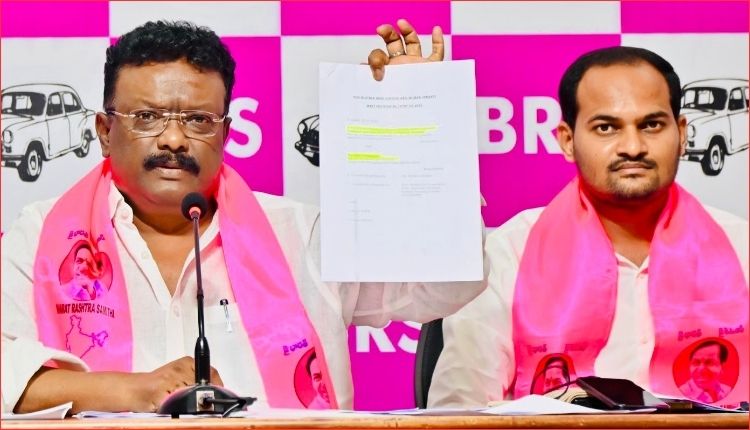
Hyderabad: BRS MLC Dr. Dasoju Sravan Kumar alleged that the tendering process in the Telangana Education Department had become illegal, manipulated and corruption-driven under a centralized procurement system.
Addressing the media, he claimed that the earlier decentralized procurement model allowed residential welfare institutions and district collectors to invite tenders based on local needs. According to him, local MSMEs, Padmashali weaving families, tailors and small industries supplied materials under that system.
Dr. Sravan Kumar said the earlier mechanism supported local employment and distributed economic growth among small businesses. However, he alleged that the Congress government replaced the system with centralized procurement after Chief Minister A. Revanth Reddy assumed office.
He also claimed that the government introduced the new system without consulting opposition parties or stakeholders. Furthermore, he described the mechanism as a “centralized corruption model” intended to control contracts worth thousands of crores through the Chief Minister’s Office.
Centralized corruption education tenders hurt MSMEs
Dr. Sravan Kumar alleged that the government established a Project Monitoring Unit through GO Ms No.17/202 to implement centralized procurement. He claimed that the PMU functioned under the SC Welfare Residential Schools Secretary and that officials recently appointed a non-IAS officer named Sharada to a key role.
He further alleged that authorities replaced officers such as Nicholas, R.S. Praveen Kumar and Ronald Rose with non-cadre officials. According to him, those officials would not question irregularities.
The BRS leader also alleged that tender eligibility norms favoured large companies. He said suppliers of uniform material had to show a turnover of Rs 250 crore, while notebook suppliers needed a turnover of Rs 150 crore. Participants also had to submit solvency certificates ranging from Rs 2 crore to Rs 4 crore.
According to him, such conditions prevented small Padmashali families, MSMEs and local manufacturers from participating in the tender process. Moreover, he criticised the government for not providing design specifications in advance for items such as trolley bags, PT dresses and blankets.
Dr. Sravan Kumar also alleged that the government failed to declare a base price in the tenders. Therefore, he said companies could quote arbitrary rates and inflate contract values.
Centralized corruption education tenders face legal questions
The BRS MLC pointed out that the Telangana government issued GO Ms No.1 in 2024 directing departments to procure cloth-related products through the Telangana State Handloom Weavers Cooperative Society Limited.
He said the order aimed to protect nearly 40,000 handloom weaving families in the state. However, he alleged that the government ignored the GO and proceeded with centralized procurement through the PMU system.
Referring to a High Court case involving a handloom cooperative society from Warangal, Dr. Sravan Kumar said Justice Anil Kumar Jukanti observed that cooperative societies enjoyed constitutional protection under Article 43B.
According to him, the High Court directed the government to make purchases through TESCO. Despite that, he alleged that the government continued centralized procurement while claiming that TESCO lacked supply capacity.
Dr. Sravan Kumar questioned how contracts worth Rs 1,200 crore were being awarded to companies that should have been denylisted. He demanded immediate cancellation of the tenders and a comprehensive inquiry into the procurement process.
He warned that if the government failed to act, the BRS would approach the State Vigilance Commission, Central Vigilance Commission and courts.