

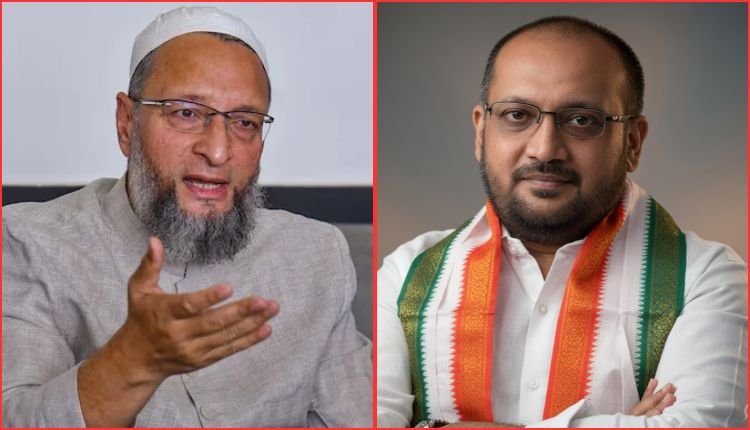
Hyderabad: Congress leader Mohammed Waliullah Sameer accused AIMIM president Asaduddin Owaisi of promoting a political formula in Uttar Pradesh that he had never implemented in Telangana. He questioned Owaisi’s Muslim leadership model, alleging that AIMIM had failed to develop independent leaders beyond its traditional strongholds.
Sameer, the Congress in-charge for the Hyderabad Lok Sabha constituency and a former DCC president, issued the criticism on Thursday. He was responding to Owaisi’s recent speeches urging Muslims in Uttar Pradesh to develop independent leadership rather than depend on Nehru-Gandhi or Yadav political leadership.
Sameer said Owaisi must explain how many independent Muslim leaders AIMIM had developed outside its established constituencies during decades of political influence in Telangana. He questioned why the party had not expanded opportunities for Muslim leaders across the state despite its organisational presence.
Congress questions Owaisi’s Muslim leadership model
Sameer referred to Owaisi’s remarks that Muslims should stop serving other political leaders and instead become leaders themselves. He asked why AIMIM had not applied the same principle in Telangana.
“Owaisi is telling Muslims in Uttar Pradesh that Abdul should no longer spread the carpet for others and should himself become a leader. Fine. But before giving this advice in Azamgarh or Rampur, he should tell us what happened to Abdul in Telangana. Why was he never allowed to move beyond a few selected constituencies?” Sameer asked.
He said greater Muslim political representation was necessary and should not become a point of disagreement. However, he questioned whether AIMIM had expanded representation or concentrated political influence within a limited geographical area.
“Muslims certainly need more representation. They need more MLAs, MPs, ministers, mayors, councillors and party office-bearers. But the real question is whether Owaisi has expanded that representation or simply monopolised it in a limited geography,” he said.
AIMIM’s nine-seat strategy in Telangana questioned
Sameer pointed out that AIMIM contested only nine of Telangana’s 119 Assembly constituencies in the 2023 elections. He questioned why the party had not offered opportunities to Muslim professionals, women, social workers and educated young people elsewhere.
“If Owaisi genuinely believes that Muslim youth are being denied platforms by larger parties, why did AIMIM itself leave 110 Assembly constituencies untouched?” he asked. He also criticised AIMIM’s support for the then BRS in most constituencies where it did not field candidates.
Sameer argued that this approach contradicted Owaisi’s call for independent Muslim political leadership in Uttar Pradesh. “In Uttar Pradesh, Owaisi says Muslims should stop depending on others. In Telangana, he voluntarily handed over political space to another party. That is not independent leadership. That is selective politics,” he said.
He alleged that AIMIM promoted Muslim empowerment more aggressively while expanding into Uttar Pradesh, Bihar, Maharashtra and West Bengal. However, he claimed the party had not developed a statewide generation of Muslim leaders in Telangana.
Hyderabad’s political representation comes under scrutiny
Sameer said Hyderabad should have demonstrated the effectiveness of Owaisi’s Muslim leadership model if the approach had delivered meaningful results. He referred to AIMIM’s longstanding parliamentary representation, municipal influence and elected representatives in Hyderabad.
According to Sameer, the party should have developed numerous leaders from ordinary families with statewide and national political standing. Instead, he alleged that political influence remained concentrated while ordinary Muslims continued to face problems.
He identified education, employment, housing, healthcare, civic infrastructure and economic opportunities as major concerns. Sameer also criticised Owaisi’s metaphor about Muslims spreading carpets for other political leaders.
He argued that the comparison portrayed Muslim voters as passive followers rather than independent political decision-makers. “Muslim voters are not people who have spent decades spreading carpets for politicians. They have repeatedly made strategic choices based on the political situation before them,” he said.
He noted that Muslim voters had supported Congress, regional parties, independents and AIMIM at different times. Sameer rejected Owaisi’s criticism of Congress over Muslim political leadership.
He said Congress had provided opportunities for Muslims to occupy major constitutional, political and administrative positions. He cited Muslim Presidents, Governors, Union Ministers, Chief Ministers and State Ministers under Congress-led politics.
According to him, the party’s record demonstrated that Muslim leaders could hold responsibilities extending beyond their own communities. He acknowledged that Congress needed to create more opportunities for Muslim youth and women.
However, he rejected suggestions that Muslims had historically remained political followers under Congress. Sameer also argued that genuine leadership required support across religious and social communities.
He said Muslim leaders should seek the confidence of Hindus, Dalits, OBCs, Christians, Sikhs and other sections of society. He cautioned against equating independent Muslim leadership with political isolation.
Sameer challenges AIMIM over electoral strategy
Sameer questioned AIMIM’s electoral approach in Hyderabad and other states. He alleged that AIMIM urged Muslims to consolidate behind the party in Hyderabad by warning against a possible BJP advantage.
However, he claimed the party encouraged Muslim voters to move away from Congress and other anti-BJP formations elsewhere. He argued that the difference required public scrutiny, particularly in closely contested elections.
Sameer acknowledged AIMIM’s democratic right to contest elections but said voters could also question the political consequences. He referred to triangular and multi-cornered contests where narrow victory margins could influence electoral outcomes.
Additionally, he challenged AIMIM to disclose how many new Muslim leaders it had developed across Telangana over two decades. He sought details about opportunities given to women, younger politicians and people from poor and middle-class families.
Sameer also raised questions about Owaisi’s financial progress and Hyderabad’s development. He claimed Owaisi’s declared assets had increased from approximately Rs 39 lakh in 2004 to more than Rs 23 crore in 2024.
However, he said legitimate personal prosperity was not objectionable. Instead, he argued that voters should examine whether their own economic security, educational opportunities and living conditions had improved.
Sameer called for political debates to focus on measurable outcomes rather than symbolic slogans. He identified schools, scholarships, employment, business opportunities, housing, hospitals and clean neighbourhoods as priorities for Muslim communities. Sameer challenged Owaisi to demonstrate his political approach through concrete measures in Telangana.
He suggested that AIMIM should contest more Assembly seats and identify 50 to 100 young Muslim leaders across the state. He also called for a five-year leadership development effort, with greater opportunities for women and first-generation political workers.
According to Sameer, such measures would demonstrate whether AIMIM could build leadership beyond its existing electoral strongholds. “Let him prove that AIMIM is a leadership-building movement and not merely an election machine concentrated in a few seats,” he said.
He maintained that Owaisi’s speeches in Uttar Pradesh would gain credibility only if AIMIM demonstrated comparable leadership development in Telangana. “Until then, it will look like he is exporting a political product that he never tested successfully at home,” Sameer said.