

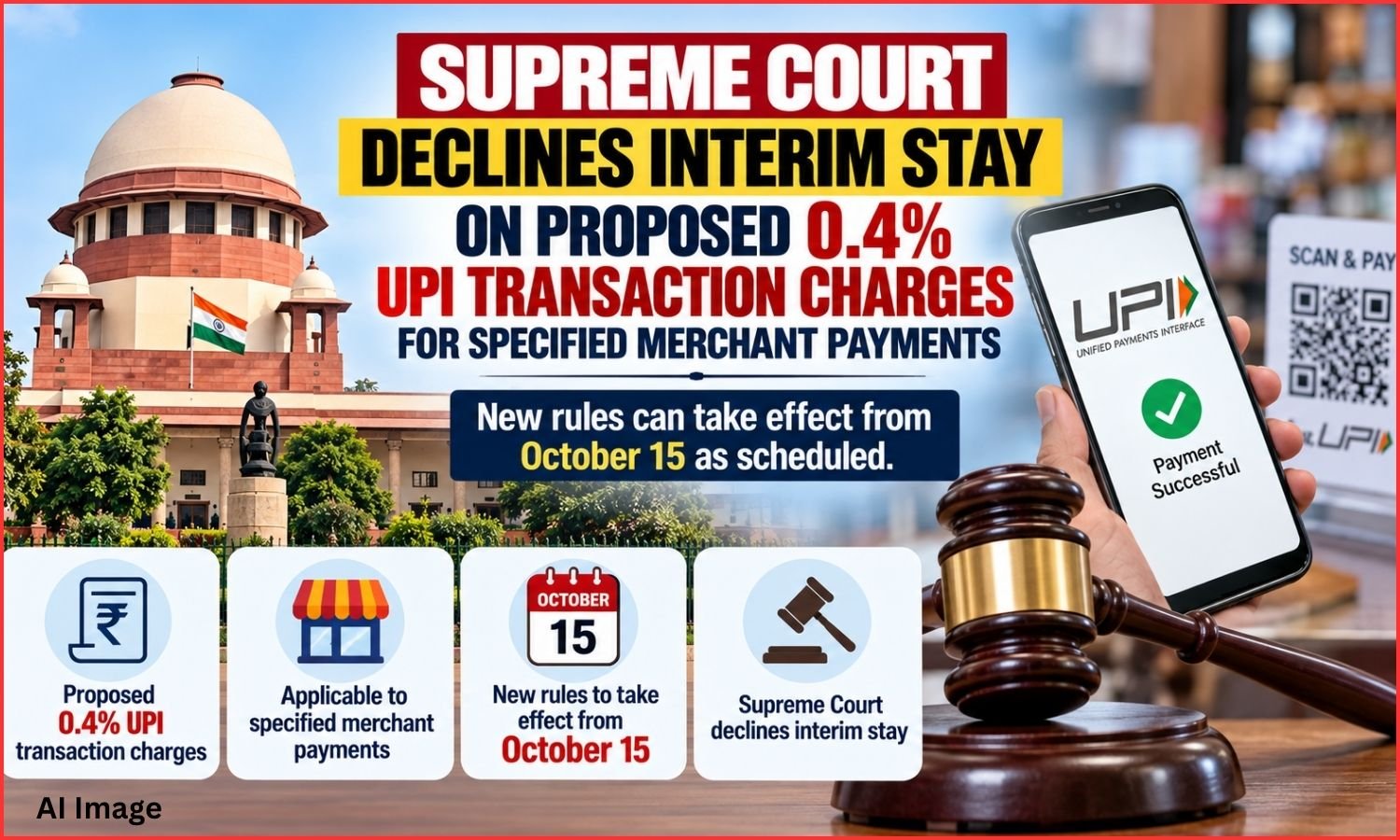
Hyderabad: The Supreme Court declined an interim stay on the proposed UPI transaction charges of 0.4% for specified payments. As a result, the new rules can take effect from October 15.
The court heard a public interest petition challenging the proposed charges. Meanwhile, a bench headed by Chief Justice Surya Kant refused to suspend the rules at this stage.
The bench also issued notices to the Centre, Reserve Bank of India, National Payments Corporation of India and other respondents. It gave them four weeks to file their counter affidavits.
In addition, the court asked the Centre to explain the basis for introducing the new charges. Accordingly, the government must provide details on the rationale behind the proposed fee.
UPI transaction charges will apply to specified merchant payments
Under the September notifications, a 0.4% Merchant Discount Rate will apply to specified UPI payments above Rs 2,000 made to merchants. However, the structure includes different limits and exemptions.
For transactions of Rs 75,000 and above, the maximum charge will be Rs 300. At the same time, the government said the revised structure would have limited impact on ordinary users.
In particular, person-to-person UPI transactions will remain outside the proposed charge structure. Similarly, payments of up to Rs 2,000 made to merchants will remain free.
In addition, small merchants receiving up to Rs 1 lakh a month through UPI QR code payments will continue under the zero-MDR provision. For essential services, the charge will remain a flat Rs 5.
Meanwhile, capital market transactions will carry a lower charge of 0.02% under the proposed structure.
The Centre also told the court that nearly 96% of merchant transactions would face no impact from the new fee. It further said the charge was not a tax intended to generate government revenue.
Instead, the government described it as a settlement fee linked to the payment system. The additional solicitor general appearing for the Centre also said consumers would not pay the charges directly.
Therefore, the court’s refusal to grant an interim stay allows the proposed rules to proceed from October 15. However, the Supreme Court has not issued a final ruling on the validity of the charges.
Going forward, the court will examine the matter after the Centre and other respondents file their affidavits.