

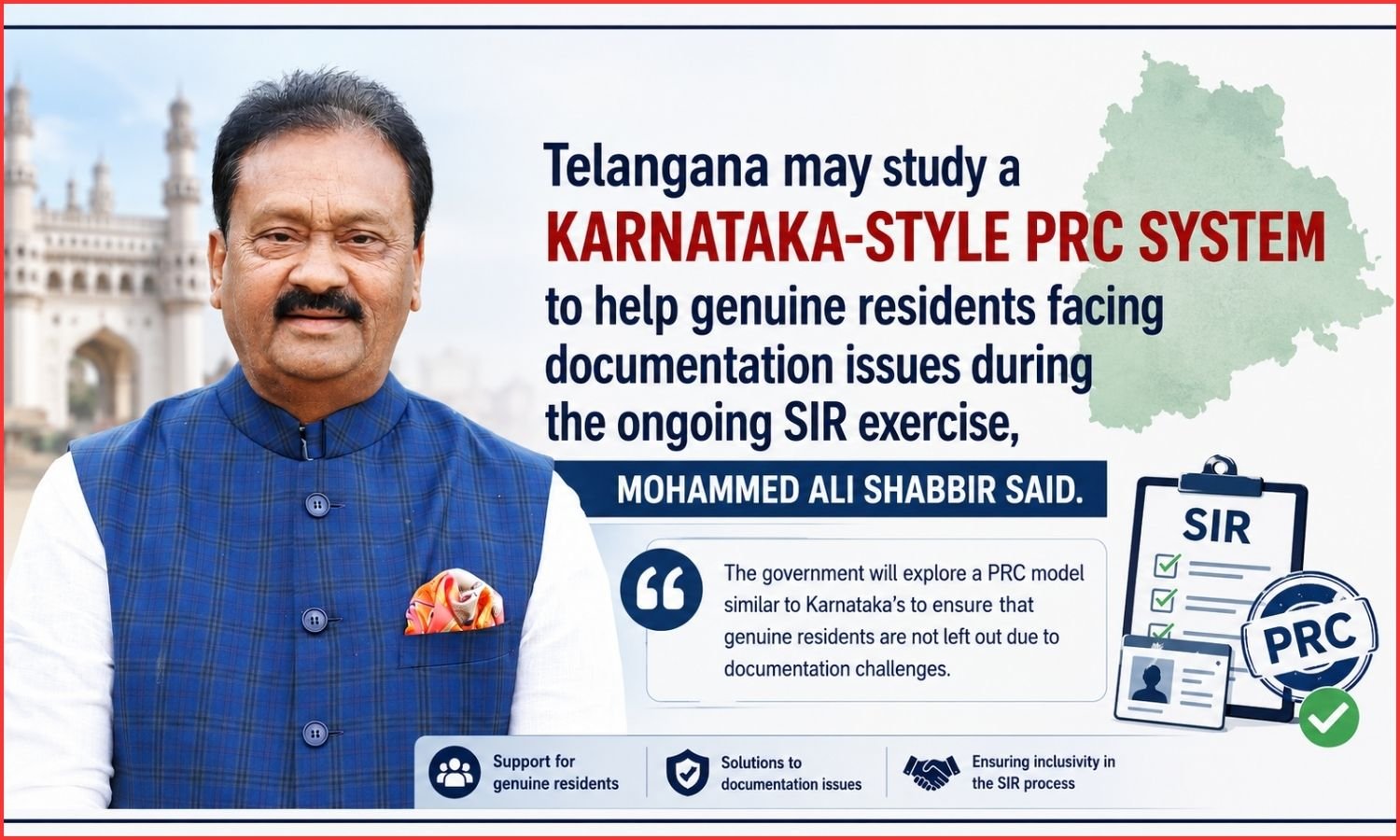
Hyderabad: The Telangana government may constitute a cabinet sub-committee to examine the feasibility of introducing a Karnataka-style PRC system, Adviser to the Government Mohammed Ali Shabbir said on Monday.
Shabbir Ali said he had submitted the proposal to Chief Minister A. Revanth Reddy. Meanwhile, he said the Chief Minister had discussed the issue with senior officials.
According to Shabbir Ali, the proposed panel would study Karnataka’s Permanent Residence Certificate (PRC) framework. It would also examine whether Telangana could adopt a similar system.
Karnataka-style PRC system to address SIR documentation issues
Shabbir Ali said the proposed certificate could help long-term residents establish permanent residence during the ongoing Special Intensive Revision (SIR) of electoral rolls. Further, it could assist residents who could not trace their own names or those of their family members in the 2002 electoral rolls.
He said the Election Commission’s indicative list of documents included a Permanent Residence Certificate issued by a competent State authority. Therefore, a PRC issued after verification by the Telangana government could serve as supporting evidence if electoral authorities later sought proof of eligibility.
Shabbir Ali clarified that officials were not seeking documents while collecting enumeration forms during the house-to-house survey. However, electoral authorities could later issue notices to voters whose names could not be linked to the 2002 electoral rolls.
He said the proposed PRC could benefit young voters who were not eligible in 2002. It could also help married women whose names or addresses had changed. Additionally, families that shifted between constituencies and residents with spelling differences in old records could benefit. Poor and older residents lacking older records could also use the certificate to establish long-term residence.
Explaining the Karnataka model, Shabbir Ali said revenue officials issued the certificate after verifying an applicant’s permanent residence. Moreover, officials considered the overall evidence instead of rejecting applications because one document was unavailable. They could examine birth records, educational certificates, Aadhaar, ration cards, property records, electoral entries and government service records. Local enquiries could also support the verification process when required.
Shabbir Ali said a similar system in Telangana could reduce hardship for genuine residents without weakening the verification process. He expressed confidence that the proposed cabinet sub-committee would recommend a framework suited to Telangana’s administrative and legal requirements.