
Hyderabad Ramadan food delivery surge reshaped orders and operations

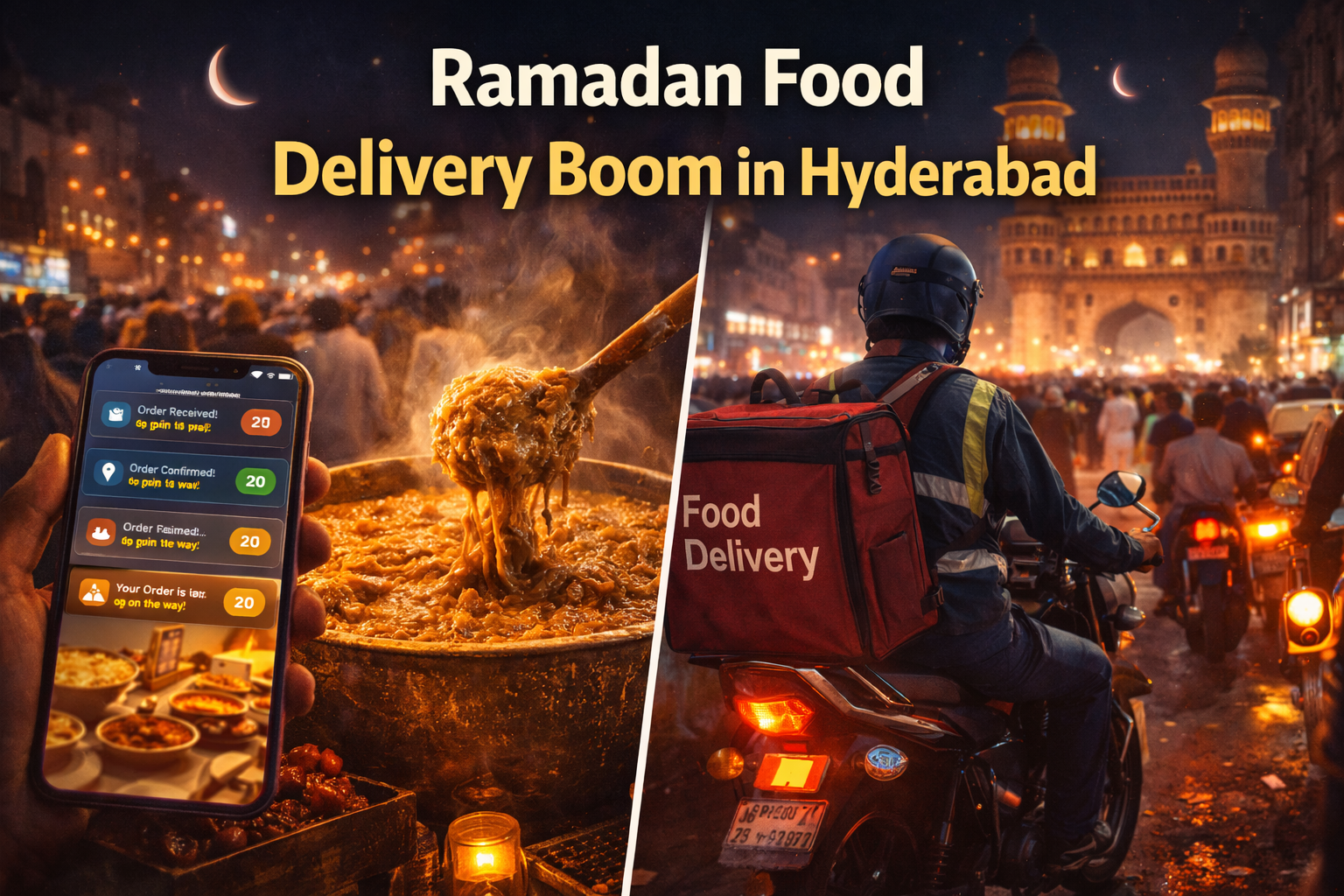
Hyderabad: The Hyderabad Ramadan food delivery boom drove a sharp rise in online orders during the holy month, reshaping consumer habits, restaurant operations and delivery networks across the city.
The surge turned Ramadan into the busiest and most profitable season for food delivery platforms such as Swiggy and Zomato in Hyderabad. The shift also altered a long-standing food culture that had traditionally relied on family visits to restaurants for Iftar and Sehri.
Hyderabad’s Ramadan season remained a major cultural and economic event. Across areas from Charminar, Pathergatti, Mallepally and Moghalpura to Hitech City, Banjara Hills and Gachibowli, food activity intensified after sunset. However, worsening traffic and changing lifestyles pushed more residents toward app-based ordering.
The Hyderabad Ramadan food delivery trend drew strength from the city’s culinary identity. Hyderabad retained its global reputation for biryani, while haleem became the defining Ramadan dish. The source described haleem not only as a food item but also as part of the city’s cultural identity, noting that it had received a GI tag.
Hyderabad Ramadan food delivery surged on haleem demand
During Ramadan, order volumes on food delivery apps rose several times above normal levels. According to Swiggy’s Ramadan Order Analysis 2024, Hyderabad again stood out for high consumption of biryani and haleem.
The source said haleem orders recorded an extraordinary increase of 1454.88 percent during Ramadan. It presented this as the sharpest rise among all dishes on the platform. The same data also said Hyderabad residents ordered more than 10 lakh plates of biryani through Swiggy during Ramadan 2024.
These figures placed haleem and biryani at the centre of the city’s Ramadan economy. They also showed how strongly the Hyderabad Ramadan food delivery pattern depended on a few iconic dishes that dominated both consumer demand and platform revenue.
Apps also faced a shift in timing. Instead of regular lunch and dinner peaks, Ramadan produced what the source called a three-peak window. This changed staffing, logistics and kitchen workflows across the sector.
Hyderabad Ramadan food delivery followed three peak windows
The first wave came before Iftar, between 4:30 pm and 6:30 pm. This period emerged as the busiest part of the day as fasting residents prepared to break their fast. Swiggy said orders rose 34 percent during this window. Haleem, samosas, dahi vada and lukhmi led demand.
The source said delivery riders were seen queueing outside popular outlets such as Pista House and Shah Ghouse during this period. That rush reflected the pressure placed on restaurants and platforms in the narrow window before sunset.
The second peak came after Isha prayers and Taraweeh, between 10 pm and 12:30 am. At that hour, customers moved toward heavier meals, especially biryani, nihari and kebabs. The source said IT professionals in Hitech City and Gachibowli relied heavily on apps during this late-night period.
The third wave came during Sehri, from 2 am to 4 am. Orders for khichdi-keema-khatta and fried meat increased during these hours. The source also said some users continued ordering biryani even at 4 am, underlining Hyderabad’s unusual Ramadan food habits.
Alongside the large platforms, the report referred to special early-morning services such as Suhoor Express and Sehri Dot In. These services delivered home-style meals including parathas, eggs and curd around 3 am. The source said the trend continued in Ramadan 2025, although rider strikes created some disruption.
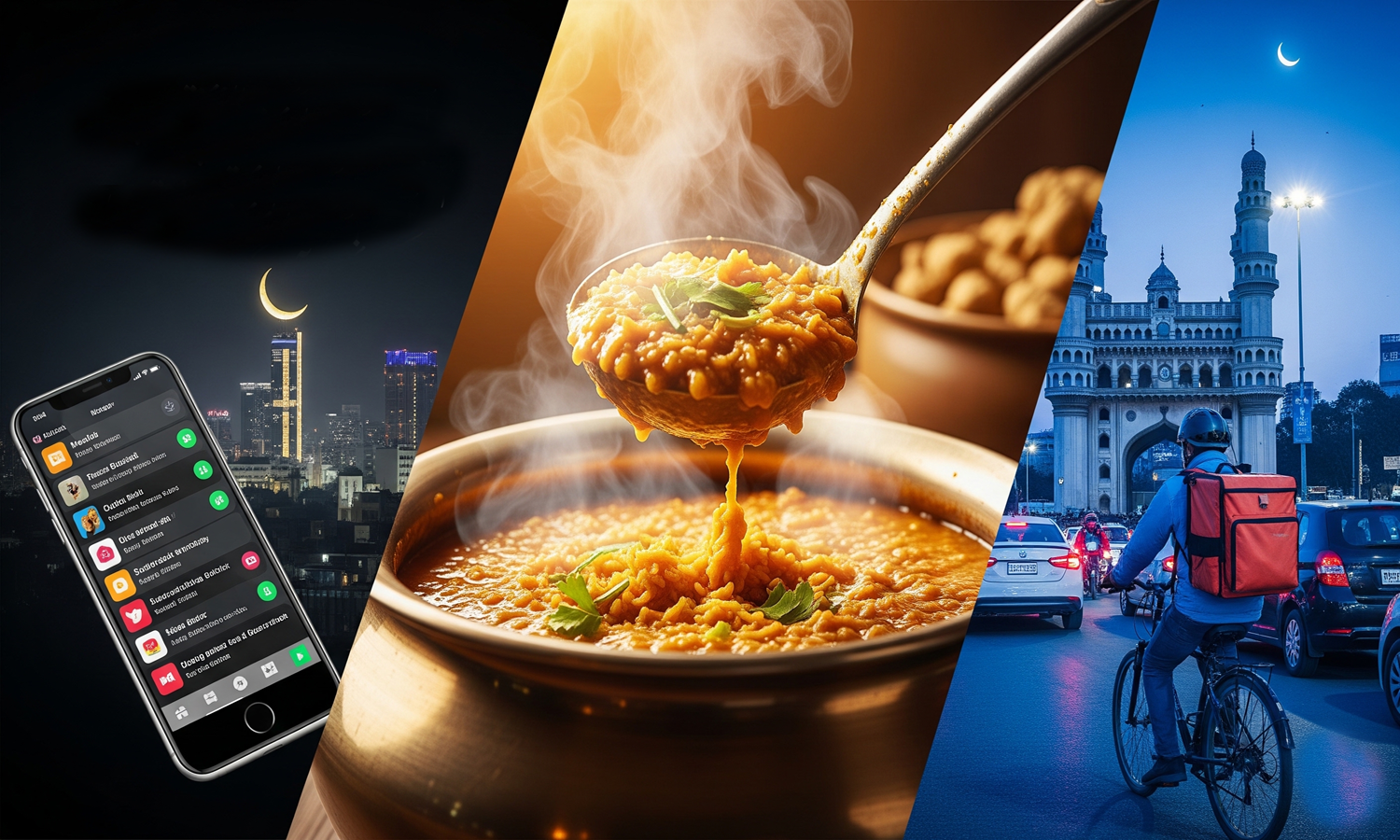
Consumer shifts widened Hyderabad Ramadan food delivery habits
Ramadan also changed how users placed orders. Family and group orders became more common because Iftar and Sehri remained collective meals. In response, restaurants introduced Iftar boxes and family combo packs.
The source singled out Pista House’s Iftar box, which included haleem, dates, fruits and snacks, as one of the most popular online choices. Corporate offices also placed large Iftar orders, expanding the customer base beyond households.
Quick commerce added another layer to the Hyderabad Ramadan food delivery market. Demand grew not only for prepared meals but also for raw and semi-prepared essentials such as dates, dry fruits and beverages. Platforms such as Swiggy Instamart and Blinkit saw heavy Ramadan demand.
The source said Swiggy Instamart received around five lakh orders for dates and dry fruits in Hyderabad during Ramadan 2024. It presented this as evidence of the growing appeal of rapid delivery for Iftar essentials, with customers seeking fresh and premium products within 10 to 15 minutes.
Health-focused ordering also increased. While traditional dishes remained dominant, more consumers searched for high-protein meals, fruit salads and lower-oil options for Iftar and Sehri. The source said Swiggy’s 2025 report placed Hyderabad as India’s third-largest city for high-protein orders, with volumes reaching 22.13 lakh.
Hyderabad Ramadan food delivery boosted platform revenue race
Ramadan remained financially valuable for food delivery companies, but it also tested their logistics. The source said India’s food delivery sector reached gross output of Rs 1.2 lakh crore in financial year 2024-25.
Within Hyderabad, competition between Zomato and Swiggy remained intense. The source said Zomato held a market share of about 55 to 58 percent, while Swiggy stood at 42 to 45 percent. During Ramadan, both companies stepped up promotions to capture a larger share of orders.
The report said Swiggy installed LED billboards in places such as Secunderabad and Tolichowki. These displays showed a burning haleem pot to attract attention during the season. This aggressive marketing reflected how central Hyderabad Ramadan food delivery had become to the companies’ seasonal business strategy.
The labour side also came under strain. Many delivery partners were themselves fasting and took breaks at Iftar, reducing rider availability during the busiest slot. To manage the shortfall, platforms hired extra temporary workers and offered peak-hour bonuses.
The source said Swiggy and Zomato introduced bonus payouts of Rs 120 to Rs 150 per order for evening work. It also said some riders earned up to Rs 3,000 a day during Ramadan. At the same time, platforms relied on AI-based route optimisation and batching tools to reduce delays and assign multiple orders within the same locality to one rider.
Restaurants adapted Hyderabad Ramadan food delivery operations
For Hyderabad’s restaurant sector, Ramadan marked the high point of the business calendar. Major brands such as Pista House, Paradise and Mehfil reportedly redirected major resources toward online fulfilment.
To manage demand, many outlets adopted the cloud kitchen model. These kitchens focused only on delivery and did not offer dine-in service. The source said brands such as Pista House set up hundreds of temporary stalls and kitchens during Ramadan to reduce delivery times while following standard procedures.
Restaurants also narrowed their menus during the month. Instead of offering wide selections, they focused on high-demand items such as haleem and biryani. This improved kitchen efficiency and allowed faster order processing during peak periods.
The report said restaurants also trained waiters and kitchen staff for the Iftar rush. Some businesses used inventory management software to secure dates, meat and grains in advance and avoid shortages during high-demand periods.
The source further said tax scrutiny increased as turnover rose. It stated that in November 2025 the Income Tax Department conducted searches on major Hyderabad restaurant groups, including Pista House, Shah Ghouse and Mehfil, to examine sales records and digital transactions. The report linked that action to the huge volumes generated during festive trading periods.
Safety and traffic strained Hyderabad Ramadan food delivery
The expansion of Hyderabad Ramadan food delivery also exposed deep operational problems. Congestion in Charminar, Mallepally and Tolichowki worsened during Ramadan evenings. Under pressure to deliver quickly, some riders were seen violating traffic rules by breaking signals or riding in the wrong direction.
The source said the Telangana Gig and Platform Workers Union raised concerns that quick-delivery policies were putting riders at risk. Heat added another hazard because Ramadan often fell during warmer months, increasing the risk of dehydration for fasting workers on the road.
The report also cited an August 2025 incident involving a Hyderabad delivery rider, Syed Farhan, who fell into an open drain during rain. His motorcycle and phone were lost. The source said the incident renewed debate over worker safety and the responsibility of platform companies. It added that the union argued a rain bonus of Rs 10 or Rs 15 could not compensate for the risk to life.
Order cancellations and quality control remained additional challenges. At Iftar, apps sometimes crashed or deliveries were delayed for hours because of the volume spike. That led customers to cancel orders, affecting both riders and restaurants. The source also said maintaining hygiene and food quality during extreme rush hours remained difficult.
Hyderabad Ramadan food delivery prompted reform proposals
The report also outlined practical steps for the sector. It said apps should encourage pre-ordering and scheduled deliveries two to three hours before Iftar so that pressure did not build in the final minutes.
It recommended hydration stations for riders at different locations in the city, run jointly by restaurants and platforms. It also called for improved packaging that could keep haleem, nihari and similar dishes hot for longer periods.
The source said restaurants needed to protect hygiene standards despite the rush. It also argued for wider structural measures, including life insurance and safety protections for riders and stronger coordination between traffic police and delivery platforms through a dedicated Ramadan traffic task force.
Consumers, too, were asked to change behaviour. The report urged residents to place Iftar orders at least an hour earlier so that riders faced less danger on the roads.
The Hyderabad Ramadan food delivery surge therefore reflected more than a digital convenience story. It showed how technology had reshaped a deeply rooted culinary tradition while creating fresh opportunities, heavier workloads and new safety risks. The month drove record demand for haleem, biryani and Sehri meals, but it also exposed the pressure placed on riders, restaurants and city infrastructure.