
Hyderabad Ramadan dining culture drives night economy and social change

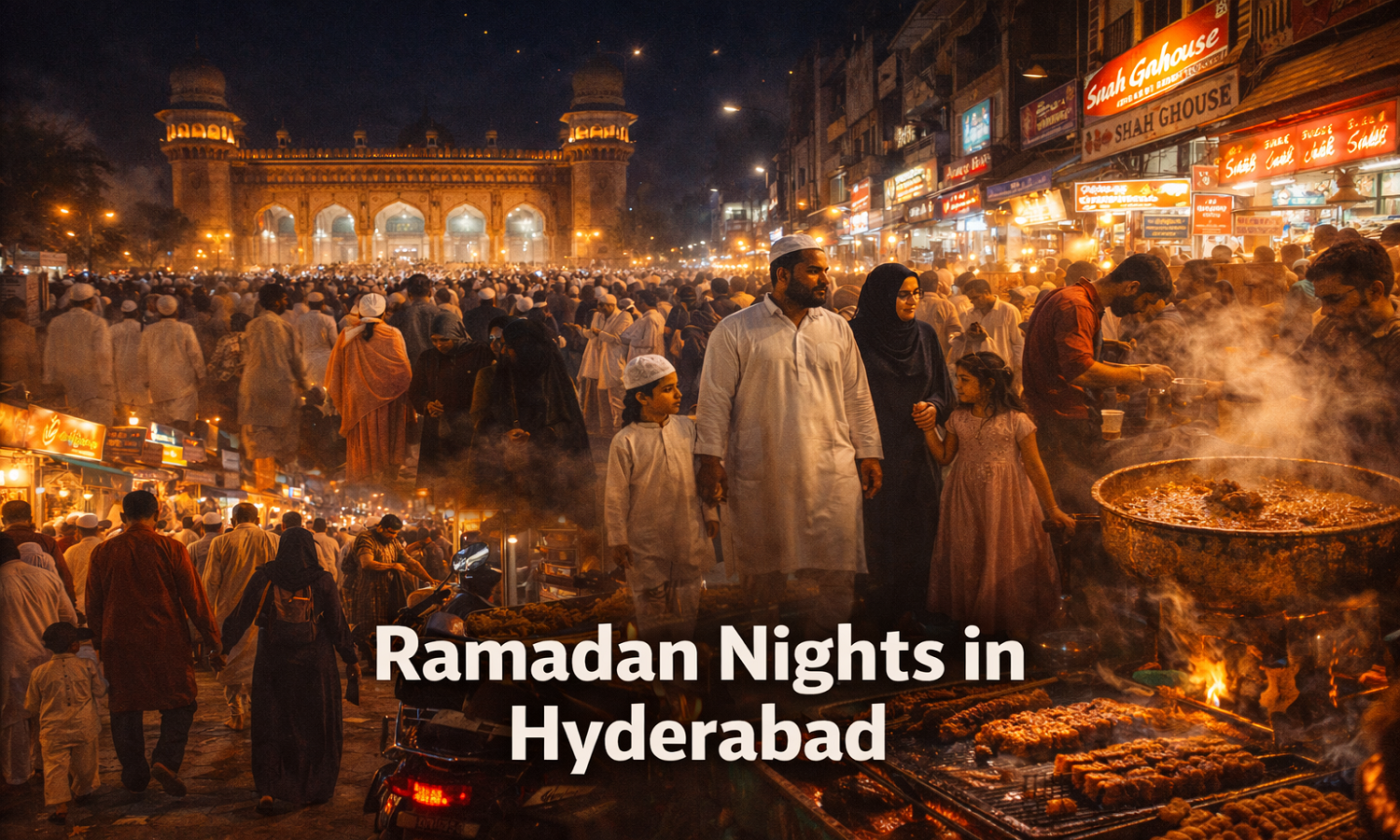
Hyderabad: The Hyderabad Ramadan dining culture transformed the city’s routine into a night-centric economy, where religious practice, social life and commerce converged during the holy month.
The shift from day to night activity became pronounced during Ramadan. After Taraweeh prayers, markets and restaurants witnessed a surge in crowds. This post-prayer movement created a second wave of economic activity, linking spirituality directly with commerce.
As a result, the Hyderabad Ramadan dining culture emerged as a defining urban phenomenon. It combined centuries-old traditions with modern consumption patterns, sustaining both identity and economic momentum.
The report examined how religious observances interacted with commercial expansion. It also analysed traffic management, civic planning and changing consumer behaviour during late-night hours.
Hyderabad Ramadan dining culture rooted in history
The Hyderabad Ramadan dining culture traced its origins to the Bahmani period and expanded under the Asaf Jahi rulers. Over time, Persian, Arab and Mughal influences blended with Deccani culinary practices.
Traditional communal dining on floor-spread cloths gradually evolved into modern restaurant formats. However, the essence of shared meals and rich flavours remained intact.
In the nineteenth and twentieth centuries, migrant communities added further diversity. Iranian tea became a staple between prayers and Sehri. Meanwhile, the Arabic dish Harees evolved locally into Hyderabadi haleem.
Haleem later received a geographical indication (GI) tag. Consequently, it gained recognition in both domestic and global markets, strengthening the Hyderabad Ramadan dining culture.
Post-Taraweeh surge defines Hyderabad Ramadan dining culture
During Ramadan, daily schedules followed the lunar calendar. However, peak activity began after Taraweeh prayers. From Iftar to Sehri, the city functioned as a vibrant night economy.
Large congregations gathered at major mosques such as Mecca Masjid and Shahi Masjid. After prayers, these crowds moved collectively toward food hubs and markets.
This sudden influx created intense demand at restaurants. Notably, people from different communities also joined the gatherings. Therefore, the Hyderabad Ramadan dining culture reflected both religious and social integration.
Women’s participation strengthens Hyderabad Ramadan dining culture
Improved facilities for women in mosques significantly influenced late-night activity. Separate entrances, ablution areas and prayer spaces encouraged higher participation.
Earlier, women’s presence in congregational prayers remained limited. However, better infrastructure changed this trend. Consequently, families increasingly stayed out after prayers instead of returning home.
This shift directly impacted dining patterns. Entire families, including elders and children, became part of late-night outings. Thus, the Hyderabad Ramadan dining culture expanded into a family-oriented social space.
Regional hubs shape Hyderabad Ramadan dining culture
Different areas of the city reflected distinct patterns of night activity. The Old City, especially around Charminar and Madina Building, remained the emotional and commercial core.
Thousands of temporary stalls operated from evening until Sehri. The air carried aromas of kebabs, haleem and sweets. Meanwhile, Tolichowki emerged as a bridge between traditional and modern dining preferences.
Areas like Mehdipatnam, Mallepally and Banjara Hills also witnessed high activity. Barkas gained attention for Yemeni-influenced dishes and collective mandi dining. In contrast, IT corridors such as Gachibowli and Madhapur adapted the culture into a more cosmopolitan format.
Haleem industry drives Hyderabad Ramadan dining culture
Haleem became the economic backbone of Ramadan activity in the city. The seasonal industry generated revenue worth hundreds of crores within a month.
It also created employment for nearly one lakh people. Workers included chefs, helpers, delivery staff and even management students seeking temporary roles.
However, rising demand caused price fluctuations in meat, ghee and spices. This trend placed pressure on small traders, highlighting challenges within the Hyderabad Ramadan dining culture.
Civic management challenges during Hyderabad Ramadan dining culture
Authorities implemented special measures to sustain round-the-clock activity. Shops received permission to remain open for extended hours. Traffic police deployed additional personnel in busy zones.
Despite these steps, enforcement varied across locations. This inconsistency created confusion among traders and consumers.
On occasions like Jummat-ul-Vida, large-scale traffic diversions and designated parking zones were introduced. Public transport services were also extended. These measures reflected the complexity of managing the Hyderabad Ramadan dining culture.
Social shifts redefine Hyderabad Ramadan dining culture
Ramadan nights in Hyderabad increasingly adopted a family-oriented character. Restaurants introduced family halls, group dining packages and children-specific menus.
Social media further accelerated visibility. Viral videos often turned small eateries into citywide attractions overnight.
At the same time, challenges such as inflation, congestion, sanitation and food quality persisted. Addressing these concerns remained essential for long-term sustainability.
The Telangana government’s tourism policy aimed to integrate this night economy into formal planning. Projects to upgrade heritage zones like Charminar indicated a shift toward structured development.
The Ramadan dining culture thus represented more than a seasonal trend. It connected history, religion and commerce within a single urban framework.