

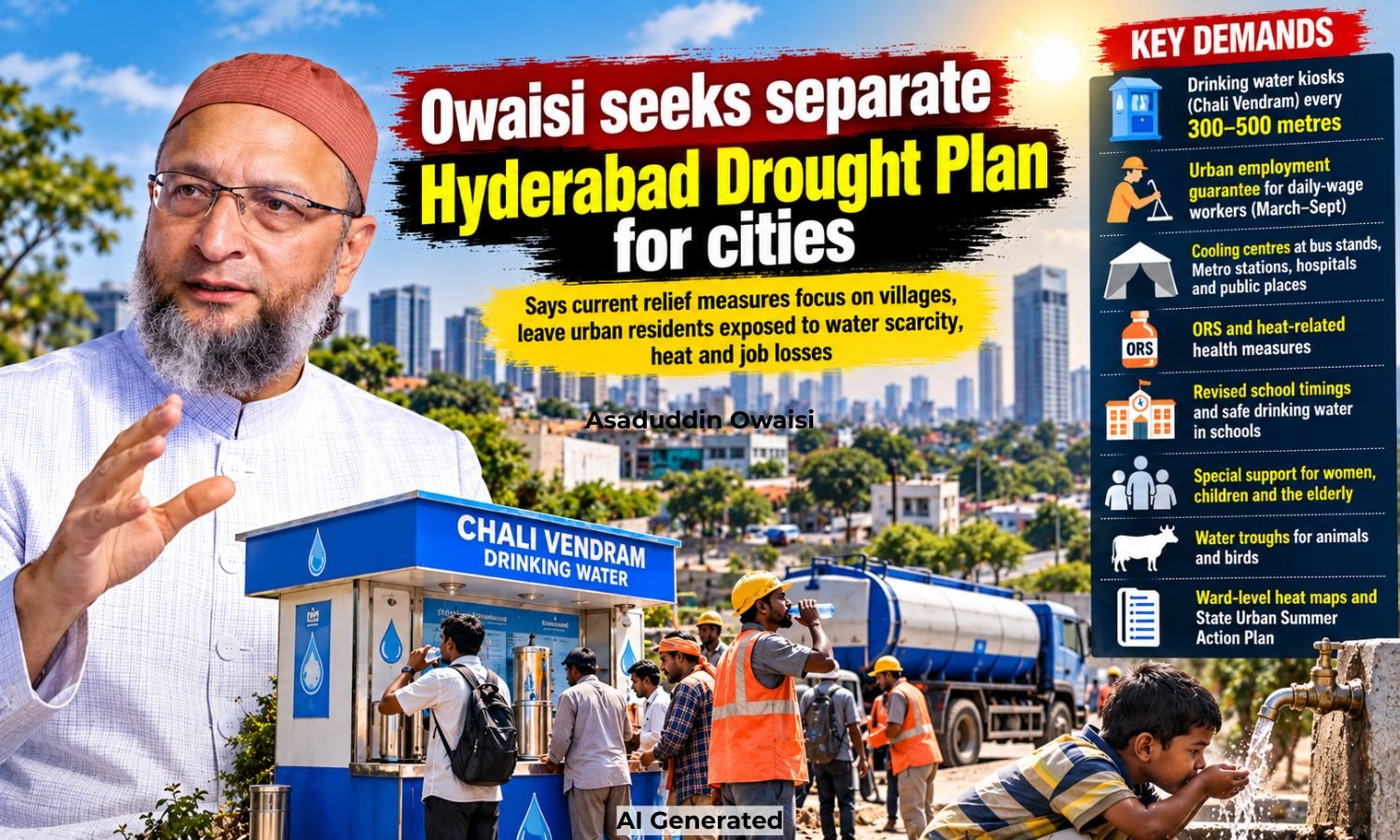
Hyderabad: AIMIM president and Hyderabad MP Asaduddin Owaisi has asked the Telangana government for a separate Hyderabad drought plan for cities, saying the State’s current relief measures are built for villages and leave urban residents exposed to water scarcity, heat and job losses.
Owaisi made the demand in a representation to Deputy Chief Minister Bhatti Vikramarka on October 28. He wanted the plan to cover Hyderabad, Cyberabad, Malkajgiri and the surrounding metropolitan areas, with specific protection for daily-wage workers, women, children and the elderly.
He welcomed the government’s move to declare 365 mandals in 31 districts as drought-affected. The declaration was made through G.O. Ms. No. 03, issued by the Revenue (DM-II) Department on October 24, 2026, after rainfall assessments.
Owaisi called the order a significant administrative step, but said it did not deal with the problems of crowded urban settlements, where water shortages, high temperatures, lost work and health risks can together cause serious hardship. Drought hits cities differently from farming areas, he argued, and so needs its own policy response.
Owaisi seeks drinking water kiosks every 300 to 500 metres
Owaisi proposed that the government issue an Urban Summer Action Plan and attach it to the existing drought-relief proceedings. The plan should apply to Hyderabad, Cyberabad, Malkajgiri and all HMDA towns, and fix the duties of each department involved.
Among his main demands was a network of drinking water kiosks, called Chali Vendram, placed every 300 to 500 metres along main roads, bus routes, markets, construction clusters and other busy public spots. He said the kiosks should supply safe, tested water and be maintained and monitored for the whole summer, so that pedestrians, transport workers, labourers and others who spend long hours in the heat can use them.
He also sought an urban employment guarantee for the March to September period, when water shortages and heat could slow economic activity. According to Owaisi, lakhs of daily-wage earners, including construction workers, street vendors and domestic workers, could lose work during the long dry spell.
He suggested that urban local bodies, including the Greater Hyderabad Municipal Corporation, be allowed to hire such workers in a manner that fits the existing drought-relief framework. The jobs could include running water kiosks, managing heat shelters, supporting sanitation work and cleaning tanks. The government, he said, should act in advance to protect jobs rather than step in only after livelihoods are hit.
Cooling centres and ORS at bus stands, Metro stations and hospitals
Owaisi demanded cooling centres at bus stands, railway stations, Metro stations, hospitals, primary health centres, schools, Anganwadis and places where people gather in large numbers. These would give short relief to people exposed to high temperatures, especially outdoor workers and those without proper shelter, he said.
He asked for oral rehydration salt (ORS) to be made available at public facilities and for health departments to be ready to treat heat-related illness. The representation also proposed an awareness drive for migrant workers, daily-wage labourers and other vulnerable groups on prevention and on how to get emergency help.
At bus terminals, labour addas, markets and other large public spaces, he wanted cooling centres and water kiosks set up in line with heat-action guidance from the National Disaster Management Authority and the National Disaster Management Institute. He also sought shade, water, ORS, seating and first aid at vulnerable locations.
On schools, Owaisi suggested changing timings so that children are not out in peak sunshine during assembly, dismissal and travel. He sought clear orders to government, aided and private schools to keep enough drinking water and proper hygiene facilities.
He asked for special arrangements for women, children and elderly residents, particularly those living alone or with poor access to basic services. These would include water kiosks, cooling facilities and ORS at Anganwadi centres, maternity centres, hospitals and women’s workplaces, along with separate and dignified water and sanitation facilities where needed.
Water troughs for animals and birds, ward-level heat maps sought
The plan Owaisi proposed also covers animals and birds. He sought water troughs and tanker refilling points for stray and community animals, cattle in peri-urban areas and birds, placed in public spaces and parks with named custodians to look after them. He called for municipal, public health, education and animal welfare agencies to work together on these measures.
Owaisi said the State should frame a specific State Urban Summer Action Plan with set heat-action thresholds, ward-level maps of heat and water vulnerability, named nodal officers, coordination between departments and information open to the public.
He listed the Municipal Administration and Urban Development Department, HMWSSB, TSSPDCL, Health, Education, Women and Child Welfare, Animal Husbandry and municipal bodies as the agencies that should take part.
According to Owaisi, urban drought preparedness should be handled as a separate administrative responsibility and not as a side extension of rural relief. He asked the government to publish the Hyderabad drought plan before summer, review its implementation at regular intervals, and include the protection of urban livelihoods and public health in Telangana’s response to the expected El Niño-related challenges.