

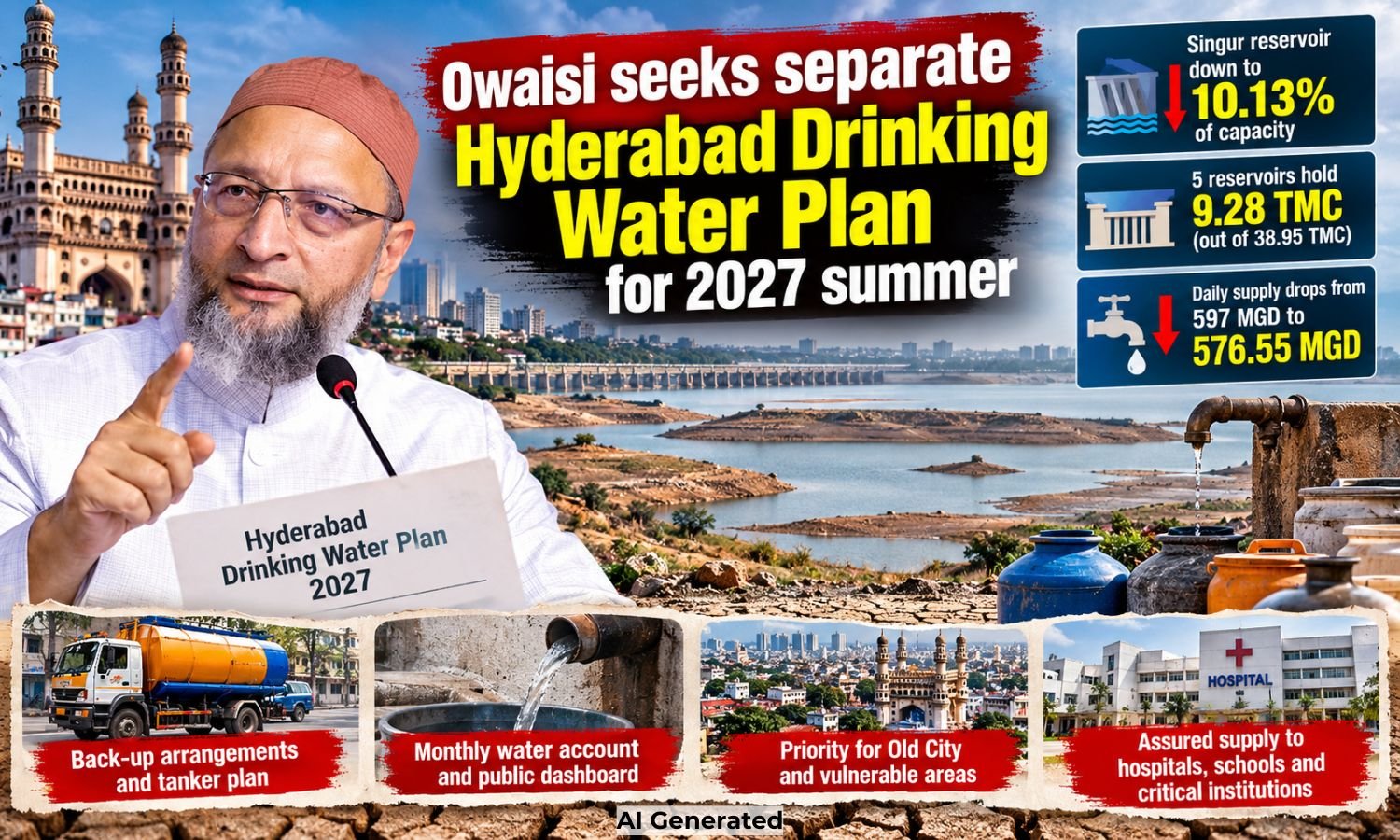
Hyderabad: AIMIM president and Hyderabad MP Asaduddin Owaisi has asked the Telangana government to draw up a separate Hyderabad drinking water plan for the 2027 summer, warning that falling reservoir levels could leave the city badly short of supply unless action is taken now.
Owaisi made the demand in a detailed representation to Deputy Chief Minister Bhatti Vikramarka on October 28. He wanted the plan to cover Hyderabad, Cyberabad, Malakajgiri and the full Hyderabad Metropolitan Development Authority (HMDA) region, with backup arrangements, open monitoring of how much water is available, and special protection for families who rely on public supply and private tankers.
The MP referred to the drought conditions linked to El Niño and the expected effect of poor rainfall in the months ahead. He welcomed the Cabinet sub-committee formed under the Deputy Chief Minister, but said the capital needed a separate response to its own water problems.
Singur reservoir down to 10.13% of capacity, says Owaisi
According to the figures he cited, Singur held 3.03 TMC against a full capacity of 29.92 TMC. Five of the eight reservoirs feeding the Hyderabad Metropolitan Water Supply and Sewerage Board (HMWSSB) together held 9.28 TMC, against a capacity of 38.95 TMC.
He said HMWSSB’s daily supply had already slipped from its usual 597 million gallons per day (MGD) to 576.55 MGD. Parts of the twin cities, Cyberabad and Malkajgiri were facing shortages, he added.
The letter put the city’s main supply at about 560 MGD, drawn from Krishna I, II and III (270 MGD), Godavari (160 MGD), Singur and Manjeera (105 MGD), Osman Sagar (15 MGD) and Himayatsagar (10 MGD).
Owaisi was most worried about Singur and Manjeera, which supply Hyderabad and nearby areas. He said both had nearly run dry and now yield only about 40 MGD, which has left the city leaning harder on other reservoirs and on the wider transmission network.
Owaisi wants Hyderabad drinking water plan with monthly water account
Owaisi urged the government to prepare and publish the summer plan for Hyderabad and the HMDA area. In his view, it should list how much water each source can provide, zone-wise supply timings, cut-off dates for turning to emergency sources, and a dashboard open to the public.
He demanded that the Irrigation Department, HMWSSB and Mission Bhagiratha together publish a monthly water account within 72 hours. The account, he said, should show legally available shares, minimum drawdown levels, limits on treatment and trunk mains, and monthly demand in the Core Urban Region.
Before summer, he said, officials should test normal, adverse and severe inflow scenarios against demand 10% and 20% above the baseline. Such exercises would help the administration spot vulnerable localities and line up alternatives before shortages turn critical, he argued.
He also asked the government to state whether the 65 MGD shortfall from Singur could be made up by drawing more from the Godavari. HMWSSB, he said, should explain what preventive steps could achieve and how any remaining need would be met.
On quality, Owaisi said residents had complained of discoloured, foul-smelling water whenever supply came from Osman Sagar and Himayatsagar. He sought details of treatment and testing, along with regular public reporting, so that water from these lakes stays safe to drink.
Small tankers for Old City, six-hour emergency response sought
Tanker operations formed a large part of his proposals, especially for crowded neighbourhoods with narrow roads. He asked for tankers of different sizes to be bought in advance, including 2.5 to 5 kilolitre vehicles that can enter Old City lanes. He also wanted separate handling of drinking and reclaimed water, enough filling bays, and payment to operators only for verified safe litres delivered.
Hospitals, schools, hostels and other critical institutions should get priority, he said, with routine deliveries within 24 hours and emergencies at such institutions handled within six hours. He sought phone and offline complaint channels alongside the existing booking apps, with information in Telugu, Urdu and English, so that residents without smartphones or internet are not left out.
The letter dealt separately with the Old City, where residents depend on tankers and groundwater and dense housing makes regular tanker service hard. Owaisi asked for small tankers and community tanks set aside for these localities, phone and offline booking, repair camps, and subsidised float valves and tap repairs for eligible low-income families. He wanted these steps tied to predictable supply timings and safe shared storage where several households live on the same premises.
The proposed dashboard, he said, should show source availability, supply breaks, tanker waiting times and complaint resolution, so residents can check whether promised water is reaching their area. He asked the government to replace general assurances with measurable commitments, fixing responsibility on each department, setting supply targets and giving residents a way to report shortages and get a timely response.
Owaisi said the falling storage called for intervention now, not after the summer crisis sets in. He requested Vikramarka to issue instructions to the departments concerned and give Hyderabad’s water security priority in the State’s drought response.