

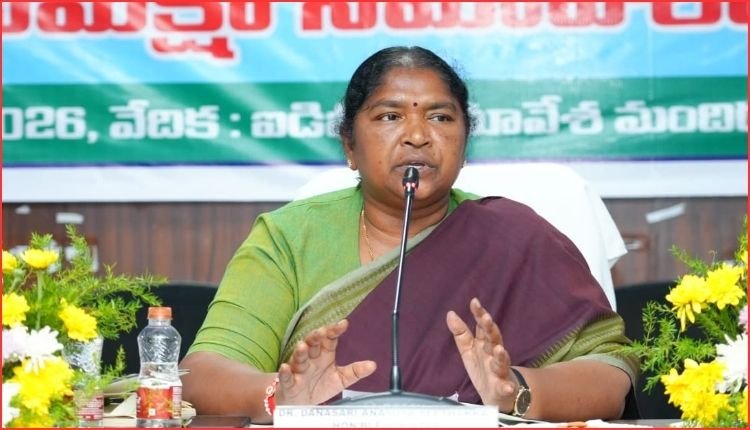
Hyderabad: Telangana aimed to complete buildings for all gram panchayats lacking their own premises this year, Panchayat Raj Minister Seethakka said on Saturday. The government had sanctioned ₹1,000 crore to construct gram panchayat buildings for 5,118 local bodies, she said. Of these, work on 3,269 buildings had already crossed 70% completion.
Panchayat Raj and Rural Development Minister Dr. Danasari Anasuya, popularly known as Seethakka, said the government had adopted saturation mode for construction. She said the programme followed directions from Chief Minister A. Revanth Reddy to provide every gram panchayat with its own building.
“Following the Chief Minister’s directions, we will construct own buildings for all gram panchayats in saturation mode. We will ensure that every gram panchayat has a building,” Seethakka said.
She reviewed development programmes for the erstwhile Nalgonda, Mahabubnagar, Ranga Reddy and Medak districts at the Ranga Reddy Collectorate. The review covered projects under the Panchayat Raj, Rural Development and Rural Water Supply departments.
Gram panchayat buildings among major rural projects
Seethakka said the government was also constructing buildings for women’s Self-Help Groups in 8,000 villages. It had sanctioned ₹800 crore for the programme, while construction had already reached the final stages, she said.
According to the Minister, dedicated buildings would help women’s groups conduct their activities more effectively. Seethakka also reviewed rural road works under the Hybrid Annuity Model. She said Telangana had become the first state to use HAM for rural road construction.
Under the project, the government was constructing 3,861 km of roads across the four erstwhile districts. The works involved an expenditure of about ₹3,382 crore.
Seethakka said these districts accounted for about 50% of the roads covered under the first phase of HAM projects statewide. Therefore, she directed officials and contractors to pay special attention to execution.
The Minister said the period from October to June was suitable for construction. She asked contractors to use the period fully and complete works within schedule. Contractors should maintain quality while meeting deadlines, Seethakka said.
“Other states are also closely observing the construction of rural roads under the HAM model in Telangana,” she said. She added that representatives from some states had already visited Telangana to study the model.
“If contractors perform well here, they will also get opportunities in other states,” Seethakka said. The Chief Minister wanted better transport connectivity from every habitation to the State capital, she said. Accordingly, the government was strengthening rural roads to support that objective.
Drinking water measures ordered ahead of summer
Seethakka directed officials to prepare in advance for possible drinking water shortages during the coming summer in view of El Niño conditions. She said 19 reservoirs supplied drinking water across the four districts. Except for Singur, the reservoirs had adequate water storage, she added.
However, Singur reservoir did not have the expected level of storage. Therefore, she directed officials to appoint a special officer to prevent drinking water supply problems. She also instructed officials to accelerate measures to bring water from Nizam Sagar to Singur.
According to Seethakka, Singur currently had drinking water reserves sufficient for about 54 days. By using local water sources, officials were planning to extend availability to about 75 days. The Minister also ordered the formation of a three-member Drinking Water Management Committee in every mandal.
These committees would visit their respective mandals and assess water availability. They would also identify alternative water sources ahead of summer. Seethakka directed officials to give special attention to drinking water supplies in Adivasi and tribal areas, including Chenchu habitations.
Seethakka said drought conditions could reduce agricultural employment. Therefore, she directed officials to provide employment guarantee works to every eligible family. “Employment work should be provided to ordinary people and assets should be created for villages. Only then will villages develop sustainably,” she said.
The Minister said a ₹6,000 crore budget was available for employment guarantee works. She directed officials to use the funds fully by taking up village infrastructure and water conservation projects.
Seethakka also sought faster completion of water conservation works under the Jalasiri programme. She asked officials to prepare and implement plans for comprehensive development in every village.
Officials told not to compromise on quality
Seethakka directed officials and contractors to work with commitment while implementing development programmes. She asked them to complete pending works quickly and warned against compromising on construction quality.
“Negligence towards duties will invite action. Officials who work well will be honoured, while those who do not will receive notices,” she said. The Minister said the government aimed to coordinate gram panchayat buildings, SHG facilities and rural road projects. She also cited drinking water, employment guarantee and water conservation works as key priorities.
Special Chief Secretary Dana Kishore and Panchayat Raj Commissioner Divya Devarajan attended the review. Special Commissioner Srilakshmi and Additional Commissioner Ravinder also participated.
Additional Collectors, CEOs, DRDOs and DPOs attended the meeting. Engineering chiefs, SEs, EEs, project monitoring officials, joint commissioners and other senior officials also participated. Contractors executing HAM road projects were also present at the review.