
Decarb Solutions: strengthening industrial performance in the Net Zero transition era


Across the world, climate ambition is accelerating. Governments are announcing Net Zero targets, investors are recalibrating portfolios around ESG frameworks, and corporations are under growing scrutiny to disclose and reduce emissions. Europe has tightened regulatory thresholds. The United States has expanded clean energy investment under federal programmes. India has committed to achieving Net Zero by 2070 while preparing for a structured Carbon Trading Scheme expected by 2026.
Yet beneath this momentum lies a structural reality that shapes the pace of transition.
The global economy continues to run substantially on fossil fuels.
Heavy transport depends on diesel-powered fleets. Shipping relies on marine fuels for international trade. Mining operations use fuel-intensive machinery operating in remote terrains. Manufacturing ecosystems rely on boilers and generators to maintain production continuity. Even as renewable capacity expands, industrial systems remain deeply intertwined with conventional fuel infrastructure.
This creates what energy economists describe as a transition gap — the space between climate ambition and operational feasibility.
It is within this transition gap that Decarb Solutions positions its work.
Rather than replacing existing fuel systems, the company focuses on improving how those systems function today. Its approach addresses a practical question confronting industries worldwide: how can emissions be reduced immediately within infrastructure that cannot yet be replaced?
The overlooked layer of decarbonisation: combustion efficiency
Public discourse around decarbonisation often centres on visible, large-scale renewable projects — solar parks, offshore wind farms, hydrogen corridors and electric mobility infrastructure. These initiatives are critical and transformative.
However, decarbonisation roadmaps issued by global institutions acknowledge a phased transition. Fossil fuel use will decline progressively, but it will not disappear overnight.
Industrial equipment has long replacement cycles. Capital expenditure constraints limit rapid fleet transformation. Energy demand continues to grow in developing economies. Infrastructure investments already made over decades cannot be abandoned abruptly.
In this context, transitional efficiency technologies gain relevance.
Combustion inefficiency is a significant but often underexamined contributor to emissions. When fuel burns incompletely, several consequences follow:
- Higher fuel consumption per operational unit
- Increased particulate matter emissions
- Carbon deposits within engines
- Emission of carbon monoxide, nitrogen oxides and unburned hydrocarbons
- Reduced engine life and higher maintenance cycles
Improving combustion efficiency does not eliminate fossil fuel use. However, it reduces the environmental and economic cost per litre consumed.
Decarb Solutions builds its proposition around this principle.

Technology integrated into existing infrastructure
One of the central barriers to large-scale decarbonisation is infrastructure replacement cost. Electrifying heavy transport fleets or transitioning industrial boilers to alternative fuels involves significant capital investment and logistical complexity.
Decarb’s approach differs in that it integrates into current systems.
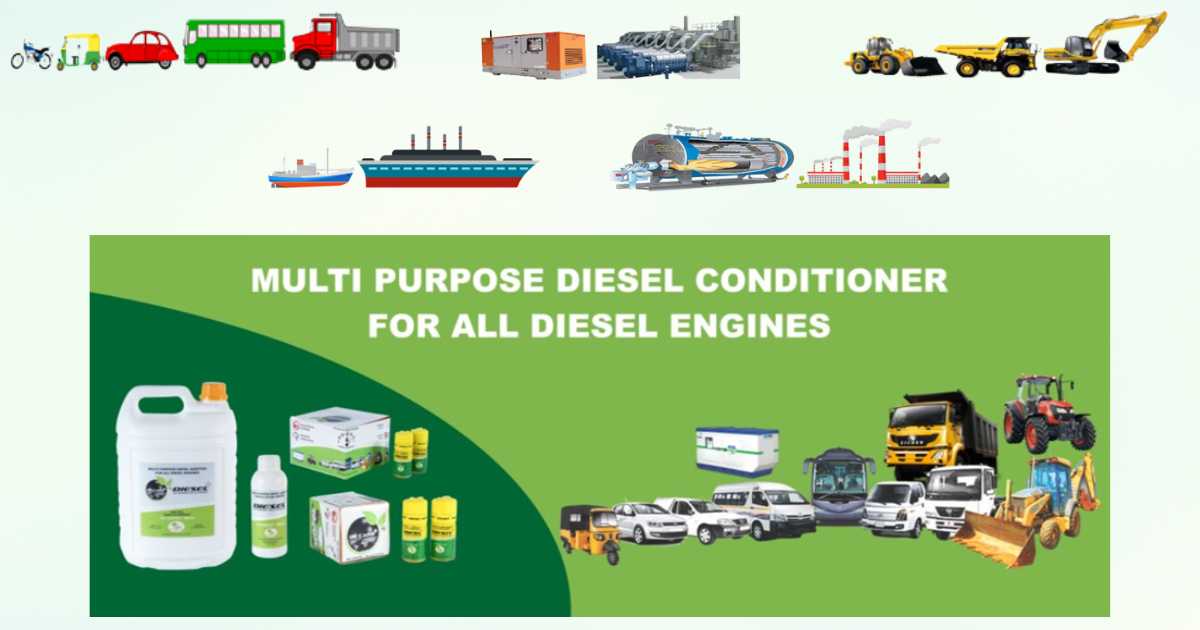
Its biodegradable fuel-conditioning formulation is designed to work with existing engines, existing fuels and existing infrastructure. Rather than requiring equipment overhaul, the technology blends with diesel, furnace oil, marine fuels and select alternative fuels.
The objective is to influence fuel behaviour at the molecular level before combustion occurs. By promoting improved atomisation and enhanced fuel-air interaction, the formulation aims to facilitate more complete combustion cycles.
The intended outcomes operate at multiple levels:
- Improved fuel efficiency, reported in the range of 8–12 percent
- Reduced emission output per litre burned
- Cleaner engine components with lower residue buildup
- Immediate operational savings from improved fuel utilisation
For industries operating large fleets or high-volume fuel systems, even marginal efficiency improvements can scale significantly across operations.
Industrial sectors with immediate relevance
The sectors targeted by Decarb Solutions reflect areas where fossil fuel dependency remains structurally entrenched:
- Road transportation and long-haul freight
- Marine shipping and port operations
- Mining and heavy earth-moving machinery
- Power generation units and backup generators
- Industrial boilers in manufacturing environments
These industries operate under demanding conditions — high loads, continuous cycles and variable environmental factors. Efficiency solutions must demonstrate reliability under such circumstances.
The company’s development narrative includes laboratory validation as well as extended field testing in industrial settings, including mining environments characterised by high-stress operational parameters.
In markets saturated with fuel additives and performance enhancers, differentiation depends on measurable, repeatable results rather than theoretical claims.
Scientific validation and regulatory compatibility
Adoption of any fuel-interacting technology requires strict regulatory compliance. Fuels are governed by detailed standards across jurisdictions, including BS VI in India, EN590 in Europe and ASTM specifications in North America.
Decarb highlights scientific testing at IIT Hyderabad and BITS Pilani, along with verification by NABL-certified laboratories. Compatibility with established fuel standards is essential for operational safety and regulatory acceptance.
Without such alignment, scalability would be geographically constrained.
In heavily regulated sectors such as marine shipping and large-scale transport, compliance forms a foundational requirement for technology adoption.
Economic logic in an era of fuel volatility
Beyond environmental considerations, fuel remains one of the largest operating expenses for heavy industry. Price volatility in global crude markets affects transportation costs, manufacturing margins and logistics pricing structures.
Improving fuel efficiency therefore introduces direct cost optimisation.
When fuel consumption decreases:
- Operating expenditure declines
- Emission output reduces proportionally
- Maintenance frequency may decrease
- Equipment lifespan may extend
This alignment between profitability and sustainability strengthens the business case for efficiency-based decarbonisation.
As ESG reporting becomes integrated into financial disclosures, emission reduction metrics increasingly influence investor perception and access to capital.
Positioning within India’s climate trajectory
India’s commitment to achieving Net Zero by 2070 sets a long-term decarbonisation pathway. However, the transition will unfold in phases.
Energy demand in India continues to grow due to urbanisation, infrastructure expansion and industrial development. While renewable capacity is increasing rapidly, fossil fuels remain a substantial component of the energy mix.
The proposed Carbon Trading Scheme (CTS) expected by 2026 introduces an additional layer of compliance economics. Emission reductions may acquire measurable financial implications within structured carbon markets.
For industries operating under such frameworks, quantifiable efficiency improvements could contribute to compliance strategies, subject to regulatory mechanisms.
The evolving role of carbon markets
Globally, carbon pricing systems and emission reporting requirements are expanding. Under these frameworks, emission reductions must be measurable, verifiable and transparent to hold financial value.
Technologies that improve combustion efficiency potentially reduce carbon intensity per operational unit. If documented and validated, such reductions may intersect with carbon accounting systems in specific regulatory contexts.
While renewable expansion remains central to long-term decarbonisation, transitional technologies that reduce cumulative emissions during the transition period may contribute meaningfully to climate objectives.
Cumulative emissions between now and 2070 influence global temperature outcomes. Incremental reductions across existing fuel-dependent systems therefore carry environmental significance.
A layered transition, not a binary shift
The global energy transition is often portrayed as a simple shift from fossil fuels to renewables. In reality, it is layered and multi-dimensional.
It will involve:
- Expansion of renewable generation capacity
- Electrification of transport and industry
- Development of hydrogen ecosystems
- Deployment of carbon capture technologies
- Behavioural shifts in consumption
- Efficiency optimisation within existing systems
Combustion optimisation represents one component of this layered strategy.
Decarb Solutions does not position itself as a substitute for renewable energy. Instead, it operates in the intermediate space — refining current fuel systems while broader structural transformation progresses.
For developing economies balancing growth and decarbonisation, such refinement mechanisms may offer practical, incremental progress without disrupting industrial momentum.
From local innovation to global relevance
Climate technology innovation is no longer confined to traditional clean-tech hubs. As emerging economies play larger roles in climate governance, innovation ecosystems diversify.
A company focused on improving combustion efficiency may not attract the attention of renewable mega-project announcements. Yet its relevance lies in practicality and immediate applicability.
The transition gap between fossil dependency and renewable maturity creates space for solutions that reduce environmental impact today.
As regulatory frameworks tighten and carbon accountability increases, industries worldwide are likely to evaluate every feasible pathway for emission reduction without compromising operational continuity.
Within that evolving landscape, technologies aimed at improving combustion efficiency may find increasing relevance — not as the final destination in decarbonisation, but as a bridge in the journey.
Because in a complex energy transition, refinement and replacement must advance together.